
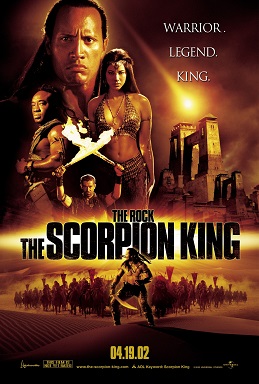
Behind the film
- Year
- 2002
- Director
- Chuck Russell
- Writers
- Stephen Sommers, David Hayter
- Runtime
- 1h 32m
- Genres
- Fantasy, Swashbuckler, Action comedy, Adventure
- Production
- WWE Studios, Universal Pictures
- Country
- United States, Germany, Belgium
- Cast
- Dwayne Johnson, Kelly Hu, Bernard Hill, Steven Brand, Michael Clarke Duncan, Grant Heslov, Peter Facinelli, Branscombe Richmond
About the film
Contains story spoilers.
Before the title, Mathayus rescues his brother Jessup from a band of barbarians. The film then opens in a mythic desert age, where Memnon’s armies have nearly crushed the free tribes. His advantage is Cassandra, a captive whose visions let him anticipate resistance. King Pheron hires Mathayus, one of the last Akkadian assassins, to kill her; Mathayus brings Jessup and fellow fighter Rama. Their approach is betrayed by Pheron’s son Takmet, who has already turned against his father. The ambush kills Rama and leaves Jessup in Memnon’s hands. Mathayus finds Cassandra but refuses to kill her, then watches as Memnon executes Jessup and orders his captive buried in the sand for the fire ants.
Arpid, a horse thief Mathayus had encountered earlier, helps him survive and escape. Mathayus returns to Gomorrah seeking revenge, and a street boy named Tutu guides him through the city for a blood ruby. His chance to reach Memnon disappears when he stops to save Tutu from punishment. During the escape Mathayus takes Cassandra with him, even though she is at first frightened of the man hired to kill her. The flight is interrupted by Memnon’s lieutenant Thorak, who hunts them through a sandstorm. Mathayus defeats Thorak and his soldiers in a cave, but a poisoned arrow leaves him close to death; Cassandra uses her power to heal him.
The group later reunites with Philos, Memnon’s court engineer, whose explosive powder gives the rebels a way to attack the palace. Their route crosses Balthazar, a Nubian king who distrusts the Akkadians and has kept his people out of the fight. Mathayus earns his respect in a duel, and Balthazar grants the travelers shelter. Queen Isis argues that the travelers should be given sanctuary. Mathayus and Balthazar’s contest ends with the recognition that Memnon is their common enemy. The duel changes the mission from one assassin’s revenge into a shared revolt. Cassandra sees the rebels being massacred and Mathayus dying if he confronts Memnon. He accepts the danger but rejects the idea that the vision has already decided his future. Cassandra returns to Gomorrah the next morning, hoping to delay Memnon from within, while Mathayus and Balthazar gather their allies for a coordinated assault.
Memnon tests Cassandra with a row of urns, some empty and others holding cobras, as the rebel attack begins. Balthazar’s fighters enter the palace, while Arpid and Philos place the powder beneath its foundations. Takmet is killed by Balthazar, who avenges Pheron. On the roof, Mathayus fights Memnon and shields Cassandra, only to be struck in the back by an arrow. He pulls it out, fits it to his bow and sends it into Memnon, who falls from the roof as the explosives destroy the palace’s defenses. The surviving soldiers accept Mathayus as their king, and Balthazar leaves for his own people. Cassandra then reveals that she had lied about losing her visions after their night together: the claim was a way to stop Memnon from taking her. She foresees peace but cautions that it will not last, and Mathayus chooses to face that future with her.
The film’s musical identity grew out of a specific editorial problem. Composer John Debney recalls that the temporary soundtrack changed repeatedly and pulled pieces from unrelated adventure, comedy and romance films. Director Chuck Russell wanted the finished score to make those shifts feel like one adventure, so they built a single Mathayus theme that could carry heroism and romance. Debney says the theme was first heard as a temporary cue during the camel ride; Russell liked it without knowing it was Debney’s own early demo. Debney carried variations of it through the film, including the intimate scene with Cassandra, where he chose the hero’s theme instead of a separate love melody. A shofar and primal vocal yell mark Mathayus’s first appearance. For the action, the score grows larger: Debney describes the final reel as nearly continuous battle music, with percussion and orchestral hits helping carry the fight toward its climax.
Russell’s physical staging also makes Mathayus’s strength part of the action’s practical problem-solving. He later said Johnson cut through a real burning curtain himself with a sword weighing about twenty pounds; CGI enhanced the real fire. That choice fits scenes where Mathayus improvises rather than simply overpowering everyone: he doubles back to save Tutu, escapes the palace through a chain of mishaps, and later turns the arrow predicted to kill him into the weapon that defeats Memnon. Russell’s contemporaneous comments emphasized Johnson’s gentler, vulnerable side alongside his athletic presence, while Kelly Hu recalled that Cassandra’s role gained physical action beyond what had originally been written. Those details broaden the film’s action beyond a sequence of fights, giving the central characters practical choices and physical risks within the adventure. The movement from a hired killing to a rebellion is built around those choices: Cassandra protects the assassin sent against her, Mathayus saves a boy at the cost of his revenge, and Balthazar changes his refusal to fight into a common cause.