
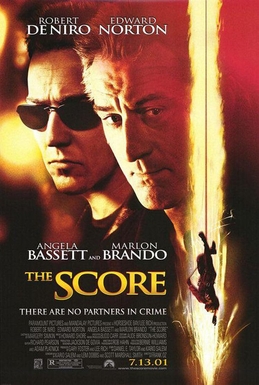
Behind the film
- Year
- 2001
- Director
- Frank Oz
- Genres
- Heist, Thriller, Drama, Action
- Production
- Paramount Pictures
- Country
- Germany, United States
- Cast
- Robert De Niro, Edward Norton, Marlon Brando, Angela Bassett, Gary Farmer, Martin Drainville, Paul Soles, Jean-René Ouellet
About the film
Contains story spoilers.
Nick Wells nearly gets caught during a burglary and wants to retire with Diane. Max draws him into stealing a French royal sceptre from Montreal's Customs House, working with Jack Teller. Jack has obtained a janitor's job there under the identity Brian, using a fabricated disability as part of his disguise. Nick demands control, while Diane questions their future. Max admits he owes a mob boss money and has concealed a much larger sale price. Increased security brings the robbery forward. Jack turns on Nick, takes the case and leaves him facing capture. Nick escapes and later tells Jack he anticipated the betrayal: the case contains a decoy. Jack becomes the main suspect, while Nick has the real sceptre and reunites with Diane at the airport.
Montreal is also Nick's adopted home, giving the job a personal risk beyond the money. His rules are to work alone and never steal in his own city; Max asks him to break both. Robert De Niro plays Nick, with Marlon Brando as Max, Edward Norton as Jack and Angela Bassett as Diane. Bassett described Diane as an independent flight attendant with a taste for adventure. In her account, Diane does not need a ring or a house: Nick is the one proposing a more settled relationship. The entire production filmed in Montreal, beginning in 2000. During scouting, Oz and his location manager spotted the Customs House near Place d'Youville in Old Montreal. Its imposing appearance persuaded Oz to move the target from the museum specified in the screenplay. Nick's jazz club, NYC, was built for the film. Production designer Jackson De Govia created its intimate interior on a Montreal soundstage, where Mose Allison and Cassandra Wilson gave actual performances for the club scenes.
Frank Oz had pictured his first drama as a smaller project with unknown actors, he told TIME. The Score instead brought him a large production whose script was still being developed during filming. Danny Taylor's initial caper was being reshaped around the characters, a direction Oz had promised De Niro. Norton later revised scenes he shared with De Niro and described disagreements over the work as creative wrestling. Asked by Cineclub's Christian Lukas about the film's trust and betrayal, Oz connected directing actors with his work as a puppeteer. Bringing a piece of cloth to life meant giving it individuality; an actor likewise supplies a character with individuality and emotion. Oz said he therefore gave performers considerable freedom in interpreting their roles.
Norton remembered a more immediate obstacle when the three leading men first worked together. Speaking to ABC's Nancy Chandross, he said the opportunity to act with De Niro and Brando had made accepting the role an easy decision. Being in the room with both was another matter: he needed a moment to settle his nerves. During that take, Brando spilled water down his front and De Niro stumbled over his lines. Those small mistakes made his co-stars feel human to him very quickly. Norton also said the role itself had made him nervous when he read it. He described an impulse to move towards that sort of challenge, even when his first reaction was to hesitate.
Cinematographer Rob Hahn and Oz watched Touch of Evil while preparing The Score. Hahn told MovieMaker's Jennifer Wood that Oz encouraged him to be bold with darkness and said the actors' eyes did not always have to be visible. After that initial discussion, Hahn recalled little further comment on lighting apart from their conversations at dailies. Their earlier collaboration had already allowed shadow across faces, and Oz urged him to go further here. Hahn linked that confidence to a working relationship in which the director trusted him to carry out their agreed approach without questioning every decision during shooting. He also singled out a complicated public-park scene involving De Niro and Norton. Hahn credited his experience working with cinematographer Owen Roizman for knowing how to photograph it.
The dialogue needed a different kind of continuity. Mixer Lee Dichter told Mix that there was unusually little replacement dialogue, crediting Glen Gauthier's location recordings. Brando did not want to wear a microphone, so his dialogue came from a boom, while Norton and De Niro used microphones attached to their clothing. Those recordings had different tonal qualities. Dichter adjusted their equalization and added room ambience to bring them together. A scene beside an empty swimming pool in Max's home made the problem particularly clear. Brando began far from the camera, with noticeable echo, before the cutting moved into closer views and the actors came together. Dichter kept some of that reverberation as the shots changed so the sound would not jump abruptly with each new camera distance. For the street scenes, he preferred leaving some background texture rather than suppressing it so heavily that voices sounded unnatural or the spaces between words went silent. He also described Howard Shore's music, the sound effects and the dialogue as supporting one another in building the scene's tension.