
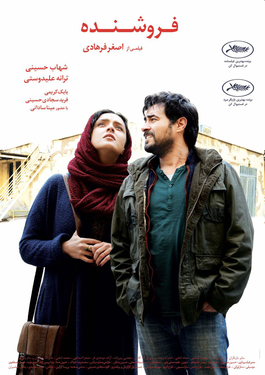
Behind the film
- Year
- 2016
- Director
- Asghar Farhadi
- Writers
- Asghar Farhadi
- Runtime
- 2h 3m
- Genres
- Drama, Rape and revenge, Thriller
- Country
- Iran, France
- Cast
- Shahab Hosseini, Taraneh Alidoosti
About the film
Contains story spoilers.
Emad and Rana are a married couple in Tehran who work as actors in a local production of Arthur Miller’s Death of a Salesman. Emad plays Willy Loman, while Rana plays his wife Linda; outside the theatre, Emad also teaches at a school. Their routine is broken when cracks spread through their apartment building because of construction next door. The residents evacuate, and the couple must find a new place while continuing rehearsals. A fellow actor, Babak, offers them an apartment whose former tenant left in a hurry, with furniture and personal belongings still inside. The couple moves in without knowing that the woman had received male clients there. That history becomes part of the room’s ordinary layout: it affects the way neighbours see the apartment and the calls that still come to its door. The previous tenant has left her belongings in a locked room and refuses to retrieve them until she finds another home. Emad moves the possessions outside, then covers them against the rain, a small act of consideration before his attitude toward the absent woman changes.
One evening, Rana is alone in the new flat and buzzes someone in, assuming Emad has returned. When Emad arrives, he finds blood in the bathroom and Rana missing. The neighbours have already taken her to hospital, where he learns she has been assaulted. Rana survives but is distressed by the bathroom and reluctant to discuss the incident with police. The film keeps the attack offscreen and follows its aftermath through what the couple can know and say. Rana has no clear memory of the visitor’s face, and everyday tasks become difficult for her. She avoids bathing and later breaks down during a performance, unable to continue the play. Emad wants to find the person who entered their home, while Rana’s need for privacy and recovery does not match the urgency he gives the search.
Emad pieces together clues left in the apartment: car keys, a phone and cash. Rana has mistaken the money for something he left and used it to buy groceries, bringing an ordinary meal into the aftermath of the attack. He increasingly blames Babak for concealing the former tenant’s history. After hearing a personal message Babak left for her, Emad carries his anger into the theatre. During Death of a Salesman, he insults Babak’s character Charley with words outside Miller’s text, making a shared performance the setting for a private accusation. His impatience also reaches his classroom, where a student takes a picture of him sleeping during a film. The change is visible in the places where he used to seem comfortable: with colleagues, with students and at home.
A student whose father formerly worked for the police helps Emad trace the pickup connected to the abandoned keys. The vehicle leads him to Majid, whom he asks to help move furniture at the couple’s empty former apartment. Majid’s prospective father-in-law arrives instead. As Emad questions him, he realises that this older man was the visitor, although the man denies intending to hurt Rana and says he startled her. The apparent breakthrough makes the confrontation harder to resolve rather than closing the case. The man has a family who do not know why he has been summoned, and Emad now has the power to expose him to them. Emad calls the man’s family and locks him in a small room while they are on their way.
When he opens the door, the man appears to be having heart trouble. Emad calls Rana in alarm, and she asks him to stop before revenge becomes another injury to their life together. The man’s family arrives believing that Emad has helped him through a medical emergency and thanks him. Emad returns the money the man left after the assault, then insists on speaking to him alone. Out of view of the family, he slaps the man. The older man collapses as he leaves with them, and they call an ambulance. Emad and Rana return to the theatre, but the film does not show that their private rupture has been repaired. Its last movement places them back in costume and make-up for the play, leaving the consequences of Emad’s choice alongside the role he is about to perform.
Farhadi’s starting image for the film came from his student theatre years: a house on a stage, with different rooms illuminated separately before the whole building becomes visible. He described developing the family story in a similar way, allowing each encounter to reveal another part of its life. Each shows Emad and Rana among people who know a different version of them. Working with cinematographer Hossein Jafarian and editor Hayedeh Safiyari, Farhadi wanted the craft to recede behind the characters, so their conversations would feel like everyday speech. He also described combining the suspense of dramatic storytelling with the texture of ordinary life. The film’s offscreen assault and extended final encounter place that combination under pressure: the audience has to follow incomplete knowledge while watching what people choose to do with it.