
Behind the film
- Year
- 1987
- Director
- Paul Michael Glaser
- Writers
- Steven E. de Souza, Stephen King
- Runtime
- 1h 41m
- Genres
- Action, Science fiction, Dystopian
- Production
- Republic Pictures, TriStar Pictures
- Country
- United States
- Cast
- Arnold Schwarzenegger, María Conchita Alonso, Yaphet Kotto, Jim Brown, Jesse Ventura, Charles Kalani, Dweezil Zappa, Richard Dawson
About the film
Contains story spoilers.
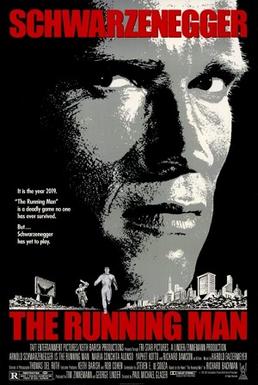
Paul Michael Glaser's The Running Man is the 1987 science-fiction action film starring Arnold Schwarzenegger as Ben Richards. Steven E. de Souza wrote the screenplay from the premise of Stephen King's novel, published under the name Richard Bachman. Maria Conchita Alonso plays Amber Mendez, Yaphet Kotto plays Laughlin and Richard Dawson is television host Damon Killian. The setting is an authoritarian United States where a state broadcaster controls public information and makes the punishment of prisoners into a popular programme. Richards enters that programme carrying a manufactured reputation, while Killian treats his notoriety as a resource for building an audience.
Richards refuses to fire on people demanding food. The massacre goes ahead without his cooperation, and edited evidence makes him appear responsible. He escapes with resistance members Weiss and Laughlin. Richards initially wants to get away rather than join their cause. At his brother's former apartment he finds Amber, an employee of the television network, and forces her to help him attempt an escape through the airport. Believing the public account of his crime, she alerts the authorities. Later false reports about the encounter give her reason to question that account.
Killian wants Richards for The Running Man and uses the recaptured Weiss and Laughlin to secure his cooperation. Once Richards agrees, the host sends all three into the game anyway. Rocket sleds deliver them to a closed arena where costumed stalkers pursue contestants with specialised weapons. Subzero's equipment turns an ice rink into a killing ground; Buzzsaw carries a chainsaw, Dynamo attacks with electricity and Fireball uses a flamethrower. Their names, costumes and entrances present each as a recognisable attraction. Richards's success against them disrupts a format built on the expectation that the prisoners will die while the audience applauds their hunters.
Amber discovers that the network's version of Bakersfield has been altered and is sent into the game herself. Inside the zone, Weiss locates the broadcast uplink and gives her its access code before he is killed. Laughlin also dies. Amber and Richards continue together and discover that the advertised freedom of earlier winners was another lie: their bodies have been concealed within the game area. Richards refuses Killian's offer to become a stalker, rejecting a place among the show's paid killers. Each discovery changes the problem from winning an individual contest to getting information beyond the people who control the cameras and transmission.
The adaptation changed the novel's protagonist and the shape of its television contest. De Souza considered the book's physically weakened, desperate father unsuitable for Schwarzenegger and made the film's Richards a man forced to participate. He also replaced largely anonymous hunters with distinct opponents who could confront the star in successive action scenes. The programme acquired the lights, dancing and presentation of contemporary television, and the roles of host and producer were concentrated in Killian. These changes give the pursuers faces and individual weapons while placing the person who orders their attacks in front of the same audience watching them happen.
Killian eventually broadcasts a fabricated confrontation in which the retired Captain Freedom appears to kill Richards and Amber. The released film reveals the manipulation before showing the supposed deaths. De Souza's earlier arrangement withheld that explanation until afterwards, and he said the scenes were reordered following test-screening responses. The difference concerns what the film audience knows while watching a false broadcast, rather than a second fate for the characters. Within the story, the deception provides Killian with an ending for his programme even though its contestants remain alive. It also gives Richards another reason to break into the broadcasting system instead of merely hiding from it.
Richards and Amber reach the resistance, which uses the access information to challenge the network. The rebels interrupt the broadcast with evidence of Richards's innocence and the fate of the supposed winners. Richards enters the studio and confronts Killian, who tries to defend the entertainment he has provided. The host's control over the account of events has already failed, and his private vulnerability replaces his confident presentation before the cameras. Richards sends him down the same launch chute used for contestants, to a fatal explosion. Richards and Amber leave together as the audience celebrates the reversal of the show it had been watching.
The film repeatedly cuts away from the arena to show how the programme is being received. Studio spectators, dancers, affluent viewers and crowds gathered around street screens form different parts of the same public. Those interruptions make a fight into an event being produced, selected and consumed elsewhere. Dawson's experience as a game-show host informs Killian's exchanges with the audience, including an ease that contrasts with the threats he makes off camera. Harold Faltermeyer's synthesiser score accompanies this television spectacle. The bright presentation, reaction shots and themed opponents keep the broadcast visible even when the immediate action follows Richards through dark industrial spaces.