
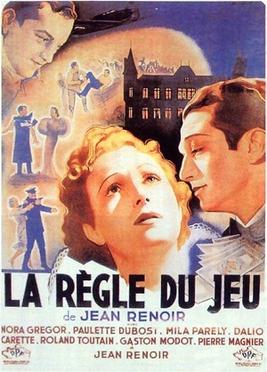
Behind the film
- Year
- 1939
- Director
- Jean Renoir
- Writers
- Jean Renoir, Carl Koch
- Genres
- Drama, Romance, Art
- Country
- France
- Cast
- Nora Gregor, Paulette Dubost, Marcel Dalio, Jean Renoir, Julien Carette, Gaston Modot, Claire Gérard, Roland Toutain
About the film
Contains story spoilers, including the ending.
The Rules of the Game begins with an achievement that fails to satisfy the man responsible for it. André Jurieux has crossed the Atlantic, but the welcome waiting for him means little because Christine is absent. His disappointment becomes a public declaration when he speaks to a radio reporter. Christine is married to Robert de la Chesnaye, whose own affair with Geneviève makes him a less straightforward rival than André might expect. Robert invites the people entangled in this situation to his country estate for a hunting weekend. Roland Toutain plays the aviator, Nora Gregor plays Christine and Marcel Dalio plays Robert. Jean Renoir takes the role of Octave, the friend who tries to manage the other characters’ desires while becoming caught in them himself. The household can accommodate infidelity more comfortably than an open expression of unhappiness. André’s broadcast has already made a private arrangement embarrassingly public before the guests assemble.
At La Colinière, the servants develop a romantic dispute of their own. Gamekeeper Schumacher catches Marceau poaching on the estate, only for Robert to hire the intruder into domestic service. Marceau soon turns his attention to Lisette, Christine’s maid and Schumacher’s wife. Upstairs, Christine sees Robert kissing Geneviève and has to reconsider the assurances within her own marriage. The evening’s masked entertainment gives these competing attachments room to collide. André and Christine discuss leaving together; Robert and André argue; Octave eventually admits his own love for Christine. Schumacher and Marceau, expelled after their dispute, watch the greenhouse from outside. Christine is wearing Lisette’s cape and hood, so they misidentify the woman beside Octave. Clothing then produces a second mistake: Octave sends André to Christine in his own overcoat, and Schumacher shoots the man he believes is carrying off his wife. Robert subsequently brings Schumacher back into the household and announces that the death will be reported as an accident.
Octave occupies an awkward position between sympathetic companion and unreliable intermediary. He understands the people at the estate well enough to intervene in their relationships, yet his involvement makes the tangle worse. When Christine wants André to take her away, André insists on first telling Robert, treating the proposed escape as another matter requiring correct behaviour. Christine turns instead toward Octave, whose affection has been present underneath his friendly interventions. His eventual decision to send André in his place puts the aviator directly in the path of Schumacher’s gun. The killing follows errors about both the woman in the greenhouse and the man approaching it. Robert’s response supplies an acceptable account for the assembled company, allowing the evening to close around a supposedly regrettable mishap. The hunt earlier in the film has already placed sudden death within the estate’s organised pleasures: birds and rabbits fall while the guests pursue their sport. The final shooting carries that violence out of the hunting field and into the romantic farce.
The rooms and corridors matter as much as the conversations within them. Renoir keeps people moving through doorways and across several planes of the image, so that one exchange can remain visible while another begins further away. Arrivals at the château and the movement along its corridors make the house a shared space with competing centres of attention. A camera following one person can discover somebody else rather than cutting the surroundings into separate, private encounters. Openings in the sets connect foreground activity to rooms beyond, giving the characters places to enter, retreat and overhear. The servants’ pursuit of pleasure develops alongside the guests’ affairs within this same architecture. Renoir’s mobile takes grew out of practices already familiar in French cinema and theatre, but his use of depth gives the overlapping actions particular force. The comedy depends on people occupying the wrong space at the wrong moment, and the camera lets those possibilities build within the room before the characters fully recognise them.
Renoir conceived the film as a portrait of a social group, rather than a story organised around a single central hero. Husbands, wives, lovers and intervening friends appear in corresponding sets among the masters and servants. French comic theatre supplied an important model, including the romantic situations of Musset and Beaumarchais. That structure coexists with a loose approach to shooting: Renoir later recalled beginning with only part of the script completed, having worked out the characters’ movements and the larger sense of the action. The hunt interrupts the longer, flowing scenes with a concentrated succession of shots and gunfire. Released in 1939 as Europe approached war, the film met a hostile Paris audience and was cut repeatedly during its initial run. It was subsequently banned and nearly lost. A reconstruction approved by Renoir appeared in 1959, restoring the ensemble story to a form closer to what he had intended. Its troubled survival is separate from the ending’s calm surface, where the household finds language capable of containing a death.