
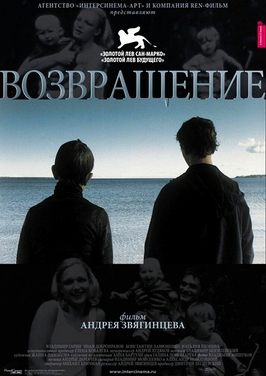
Behind the film
- Year
- 2003
- Director
- Andrey Zvyagintsev
- Writers
- Vladimir Moiseenko, Aleksandr Novototsky-Vlasov
- Runtime
- 1h 46m
- Genres
- Drama, Thriller
- Production
- REN TV
- Country
- Russia
- Cast
- Ivan Dobronravov, Konstantin Lavronenko, Vladimir Garin, Natalia Vdovina
About the film
Contains story spoilers, including the ending.
The Return follows Ivan and his older brother Andrei as their father comes home after twelve years away. The 2003 Russian drama, directed by Andrei Zvyagintsev, places an unfamiliar adult inside a family that has learned to live without him. Their mother agrees to a fishing holiday, but the boys respond differently to the man accompanying them. Andrei welcomes the chance to know his father. Ivan watches him with suspicion. On an island, the father retrieves a strongbox whose contents remain hidden. When the boys return late from fishing, he strikes Andrei. Ivan runs to a tower, where a confrontation ends with the father's fatal fall. The brothers bring his body back across the lake, only for the boat to sink with the body and box aboard.
Before the reunion, Ivan has already faced a different test of courage. Other boys jump from a tower into the water, but he cannot follow. His brother joins the leap, and Ivan remains above them after the others leave. His mother eventually comes to bring him down. The scene makes his later climb more than another confrontation in a new location. Terence McSweeney, writing about the film's treatment of masculinity, connects the two towers and the pressure on Ivan to prove himself. The brothers also look for their father's face in an old photograph before accepting the sleeping stranger as the missing parent. A picture can establish his identity; it cannot supply the years of familiarity they lack. After his death, their earlier rivalry gives way to cooperation as they carry his body through the woods. McSweeney reads that change as a painful passage out of childhood. The ending's photographs keep the question of absence alive: the father does not appear in the pictures from the trip, and the film supplies no final explanation of his past.
The journey stays close to the brothers' experience. They have little information about their father's activities, and the viewer has little more. Northern lakes and forests surround a family argument whose terms keep changing as they travel further from home. Andrei's willingness to accept the father creates friction with Ivan, whose resistance challenges the man's expectation of obedience. The remote island removes the familiar household where mother and grandmother had provided the boys' daily world. Out there, a command comes from a parent who is also a stranger. His authority depends on a relationship he has not had time to build. Ren Film produced the feature with Dmitri Lesnevski. Its central mystery belongs to this narrow family encounter: a man has returned, but being present does not tell his sons where he has been or what he wants from them.
Vladimir Garin plays Andrei, Ivan Dobronravov plays Ivan, and Konstantin Lavronenko plays their father, with Natalia Vdovina as their mother. The older boy is caught between protecting his brother and impressing the man he wants to know. That divided loyalty runs through a landscape reduced to water, trees, open ground and rain. Cinematographer Mikhail Kritchman gives the journey its physical surroundings; Vladimir Mogilevsky edited the film and Andrei Dergachev composed its music. The settings keep the family exposed to weather and distance as well as to each other. A lake must be crossed and a forest walked through. When the father is gone, the boys still have to complete those practical tasks with nobody left to direct them.
Finding the two young leads took a search lasting six months in Saint Petersburg and Moscow. Zvyagintsev told interviewer Luciana Morelli that he had noticed the eventual choices early, while casting continued. He had expected directing children to be difficult and was surprised by how readily they worked together. Their strong personalities mattered to the project from the start. He said the filmmakers would have questioned making this particular story if they had failed to find young performers capable of carrying it. The brothers' conflicting responses therefore depended on children who could hold their own opposite the adult at the centre of the journey.
The sleeping father's image prompted comparisons with Mantegna's painting of the dead Christ. Zvyagintsev explained that he wanted the shot to create associations around the father, but had hesitated over keeping it. He resisted prescribing one meaning for the film. In Morelli's interview he compared interpretation to people watching a sunset: each person could receive the same sight differently. That refusal leaves room for religious or political readings without making either a solution to the plot. The box stays closed, and a symbolic reading does not turn its hidden contents into a known fact.
The film won the Golden Lion at Venice, an experience Zvyagintsev later described as the first time he understood that other people wanted his work. The award also carried a personal loss. Garin died after filming, before the Venice triumph, and the director dedicated the prize to him. His account of that period joins the public success to the death of one of the young performers who had made the project possible. The dedication belongs to the film's history alongside the performances and the festival award.