
Behind the film
- Year
- 1967
- Director
- Mel Brooks
- Writers
- Mel Brooks
- Genres
- Comedy, Lgbtq-related, Musical
- Country
- United States
- Cast
- Zero Mostel, Gene Wilder, Kenneth Mars, Dick Shawn, Estelle Winwood, Renée Taylor, Christopher Hewett, William Hickey
About the film
Contains story spoilers.
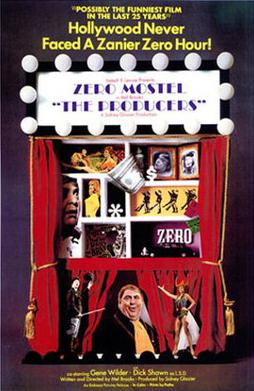
Max Bialystock persuades accountant Leo Bloom to help him profit from a flop by raising more money than the production needs. They choose Nazi playwright Franz Liebkind's Springtime for Hitler, hire Roger De Bris to direct and cast the hippie performer LSD as Hitler. Even bribing a critic cannot secure failure: the audience takes the disastrous show as satire and makes it a hit. Max, Leo and Franz try to blow up the theatre, but their sabotage fails. A trial sends them to prison, where they produce Prisoners of Love and again sell too many shares, this time to inmates and the warden.
Mel Brooks told Harry Stein in 1973 that the title Springtime for Hitler first came to him as an offhand answer while promoting the Broadway show All American. It stayed with him. He later connected it with a producer he had worked for, who lived in shabby surroundings and obtained money for plays from older women. The financial scheme needed another character: Brooks imagined an innocent accountant recognising that an overfunded disaster could be more profitable than a success. That was how the partnership and the story developed together. The form took longer to settle. Brooks began a novel, found himself writing mostly dialogue and turned it into a play. Too many scenes and locations then pushed him towards a screenplay. He insisted on directing because he wanted to protect the story he had imagined. Casting followed the contrast between the partners: he wanted Wilder's frightened vulnerability opposite Mostel's enormous physical presence.
Brooks explained the film's attack on dictatorship in his American Masters interview. He believed that making people laugh at Hitler could puncture the dictator's authority more effectively than arguing with him from a platform. The ridicule was aimed at the Nazis and their claim to power. Working with Mostel required another kind of care. Brooks recalled trying to obtain the performance he wanted without hurting the actor's feelings, a difficult balance for a first-time director dealing with a performer who resisted direction. In his Fresh Air interview, Brooks credited Wilder's tireless creative work with supplying the emotional centre of the original film.
Alfa-Betty Olsen's memories at an American Cinematheque event describe how unfinished practical details became scenes. Brooks wrote on legal pads and talked while she typed; she remained involved throughout the screenplay's development. Casting also took place in an office borrowed from theatre producer Lore Noto. An audition montage was supposed to use a song from My Fair Lady, with successive hopefuls singing portions of it. The rights proved difficult to obtain, leaving a gap while filming was already underway. Olsen recalled the replacement auditions being improvised: Brooks supplied some ideas and the actors supplied others. Her search for public-domain material led to a different discovery. Passing the Lincoln Center fountain, she turned back to tell the production about it. They visited together, and arrangements were made to film there the next day. She also remembered Kenneth Mars arriving with a German accent so strong that Brooks asked him to make it easier to understand.
Vanity Fair's account describes Mars proposing pigeon droppings on Liebkind's helmet, a detail linked to the character's birds. Brooks initially resisted, then agreed, and the two negotiated how many marks it should carry. Mars also recalled staying in costume throughout the shoot. Producer Sidney Glazier faced a more serious disagreement during filming at Lincoln Center. According to the same account, Mostel threatened to leave the picture during a dispute with Brooks. Glazier rushed over from a dental appointment and got the two men working together long enough to finish the film.
Choreographer Alan Johnson recalled that he initially recommended Ron Field for the stage number. When an arrangement with Field ran into a problem involving his schedule or money, Brooks asked Johnson instead. Their earlier conversations had convinced Brooks that Johnson understood what he wanted. Johnson, composer John Morris and Brooks then gathered around a piano, reworking the material together. Johnson remembered questioning some of Brooks's ideas as they shaped the number. Brooks told Robert Weide that the stage performance and opening-night scenes had to be filmed during two days in the theatre. Four cameras covered the action. Johnson sat beside him, cooperating with an approach Brooks compared to filming a documentary. They recorded only two takes of the complete number. The elaborate show within the film therefore had a much tighter shooting window than its scale might suggest.
In the same interview, Brooks recalled persuading Joseph E. Levine to let him direct by explaining that he already pictured the staging, lighting and actors' expressions. He accepted the directing job at scale and secured final cut. Knowing the performances he wanted did not mean he understood every camera requirement. He admitted having only a vague idea of coverage and relying on tight shots and close-ups, rather than knowing how to supply cutaway shots. He also credited editor Ralph Rosenblum with helping him. The American Film Institute records a Philadelphia premiere and a Pittsburgh opening in late 1967. New York followed in the spring of 1968, accounting for the later year often associated with the original film.