
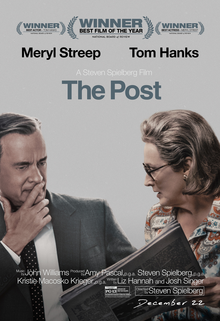
Behind the film
- Year
- 2017
- Director
- Steven Spielberg
- Writers
- Liz Hannah, Josh Singer
- Runtime
- 1h 55m
- Genres
- Thriller, Drama, Biographical, Historical
- Production
- Amblin Entertainment, DreamWorks, Amblin Partners
- Country
- United States
- Cast
- Tom Hanks, Meryl Streep, Sarah Paulson, Bob Odenkirk, Tracy Letts, Bradley Whitford, Bruce Greenwood, Matthew Rhys
About the film
Contains story spoilers.
The Post begins in Vietnam in 1966, where military analyst Daniel Ellsberg accompanies American troops and sees battlefield experience clash with official optimism. Five years later, Ben Bradlee is irritated by the New York Times’ coverage of a classified study and sends Post reporter Ben Bagdikian to follow a lead. Bagdikian meets Ellsberg, who has copied thousands of pages and hands him a portion of the Pentagon Papers. The Times has already published excerpts and faces a government injunction, so the Post gets a narrow window to report from the same study. The film links Ellsberg’s change of mind to the newsroom’s chase: a source who saw the war’s cost risks prison, while editors race to make a public record from what he brings.
The material arrives as a reporter’s nightmare. Bagdikian tells Bradlee that the Post has more than four thousand pages, that they are not in order, and that the page numbers and top-secret stamps have been cut away. The Times had three months; Bradlee’s team has less than eight hours before deadline. Editors divide the documents, search for partial cables and memos, and piece administrations’ decisions into stories readers can follow. One page may explain another; missing halves become part of the work. The sequence gives the newsroom a physical puzzle to solve, with typewriters, paper stacks and the press deadline advancing together. The documents are not a ready-made article: reporters must identify what matters and connect evidence across decades.
Graham’s decision is complicated by her relationship with Robert McNamara, the former defense secretary who commissioned the study and a friend of her family. He tells her that the papers were meant for posterity and should not be released while the country is still at war. Graham has already read them. She asks how he could watch the deception continue while families, including hers, sent sons to Vietnam; McNamara answers that officials believed in containment and thought military pressure might bring Ho Chi Minh to negotiations. He acknowledges that the decision-making process was flawed. The exchange is not an abstract argument about access: Graham is judging a friend whose choices helped shape the war, while deciding whether the paper she leads should make those choices public.
Bradlee pushes from the other side of the friendship. He tells Graham that the days of smoking cigars with political leaders are over and that the paper must hold them accountable. Their earlier banter shows how close access can blur the line between a publisher and the people she covers. At Bradlee’s house, a conversation about John F. Kennedy’s praise for Phil Graham turns to Kay’s father having given the company to his son-in-law; the reply that this says something about the time makes the gendered power around her visible. She is caught between old social ties, a newsroom demanding support and a boardroom where men weigh her authority alongside the company’s finances.
The Post’s planned stock offering sharpens every warning. Bankers lower the share price, investors question whether a newspaper can make a profit, and board members raise the possibility of giving the family less control. Some speak openly about whether buyers will accept a woman in charge. Then lawyers explain that publishing the Papers could bring an injunction and criminal charges under the Espionage Act. Bradlee argues that the reporters who have covered the war understand the risk of publication better than a judge who has just entered the case. Graham listens to counsel, colleagues and family before she chooses. The film lets this pressure accumulate around one decision, rather than treating the newsroom as an isolated room where journalists can publish without consequences for the institution that employs them.
Graham tells Bradlee to go ahead, and the Post prints excerpts after the Times has been stopped from publishing further installments. The actual chronology matters: the Times broke the story first, and the Post joined after the injunction. The National Archives dates the Post’s first publication to June 18, 1971; on June 30 the Supreme Court ruled 6–3 that publication could continue. In the film, the decision reaches the newsroom as relief, and the staff celebrates that the ruling protects both papers. Graham’s choice helps move the Post onto a national stage, but Nixon retaliates by barring Post reporters from the White House.
The final image jumps forward to Frank Wills, the Watergate security guard, calling police about a burglary in progress. The brief turn points toward the Post’s later investigation without folding it into the Papers story. Spielberg moves between the newsroom, Graham’s private meetings and the press floor to keep the crisis moving. Typewriters, pneumatic tubes and presses give the reporting visible steps: find a page, confirm its meaning, write, print. Meryl Streep recalled that filming ran from May through July 2017 and that a cut followed two weeks later. The focus on a few days makes the decision legible; the Watergate call leaves the newsroom’s next chapter just beyond the frame.