
Behind the film
- Year
- 2012
- Director
- Peter Lord
- Writers
- Gideon Defoe
- Runtime
- 1h 28m
- Genres
- Comedy, Adventure, Pirate, Swashbuckler
- Production
- Aardman Animations, Sony Pictures Animation
- Country
- United States, United Kingdom
About the film
Contains story spoilers, including the ending.
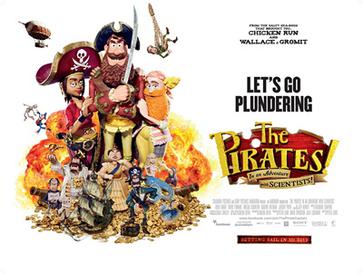
The Pirates! In an Adventure with Scientists! follows a captain whose ambition exceeds his ability to bring home treasure. Peter Lord directed the Aardman feature, with Hugh Grant voicing the Pirate Captain. Gideon Defoe adapted his own comic books, but the film's story changed considerably during development. Lord wanted to carry across the books' world and sense of humour, rather than reproduce their plot. Defoe stayed involved while the team introduced characters, altered motives and then trimmed an overgrown story. Later changes reached down to individual lines before recording. That process leaves room for the Captain's friendship with Darwin to develop through changing advantages: the scientist may be cleverer, but the pirate can still wrongfoot him. Lord described Darwin's haplessness as part of the appeal of putting them together, with the apparently better-equipped man repeatedly finding himself behind.
Released in the United States as The Pirates! Band of Misfits, the 2012 film sets its comic adventure in 1837. Darwin recognises Polly, the crew's supposed parrot, as a dodo and proposes entering her in a scientific competition. The Captain expects money, but wins an audience with Queen Victoria. She wants Polly and eventually offers treasure for her. He accepts, hoping to win the pirate trophy. Black Bellamy then exposes the royal pardon that makes him ineligible, and his crew deserts him after learning he traded away their bird. Discovering that Victoria intends to eat Polly sends him back into action with Darwin and Bobo. The crew returns to help rescue her aboard the QV1, and Victoria revokes the Captain's pardon after their escape. He can sail with his companions again because he has acted for Polly's safety. The coveted award has led him to lose the people who supported him, while the rescue gives them a reason to return. Darwin continues his discoveries, and Bobo joins the pirates' further adventures.
Lord gave the pirates and scientists contrasting worlds to occupy. He described the pirates as noisy and extravagant, while the scientists' formal habits accompany a more monochrome setting. The mismatch reaches the prizes themselves: the Captain's excitement does not extend to being offered encyclopedias. The joke depends on what each group thinks valuable, allowing their meeting to produce misunderstandings before Victoria's appetite becomes clear. Lord also treated surprise as a guiding part of the comedy. Black Bellamy's whale entrance puts an enormous visual gag near the start, rather than saving that scale for a finale. The whale in flight was computer-generated, but its landing involved a physical model with an opening jaw and a large rubber tongue. That switch between effects supports the same entrance, making the creature's movement and the tongue's slap part of one joke. Smaller background business, including a pirate playing the '2001' theme on an accordion, gave the filmmakers another scale on which to work. A spectacular arrival could coexist with something happening at the edge of a scene.
Visual-effects supervisor Andrew Morley helped establish a department at Aardman while the film was already being made. The effects work extended to cleanup on every shot, with material arriving from forty shooting units. Morley approached the photographed puppets and their real lighting much as he would live-action material. Digital additions needed to match those images, including when a completely digital shot sat between physical sets. Water presented a particular problem: an ordinary simulation of a full-size ocean would not suit the miniature characters and boats. The brief called for an Aardman appearance, with a more modelled feel and room for squash and stretch. The team used several approaches for different distances and splashes. Editing complicated that work because frames could be added or removed inside a photographed animation shot, changing its timing before effects were finished. Getting the shot locked mattered especially when animated water had to match it. The result combines the measured movement of physical puppets with sea and space that could be shaped around their scale.
Recorded performances supplied another kind of movement before the puppets reached the screen. Lord described the sudden amount of character and comedy an actor could bring in a few hours, after the slow work of writing and storyboarding. He sometimes supplied the Captain's temporary voice himself, so hearing the cast gave an already familiar scene a different life. That pleasure in performance accompanied his commitment to stop-motion. He regarded the craft as something developing through new animators, ideas and technology, and valued the busy studio of handmade sets, engineers and artists around it. His aim for The Pirates! was mischievous entertainment, with a moral direction arising within the adventure. He had not begun by designing a lesson for puppets to deliver. The Captain's mistakes and the actors' comic timing could therefore carry the story's loyalty problem together, while the physical production gave their impossible voyage objects and places to inhabit.