
Behind the film
- Year
- 1963
- Director
- Blake Edwards
- Writers
- Maurice Richlin, Blake Edwards
- Runtime
- 1h 53m
- Genres
- Heist, Comedy
- Production
- The Mirisch Company, United Artists
- Country
- United States
- Cast
- David Niven, Peter Sellers, Robert Wagner, Capucine, Claudia Cardinale, Riccardo Billi, Brenda De Banzie, Colin Gordon
About the film
Contains story spoilers.
Princess Dala receives the Pink Panther as a child in Lugash: it is a huge diamond with a tiny flaw that resembles a leaping cat. Years later, a military takeover forces her into exile, while the new government claims the stone belongs to the country. She takes it with her to the Italian Alps, where Inspector Jacques Clouseau is already watching Sir Charles Lytton. Charles is the Phantom, a jewel thief Clouseau has pursued for years, but the inspector does not know that his wife Simone is Charles’s lover and accomplice. The holiday setting brings the owner, thief, detective and hidden partner together before any of them can control the situation.
Charles’s nephew George turns up at Cortina, supposedly supported by his uncle while studying in America, though he is an amateur thief himself. Charles is attracted to Dala, complicating his plan to steal the jewel, while Simone hides her affair with Charles from Clouseau. In one hotel-suite sequence she tries to conceal two lovers in different corners while her husband is nearby. The farce comes from the gap between Clouseau’s confidence and what the audience sees: he investigates a thief without reading the people closest to him. The case is personal before he understands why.
Clouseau’s physical clumsiness keeps interrupting the genteel jewel-thief story. He tails Charles, but his own movements repeatedly attract attention, and at Dala’s costume party he appears in a suit of armour as a knight. The party is planned around Clouseau’s warning that the Phantom will target the diamond in the villa library safe. Charles and George arrive separately dressed as gorillas, each trying to open the safe from an opposite side. They crack it at once, only to find it empty except for Charles’s white-glove calling card. The lights go out, and the guests discover the Pink Panther has vanished. The detective’s prediction was right about the thieves and the location, but he still cannot explain the missing stone.
Charles and George flee after the empty safe and the blackout, and their escape sets off a wild car chase. Clouseau pursues them through the streets and apprehends both men at the end of it. The arrest appears to close the case, but Simone goes to Dala and asks her to help free Charles. Dala reveals that she had hidden the diamond herself, keeping it from the government that claimed it after her father’s death. She is also in love with Charles, so the missing jewel has let her influence what happens next: the Phantom is caught, yet Dala can still decide whether he leaves prison. The case now rests on a secret shared by the women rather than Clouseau’s deductions.
At the trial, Clouseau is called as the defense’s only witness. He explains that he was present at the Phantom’s earlier robberies, but the questions turn his proximity to those crimes into suspicion that he committed them. When he reaches for his handkerchief, the Pink Panther is attached to it. Simone and Dala have planted the stone, making the inspector appear to be the thief he has been chasing. Charles and George are released and Simone takes them away. Clouseau protests, though the crowd’s admiration distracts him: he is being arrested for a crime he did not commit while enjoying the first public attention he has received.
Charles tells Simone that once they reach South America, he will write the Italian government to clear the innocent Clouseau. The promise leaves the inspector’s future unresolved. The crowd mistakes his handcuffs for proof that the famous detective has been unmasked, while viewers know how Dala and Simone arranged the evidence. Clouseau is carried off in a police car with his public profile larger than his reputation as an investigator, ending on the gap between celebrity and a case he has failed to solve.
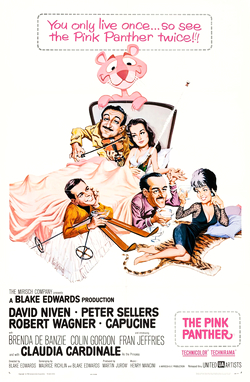
The animated Panther’s place in the opening titles began as a design request, not as a character in the live-action caper. David DePatie recalled that his team prepared around a hundred variations for Blake Edwards; Edwards chose Hawley Pratt’s design. Only after the film was finished did he ask DePatie and Friz Freleng to build a main-title sequence around the figure. Henry Mancini had not completed the theme when the animators needed music, so he supplied its beats and Freleng used them to time the Panther’s movements. That production history explains why the title figure can play with the film’s diamond motif while remaining outside the mystery Clouseau investigates.
The film’s changing emphasis is also visible in its casting. Peter Ustinov was originally to play Clouseau, opposite Ava Gardner as Simone, before both departed and Sellers and Capucine took the parts. Niven’s gentleman thief remained central to the caper, but Sellers’s improvised physical business gave the inspector much more presence than a supporting policeman would ordinarily have. This first film still shares its attention among the thieves and their romantic entanglements. Clouseau disrupts a world of expensive clothes, ski holidays and discreet affairs that otherwise looks comfortable for the Phantom to inhabit.