
Behind the film
- Year
- 1925
- Director
- Rupert Julian, Lon Chaney, Edward Sedgwick
- Writers
- Elliott J. Clawson, Raymond L. Schrock, Bernard McConville, Richard Wallace, Walter Anthony, Gaston Leroux
- Genres
- Horror, Monster, Drama, Silent
- Production
- Universal Pictures
- Country
- United States
- Cast
- Lon Chaney, Mary Philbin, Norman Kerry, Arthur Edmund Carewe, Gibson Gowland, Snitz Edwards, Virginia Pearson, Chester Conklin
About the film
Contains story spoilers, including the ending.
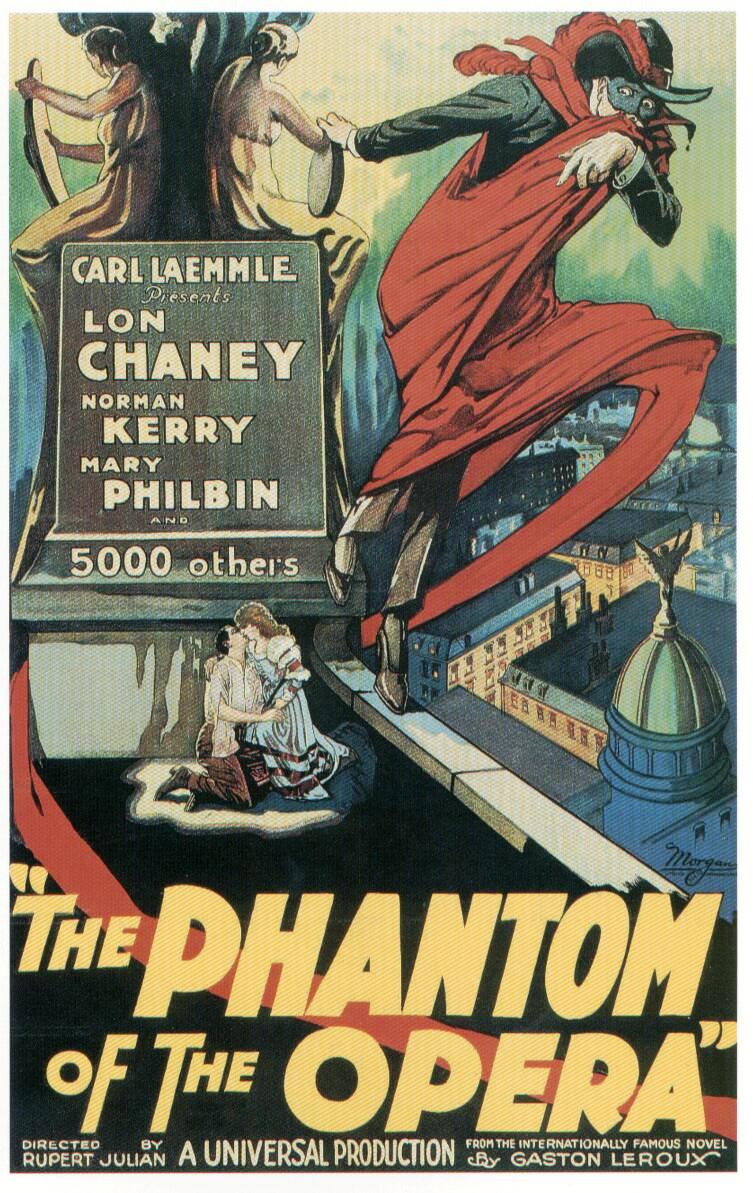
The Phantom of the Opera turns a place of public entertainment into the hiding place of a possessive musical master. Lon Chaney plays the masked Phantom in Universal's 1925 silent adaptation of Gaston Leroux's novel, with Mary Philbin as Christine Daaé and Norman Kerry as Raoul de Chagny. Rupert Julian is the credited director. Christine first knows her teacher as a voice coming through the wall of her dressing room. She associates his instruction with the Spirit of Music, while the opera's staff already fear a presence haunting their building. The promise of artistic success draws her toward someone who expects obedience beyond the stage. Erik wants her to give up Raoul and devote herself to opera under his direction. The theatre's visible performances therefore depend on another struggle taking place in concealed rooms, where a singer's ambition becomes entangled with the demands of the man encouraging it.
In the 1925 general-release story, Erik punishes the refusal to let Christine sing by dropping the chandelier during a performance. Christine follows him beneath the opera, where she discovers the masked man behind the voice. Removing his mask exposes his face and provokes his declaration that she is a prisoner. He later permits a return to the surface, but forbids her to see Raoul. Their meeting and escape plans bring another abduction. Raoul and Inspector Ledoux descend to rescue her and become trapped in Erik's torture chamber. Christine promises herself to Erik if he will spare Raoul, and he releases the men. A pursuing mob then destroys the possibility of his keeping her. Raoul saves Christine, while Erik attempts one last deception, pretending that his clenched hand holds a weapon. The empty palm gives away the trick. The crowd kills him and throws his body into the Seine; Christine and Raoul's honeymoon closes their story. This is the general-release narrative, rather than a claim that every surviving print arranges all these events identically.
The opera house was built as a large practical spectacle. Universal constructed a full-scale auditorium and stage, with a steel frame and concrete foundations on its backlot. Cinematographer Charles Van Enger later recalled that the resulting structure still presented a problem for wide views: the camera had to be moved outside and up the hill to take in the set. Sculptors and scenic artists created decorative work, including the rooftop Apollo and the chandelier, while European furnishings and props supplied other rooms. Christine's extraordinary underground bed came from the effects of entertainer Gaby Deslys and later appeared in Sunset Boulevard. Chaney's face required equally deliberate work at a smaller scale. He experimented with cameramen to understand how makeup changed with lenses, viewing distance and the sensitivity of film to colour. The design needed to transform him while leaving his face expressive. Darkened eye sockets, altered contours and the shape of the mouth worked together to suggest a living skull. Chaney described the effect as an interaction of paint and light, treating the apparent horror as a problem of performance and photography rather than an unexplained trick.
Chaney used a wax head cast from life to practise aspects of his makeup. The surviving object records a working method involving hairlines, sideburns and cotton-and-collodion additions that could alter the cheeks. It offers a physical counterpart to accounts of the actor developing his own transformations. The Phantom's skull-like appearance also depends on dark areas around the eyes and nostrils, changing how the features register on film. The production's wider visual design extended beyond plain black and white. Tinting, lithographic dye-transfer work and two-colour Technicolor were used to give the images different kinds of colour. Chaney's appearance and costume drew on an André Castaigne illustration associated with Leroux's book. The 1999 George Eastman Museum restoration is one later presentation of this material, bringing a particular combination of surviving images to the screen. Colour is therefore part of the film's visual history, even though it remains a silent feature. The mask, the face beneath it and the decorated theatre belong to that broader interest in giving an audience something striking to look at.
The film's different versions grew out of repeated efforts to reshape the story. After an early preview, Universal delayed release and ordered new material, including a different ending. Additional comedy and romance entered the production as the studio tried to find a satisfactory arrangement. Lois Weber helped reorganise the footage before the film finally reached audiences. The studio returned to it for sound and silent reissues in 1929, adding scenes and performers and cutting other material. That later recut underlies a familiar restored version, so a screening labelled with the original year need not reproduce the general-release sequence. Removing Christine's visit to her father's grave reduced the explanation for her attachment to the mysterious teacher. Other cuts shortened Erik's history and left references whose surrounding events had disappeared. The remaining action could concentrate more directly on his pursuit of Christine while making some connections harder to follow. The unmasking remains a central confrontation: Christine reaches for the concealed face despite his warning, and the supposed musical protector becomes an immediate visible threat. The troubled revisions help explain why the film's story survives in differing shapes alongside its recognisable central figures.