
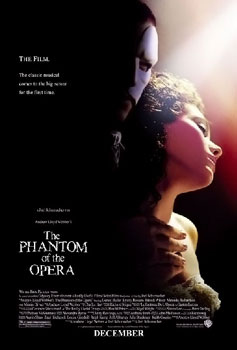
Behind the film
- Year
- 2004
- Director
- Joel Schumacher
- Writers
- Andrew Lloyd Webber, Joel Schumacher
- Genres
- Romance, Drama, Musical
- Production
- Really Useful Group, Joel Schumacher Productions
- Country
- United Kingdom, United States
- Cast
- Gerard Butler, Emmy Rossum, Patrick Wilson, Miranda Richardson, Minnie Driver, Ciarán Hinds, Simon Callow, Murray Melvin
About the film
Contains story spoilers.
In 1870 Paris, Christine replaces Carlotta at the opera house and reunites with Raoul. Her unseen singing teacher, whom she believes her father sent, is the Phantom living beneath the theatre. He takes her underground, demands her promotion, sabotages Carlotta and kills a stagehand. He overhears Christine and Raoul declare their love, then interrupts a masquerade to demand his own opera. Giry reveals that she rescued him as an abused boy. At the cemetery, Raoul intervenes when he approaches Christine. During Don Juan Triumphant, the Phantom replaces the tenor; Christine unmasks him. He abducts her and drops the chandelier, starting a fire. Threatening Raoul, he demands marriage. Christine's compassionate kiss moves him to release them, and he escapes. In 1919, elderly Raoul leaves the Phantom's music box at Christine's grave, where a fresh rose and her ring suggest the Phantom survives.
Joel Schumacher approached Andrew Lloyd Webber's musical with questions about what a film could add for people who knew the stage production and those encountering it for the first time. He told Tribute's Bonnie Laufer that casting should serve the roles, whether or not the performers were famous. Lloyd Webber required the leads to sing. Gerard Butler's audition included Music of the Night, while Patrick Wilson was the first performer hired. Raoul also became a more active figure in the adaptation. Schumacher described expanding the lover's part into an action role, with swordfighting, riding and escapes from the burning opera house. Wilson performed those stunts himself. Giving Raoul that physical work changed what the character had to do on screen as Christine's relationship with the Phantom developed.
Emmy Rossum wanted Christine to be the emotional centre of the theatrical spectacle. In her interview with Blackfilm's Wilson Morales, she recalled meeting Schumacher on a Wednesday before a Saturday screen test. She initially intended to attend a family gathering, assuming there would be another opportunity to audition. Learning that this was her chance changed her plans. She arrived focused on doing the role as she imagined it, while doubting she would be cast. For Rossum, Christine's kindness and understanding of people who look different offered the strongest connection to the character. She identified carrying a film of this size as the challenge, and remembered Butler and Wilson treating her professionally.
The songs needed room for those performances to change during a scene. Schumacher explained to Dark Horizons' Paul Fischer that a scratch recording supplied a guide while the actors performed. Some singing could be captured live; performers could also return to the edited scenes and record the emotions they had found while acting. A pause, a whisper or a moment of crying therefore did not have to be forced into an unchanging earlier recording. This combined on-set performance with later vocal work. Lloyd Webber, meanwhile, reworked the music with 110 musicians at Abbey Road. Schumacher described their longstanding friendship as the basis for trusting each other's responsibilities: Lloyd Webber concentrated on the music while he shaped the film. Minnie Driver's Carlotta was an exception to the leads supplying their own singing; Schumacher cast her for the comedy rather than the operatic notes.
Editor Terry Rawlings described the opera house as a place cinema could enter from both sides of the stage. The opening rehearsal moves between the performers and the backstage crew having tea. In his CineMontage interview, Rawlings said balancing those simultaneous activities took time: each cut had to decide which part of the working theatre to show. Schumacher let him assemble an initial interpretation before they discussed changes together. That freedom did not mean every preferred shot remained. Rawlings recalled additional glimpses of the Phantom watching the rooftop lovers being gradually removed in discussions with Schumacher and the producers. For the candlelit underground scenes, the available coverage let him avoid overexposed material without major continuity problems. He worked with Lightworks Touch, whose speed and memory let him try alternatives and retain earlier ideas. The theatre's front, backstage spaces and hidden rooms were assembled through those choices.
The opera house's exterior and destruction also depended on joining separately filmed elements. As Mary Ann Skweres reported for Animation World Network, the art department built the square and entrance, while Cinesite's models extended the building above the columns. The miniatures had to depict both the house in its prime and its later disrepair, requiring repainting and damage. Model supervisor Jose Granell's unit studied John Mathieson's lighting and the main unit's camera movements so the extensions would continue the same shots. Maya tracking supplied movement data for motion-control photography of the models, including moves originally made with cranes or wires. For the fire, larger window elements supplied flames, glass and debris that were incorporated into the smaller building. Real and miniature chandeliers contributed to the swinging and destruction. Digital compositing allowed individual elements' exposure to be adjusted. Asylum's work included the opening postcard transformation and more than 150 effects shots.
Mathieson's photography used gas lighting, candles, smoke, gels and older Panavision lenses to give the opera house its nineteenth-century atmosphere. In Jack Egan's interview, he connected the decision against a whole-film digital intermediate to keeping the textures of the fabrics, including velvet. He singled out digital manipulation in the black-and-white auction opening. His account concerns the film's overall photographic finish. The effects teams still used digital compositing and colour timing for their shots. The Phantom's mask required another kind of adjustment. Schumacher described collaboration among makeup artist Jenny Shircore, production designer Anthony Pratt, costume designer Alexandra Byrne, Mathieson and Butler. Final changes waited for Butler's arrival; soft leather suited his face and photographed well.