
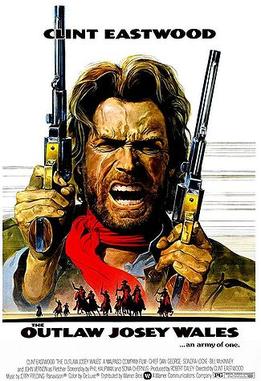
Behind the film
- Year
- 1976
- Director
- Clint Eastwood
- Writers
- Philip Kaufman, Sonia Chernus
- Genres
- Western, Vigilante
- Production
- Malpaso Productions, Warner Bros. Entertainment
- Country
- United States
- Cast
- Chief Dan George, Sondra Locke, Clint Eastwood, John Vernon, Bill McKinney, John Russell, Will Sampson, Paula Trueman
About the film
Contains story spoilers, including the ending.
The Outlaw Josey Wales begins with the destruction of a home and follows a man who has no secure place to return to. Union-affiliated Redlegs murder Josey's wife and son, drawing the farmer into the Confederate side of the Civil War. When his fellow fighters accept an offer of amnesty, he refuses to surrender. Their supposed reconciliation becomes a massacre, and Josey escapes with the wounded young Jamie after firing on the attackers with a Gatling gun. The pursuit continues beyond the end of organized fighting, led by Captain Terrill and Josey's former commander Fletcher. Jamie's injuries eventually kill him, leaving Josey to travel without the companion he tried to save. The opening establishes why declarations of peace carry little authority for him: the men who promise safety have already turned surrender into an opportunity to kill their captives.
His route west gradually brings him into the company of Cherokee elder Lone Watie, Navajo woman Little Moonlight, Grandma Sarah Turner and her granddaughter Laura Lee. Chief Dan George plays Lone Watie, whose presence gives Josey someone with whom to share the journey rather than simply another enemy to outdraw. The group eventually settles at an abandoned ranch. Josey's negotiation with Comanche chief Ten Bears secures the release of two companions and creates the possibility of coexistence outside the soldiers' campaign. When Terrill attacks, the people at the ranch help repel his men. Wounded and out of ammunition, Josey pursues Terrill and kills him with the captain's own sword. In the town afterward, residents tell two Texas Rangers that Josey Wales is dead. Fletcher recognizes him but accepts the fiction, addressing him as a stranger. Josey can leave without a final battle against his old commander, and rides back toward the ranch.
The change from solitary avenger to reluctant protector is also carried by the film's images. The opening places Josey at work in a sunlit field with his son, before the raid breaks that pastoral setting apart. His grief and subsequent training replace the farmer with an armed figure moving through a much harsher landscape. Later threats to the people around him recall the initial loss, connecting protection of the new group with memories of the first family. Cinematographer Bruce Surtees photographs the character both in deep shadow and against strong light, sometimes withholding a clear view of him until other people have registered his arrival. The film repeatedly brings its familiar gunfighter image into scenes involving vulnerable companions. Josey's skill can keep him alive on the road, but the growing household gives that skill a different use. A journey launched by bereavement begins to require responsibility for people who are still alive.
The firearms form part of that material world. Property master Edward Aiona also served as the production's main armorer, supplying the weapons handled during the shoot. Josey's conspicuous revolvers include reproduction Model 1847 Walker Colts, with other Colt models carried as well. These were Italian-made reproductions rather than a collection of original nineteenth-century guns placed at risk during action scenes. Ellis Mercantile supplied most of the firearms, with additional Walkers coming from Stembridge Gun Rentals. Carrying paired weapons increased the need for working duplicates that could be exchanged during filming. The novel refers to a large .44 without identifying it as a Walker, so that specific screen silhouette belongs to the production's interpretation of the character. Filming took eight weeks across locations in Arizona, Wyoming, Utah and northern California, giving the flight through the West a succession of physical landscapes beyond a single town or standing set.
The adaptation brought together Eastwood and Philip Kaufman before their directing roles diverged. Kaufman recalled that they knew one another through Universal and shared a friendship with Don Siegel; Surtees had also photographed Kaufman's The Great Northfield, Minnesota Raid. Eastwood approached him to write Josey Wales, and Kaufman began directing before Eastwood took over. The screenplay is credited to Kaufman and Sonia Chernus, adapting Forrest Carter's novel. Kaufman's later account of his approach to films puts character and inner relationships ahead of a thriller plot considered in isolation. That emphasis offers a practical way into this screenplay's expanding company: the people Josey encounters alter what his flight is for. The film gives the pursued man more connections as the journey continues, so surviving the next ambush becomes inseparable from deciding who will travel or settle with him.
Eastwood remembered receiving Josey Wales as a blind submission and responding to it on instinct. In discussing his directing more broadly, he described wanting performances to keep the freshness of an early take, including accidents that may not return after repeated rehearsal. He also distinguished discovering a film during shooting from shaping its existing pieces in the editing room. His account of playing damaged heroes was more directly connected to Josey himself. Eastwood named Wales as a character whose painful history gives the actor an obstacle to work with and creates depth beyond the gunfighter's skill. He described that process as imaginative, without requiring a matching experience from his own life. The farmer's loss therefore belongs to the role's emotional foundation. His later confidence with weapons does not erase the circumstances that have brought him to carry them.