
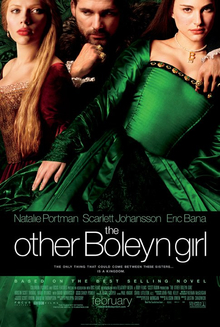
Behind the film
- Year
- 2008
- Director
- Justin Chadwick
- Writers
- Peter Morgan
- Runtime
- 1h 55m
- Genres
- Biographical, Drama, Romance, Historical
- Production
- BBC Film, Relativity Media, Focus Features
- Country
- United Kingdom, United States
- Cast
- Natalie Portman, Scarlett Johansson, Eric Bana, Jim Sturgess, Kristin Scott Thomas, Mark Rylance, Ana Torrent, David Morrissey
About the film
Contains story spoilers.
The Boleyn family sends Anne to attract Henry VIII, but a hunting injury brings him closer to her sister Mary, who tends him. Mary is married to William Carey and bears the king a son. Anne returns to court after her private marriage to Henry Percy is annulled; she makes Henry's access conditional on ending his marriage to Catherine of Aragon. The sisters' affection persists, but their relatives' ambitions make them rivals in a court where their choices are constrained.
When the Pope refuses Henry's divorce, the king breaks with Rome, marries Anne and makes her queen. She gives birth to Elizabeth, but a miscarriage and lack of a male heir weaken her position. Anne and George are accused of treason and sentenced to death; Mary pleads for her sister, and the two reconcile. Anne asks Mary to raise Elizabeth, but Henry sends Mary away and permits the execution. The sequence makes survival an uneasy outcome: Mary leaves court with the child while Anne's bid for control ends at the centre of royal power.
Philippa Gregory’s novel supplies the starting point, but the screen adaptation changes whose perspective guides the story. Gregory explained that the book gives Mary a first-person voice, whereas Peter Morgan’s screenplay distributes attention more evenly between the sisters. The author worked as a historical consultant, meeting Morgan before he began writing and discussing language and proposed scenes with him during development. She also accepted that a film needed to make its own decisions. One addition came from the cast and crew reading her novel The Constant Princess, about Catherine of Aragon: they asked Morgan to give Catherine more material. The result brings the existing queen into a drama that might otherwise have concentrated entirely on her rivals. This is an adaptation of historical fiction, with imagined private conversations and compressed events, rather than a record of the women’s thoughts or a complete account of the English Reformation.
Portman approached Anne by asking what had made her ambitious and why she behaved as she did. In discussing the role, she resisted treating cruelty as a sufficient explanation for a character. The family’s values at the beginning of the film mattered to her because they establish the world in which Anne learns to seek position. That approach gives the early household scenes a purpose beyond introducing future rivals: the sisters are being taught what their family expects from them. Portman also described Anne’s pursuit as an attempt to raise herself in power and status. The performance follows a woman trying to act within those expectations, whose ability to attract the king does not give her lasting control over his decisions or her own safety.
Sandy Powell’s costume design makes the sisters’ changing positions visible. They begin on more equal terms, while Anne’s clothes become increasingly conspicuous as she advances and Mary’s grow lighter as she moves away from court. Anne repeatedly wears green during her rise, followed by darker blue and black as her relationship with Henry deteriorates. Her coronation costume combines an indigo dress, a gold-embroidered cape and ermine; its higher waist accommodates her pregnancy. At the execution, a smaller skirt silhouette recalls her earlier appearance rather than the expansive shape of royal display. Powell also wanted the French and gable hoods to frame the actors’ faces, keeping attention on dialogue. The clothes therefore communicate status and changes in relationship alongside the spoken scenes. Their dramatic purpose remains distinct from strict historical reconstruction: the film modifies shapes and colours to make that progression readable.
Those garments changed the performers’ experience of a scene. Johansson described their size as affecting how she moved and how other people could approach her, making intimate interaction different from acting in modern clothes. Portman found Anne’s bold costumes useful for the character, while the boning encouraged an upright riding posture. The two actors also maintained their connection between takes. Johansson recalled the scale of the sets and old castles, where a large production could otherwise feel isolating; staying together helped them sustain the sisters’ relationship. Their scenes with Bana created a different situation. They rarely shared those scenes with him, so each developed her own relationship with the king without watching the other’s work. The screenplay gives those encounters different qualities, and the filming arrangement let each actor experience her side of that contrast separately.
The production used digital photography for its period setting. Portman recalled Chadwick and cinematographer Kieran McGuigan working meticulously on the images, alongside the challenge of performing in elaborate locations and costumes. A dialect coach helped her prepare the English accent, which she considered an additional acting task. The final execution material was left until late in the shoot so the performers had lived through the earlier relationship before reaching its end. Portman remembered especially difficult weather at Dover Castle: crew members wore hard hats while the actors worked bareheaded in their wigs. That account connects the film’s concluding scenes to specific practical decisions about scheduling, preparation and location work.