
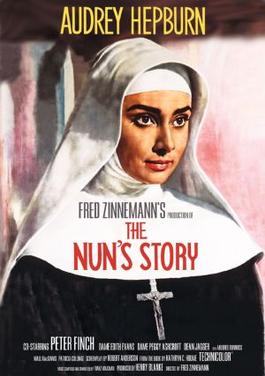
Behind the film
- Year
- 1959
- Director
- Fred Zinnemann
- Writers
- Robert Anderson
- Genres
- Drama, Biographical
- Production
- Warner Bros. Entertainment, Warner Bros. Pictures
- Country
- United States
- Cast
- Audrey Hepburn, Peter Finch, Edith Evans, Peggy Ashcroft, Mildred Dunnock, Dean Jagger, Gabriella Andreini, Barbara O'Neil
About the film
Contains story spoilers, including the ending.
The Nun's Story follows a woman who is certain she wants to serve God and gradually discovers how difficult it is to surrender her own judgment. Audrey Hepburn plays Gabrielle Van der Mal, the daughter of a Belgian physician, who enters a convent and becomes Sister Luke. Nursing in the Congo is her great hope, but she is warned that she cannot simply ask for the assignment she wants most. Fred Zinnemann's 1959 film adapts Kathryn Hulme's novel, inspired by the life of Marie-Louise Habets. Gabrielle is the story's fictional character, carrying that experience into a drama about vocation and obedience. Her father sees the difficulty before she does: poverty and chastity may be possible for his daughter, but obedience could demand something her temperament cannot give.
The convent's rules reach well beyond the tasks Gabrielle performs. Bells regulate movement, prayer, meals and silence, while discipline extends into memories, attachments and wishes. She must learn to give up the satisfaction of choosing correctly for herself. That makes obedience a continuing problem even when she wants the same result as her superiors. A successful action can become an occasion for pride; resentment at a restriction is another failure to master herself. The film spends time on this training so that the later conflicts grow from an established way of life. Entering the order is only the beginning of becoming a nun. Sister Luke has to reshape the habits of mind that made her capable and independent outside it, and the rules give her very little room to set aside a private self.
Her medical training makes the conflict particularly sharp. At Antwerp, she is asked to prove humility by deliberately failing an examination, though she knows the material. Later, at a mental hospital, a patient known as the Archangel Gabriel persuades her to unlock a cell without the required assistance and attacks her. Her confidence in her own ability has led her into danger. Once she reaches the Congo, another disappointment awaits: she will work in the segregated European hospital rather than nursing African patients as she hoped. Dr. Fortunati, played by Peter Finch, values her competence but recognises how poorly she fits the convent's expectations. When she develops tuberculosis, he sees a patient exhausted by an inward struggle as well as by work. His blunt assessment challenges the idea that professional usefulness and religious obedience will naturally settle into the same life.
Fortunati arranges treatment that allows Sister Luke to recover in the Congo. Her eventual return to Belgium comes later, when she is needed to accompany a patient, and the coming war prevents her from going back. Under Nazi occupation, the demand for neutrality becomes harder to accept. The death of her father brings her anger and inability to forgive into direct conflict with the life she has promised to lead. She requests release from her vows and finally leaves the convent in civilian clothes. The decision grows out of difficulties that began long before the war, rather than appearing as a sudden rejection of everything she believed. The final departure gives no detailed account of her future outside. It leaves Gabrielle with a life to enter after years of trying to become the person the order required.
Zinnemann wanted that departure to happen without a musical celebration. He argued that a grand ending would make it seem as though the studio were congratulating the nun for leaving, supplying a verdict the scene should not impose. Her changing clothes and walking out needed their own quiet. He had also wanted the European sections photographed in black and white before the Congo appeared in vivid colour, but Warner Bros. rejected that plan. The finished film uses colour throughout, with Franz Planer behind the camera. Preparation for the convent scenes took the performers into actual convents: Hepburn, Edith Evans and Peggy Ashcroft spent time there before the shoot. Zinnemann recalled their excitement about what they were learning, despite the cold. These choices approach religious life through its surroundings, routines and restraint, giving Sister Luke's struggle a physical setting as well as a spiritual vocabulary.
The preparation also required Hepburn to think through nursing and religious practice in detail. Her working material included lists of medical procedures and customs, a convent day's schedule, prayers and revised script pages covering the ceremonies of vesture and vows. Notes compared different versions of Sister Luke's final conversation. Zinnemann and Hepburn discussed what her departure meant for the character, and a letter from the director resisted making either the woman or the order into a villain. He regarded her inability to overcome her own nature as an honourable failure. That understanding allows the story to take her original commitment seriously even when she cannot sustain it. The rituals she learns and the skills she brings remain parts of the same person, though they have become impossible for her to reconcile within the convent.