
Behind the film
- Year
- 2016
- Director
- Shane Black
- Writers
- Shane Black
- Runtime
- 1h 56m
- Genres
- Mystery, Buddy cop, Comedy
- Production
- Warner Bros. Entertainment
- Country
- United States
- Cast
- Ryan Gosling, Russell Crowe, Matt Bomer, Kim Basinger, Margaret Qualley, Yaya DaCosta, Keith David, Beau Knapp
About the film
Contains story spoilers, including the ending.
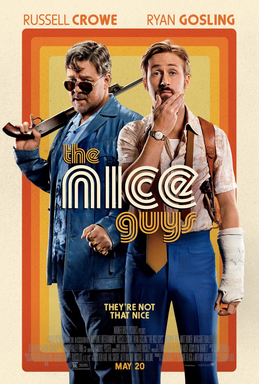
The Nice Guys introduces its detective partnership through a beating. Amelia has hired Jackson Healy to stop private investigator Holland March from following her, and Healy delivers the warning physically. Russell Crowe plays the man whose professional messages leave bruises; Ryan Gosling plays the recipient, who soon becomes his colleague. When Healy realises Amelia is in danger, he returns to March and the two follow her trail together. Their search takes them through parties, burnt buildings and the office of Amelia's mother, a powerful government official played by Kim Basinger. Matt Bomer's John Boy is the hitman coming after them. March's daughter Holly, played by Angourie Rice, keeps joining the investigation despite attempts to leave her behind. The arrangement makes the central duo an uneven trio: the men have the jobs and weapons, while a teenager keeps entering the dangerous situations they cannot control.
March's original client believes she has seen adult-film performer Misty Mountains alive after her death. That apparently impossible sighting leads to Amelia, who has been making a film combining pornography with an investigation into air pollution. Her target is collusion involving car manufacturers and her mother, Justice Department official Judith Kuttner, to suppress the catalytic converter. People connected to the film are being killed. The danger reaches March's home when John Boy arrives posing as a doctor; Amelia escapes only to flag down the killer's car and be murdered. March eventually understands that his client saw Misty projected on a wall. The surviving film becomes the evidence everyone is trying to obtain or destroy. At the Los Angeles Auto Show, it is inserted into a presentation, and March secures it while Holly persuades Healy to spare John Boy. Judith is arrested, but the ending leaves the manufacturers beyond the investigators' reach. March and Healy nevertheless continue together, advertising a detective agency called The Nice Guys.
Holly gives the case a different kind of pressure. Black described her to ComingSoon as a child whose ideal of detective work remains intact even though her father falls well short of it. Her Nancy Drew books belong to a more innocent version of the profession than the one March practises. She also becomes Healy's conscience, making his behaviour matter to someone who can still expect better. That is part of the film's wider interest in glamour meeting ugly reality. Black connected the period setting to a Los Angeles whose dreamlike appeal had begun to fray: pornography, smog and a deteriorating Hollywood sign sit beside the fantasy people bring to the city. The project itself began with Black and Anthony Bagarozzi's contemporary 2001 screenplay, then passed through television versions before becoming this period story. The characters survived those changes, while their case and surroundings were substantially rebuilt.
Black wanted the images to keep reminding people that they were following a detective mystery without making the whole film feel mournful. In his interview with /Film, he described an atmosphere full of activity, discomfort and comic incidents, with noir imagery supplying the genre's underlying shape. The men can be sweating through their clothes and surrounded by smog while the film remains lively. His approach to familiar action situations is to ask where the awkward version might be: how a slick-looking piece of violence could go wrong, or how a supposedly commanding person might lose control. That interest connects the thriller to the comedy rather than setting them on separate tracks. Black also traced his storytelling interests to private-eye paperbacks, especially the idea of an investigator entering a place, disturbing its secrets and applying a personal understanding of justice. He characterised that detective tradition as an urban form of the Western.
Cinematographer Philippe Rousselot resisted treating the 1970s as one fixed photographic style to reproduce. He had worked during the decade and pointed out that its filmmakers had many different approaches. Sets, clothing, dialogue and music could establish the period, leaving the camera free to serve each scene. The lighting still acknowledges what would have been present: sodium street lamps, tungsten fixtures and fluorescent interiors. A confrontation in Healy's home plays with expectations by having him turn a light on to confuse his attackers, rather than hide by switching it off. Rousselot likewise used warm light through the windows instead of the conventional blue night effect. At a crowded house party, there was little space for extra equipment, so changed ceiling bulbs and concealed LED panels supplied practical solutions. The visual choices grew out of the action, the available space and the need to move quickly.
The production was Rousselot's first digitally photographed feature. Speaking to Filmmaker, he connected that decision to a fifty-day schedule containing considerable night work. The Alexa's sensitivity made streets and outdoor action easier to light than they would have been with the film stocks he discussed. Driving dialogue was also photographed on a soundstage, where the actors could stay comfortable and resets did not require returning a vehicle to the beginning of a road. Rousselot contrasted that arrangement with the time spent blocking streets, lighting from an insert car and reaching the end of a route after a take. These are practical choices with a clear effect on the work: more manageable lighting and repeatable car scenes give the crew time to concentrate on the performers. For a mystery built around conversations, sudden violence and the partners' mismatched reactions, that flexibility supports the film's changing tempo.