
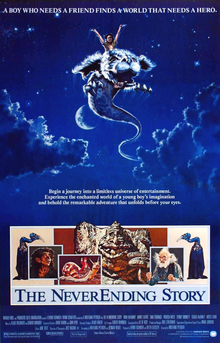
Behind the film
- Year
- 1984
- Director
- Wolfgang Petersen
- Writers
- Herman Weigel, Wolfgang Petersen, Michael Ende
- Runtime
- 1h 34m
- Genres
- Fantasy, Children's, Drama, Sword and sorcery
- Production
- Constantin Film
- Country
- Germany
- Cast
- Noah Hathaway, Barret Oliver, Tami Stronach, Moses Gunn, Thomas Hill, Patricia Hayes, Sydney Bromley, Gerald McRaney
About the film
Contains story spoilers.
Bastian takes a book from Coreander's shop and reads in his school attic. Inside it, Atreyu seeks a cure for the Childlike Empress as the Nothing consumes Fantasia. Artax sinks in the Swamps of Sadness; Falkor rescues Atreyu. The Southern Oracle requires a human child to rename the Empress. A mirror shows Bastian. Separated from Falkor, Atreyu kills Gmork, who connects the Nothing to humanity's lost hopes. Falkor recovers Auryn and brings Atreyu to the Empress. She reveals Bastian's part in their story. He names her Moonchild and rebuilds Fantasia from its last grain of sand, restoring Artax too. Riding Falkor, Bastian visits the real world to chase his bullies. The narrator leaves his further wishes and adventures for another story.
Wolfgang Petersen wanted to follow Das Boot with a world shaped by children's dreams and wishes, making something his son could enjoy. Adapting Michael Ende's story brought a dispute over what that world should become on screen. Petersen recalled repeated visits to Rome to discuss the script with Ende and his wife, exchanging versions that he felt would not fit together. He eventually completed the screenplay with Hermann Weigel. In his account, the differences between book and film led to a public split with Ende. The finished fantasy also required performers hidden beneath its surfaces. Falkor occupied the stage at full size, with puppeteers controlling separate features from concealed positions near and below the floor. They rehearsed movements to prerecorded dialogue, coordinating eyes, nose and tongue into a speaking creature.
Creature designer Colin Arthur began with a small Spanish team that included his wife as a foam-rubber technician and his mother as a sculptor. He brought mechanical collaborator Giuseppe Tortora onto the project. Rather than start with a speaking animal, Arthur proposed tackling the racing snail first. Its accepted design became a working creature within weeks and gave him a basis for developing the dragon, Rockbiter and tortoise. Arthur explained Falkor's doglike form as a way to make expressions familiar and readable; he wanted less aggression than he associated with a Far Eastern dragon. Wings also fell away under pressures of time and money. Gmork posed a different design problem in Arthur's recollection. Expecting a gradual reveal in darkness, he found the early footage exposed the wolf clearly and undertook a full rebuild.
Cinematographer Jost Vacano described a production where effects restricted camera movement, making editing carry more of the drama. VistaVision's larger negative helped limit image deterioration through optical copying. Bluescreen photography demanded plentiful light, but heat could damage the models: an Ivory Tower miniature melted during a take. The Swamps of Sadness combined a painted background with smoke, steam and dry ice, lit by about 120 Spacelights to suggest diffuse daylight and depth. Maintaining the same mist across weeks of shooting proved difficult. Artax's descent used a hydraulic platform beneath the horse. Rockbiter needed another adjustment to physical scale. Separate sets placed the smaller characters in oversized scenery and the giant in scenery proportioned for a human performer. Filming Rockbiter at 75 to 100 frames per second slowed falling rock fragments, requiring the face and mouth operators to accelerate speech movements. For Falkor's flights, a crane-mounted camera moved and rotated around the puppet to simulate airborne motion.
Craig Barron described the separate work of extending these sets into Fantasia's landscapes. At Industrial Light & Magic, photographed plates could be enlarged and painted over to settle a design before the final matte painting began. The Silver Mountains sequence used a riding double filmed at a quarry in San Rafael. Masking the original negative allowed the painting to be added through another exposure, preserving image quality. Chris Evans's painting was combined with mountain miniatures using aluminium foil to reflect light. Caroleen Jett Green's Ivory Tower establishing view had to match the colourful lighting of the German miniature footage. Falkor presented a less solid boundary between photography and background. His windblown white fur required a soft outer matte, with a denser, smaller matte inside it to stop the background showing through. Barron recalled how repeated optical printing could scratch an element, while developing a replacement matte could shrink it enough to spoil alignment.
Visual-effects supervisor Brian Johnson approached Fantasia through the screenplay rather than Ende's novel. Moving from spacecraft to trees and earth still required attention to scale and detail. Petersen entrusted him with substantial second-unit work, including the wolf sequence, and Johnson also suggested Patricia Hayes, Sydney Bromley and Deep Roy for the cast. For the Nothing, he devised landscapes that seemed to recede and break apart. Camera tricks sent debris out of the frame rather than letting it fall visibly to the floor. Johnson specified a double layer of blue in the screen because of the brightness of the lighting. Before shooting began, a dropped lighting gobo tore a hole through the temperature-sensitive screen during testing.
Alan Oppenheimer asked to record Falkor again after hearing his first performance played back, seeking more heart and humanity. The second take was used; he also voiced Rockbiter, Gmork and the narrator. Different releases changed the film's pace and sound. Petersen said Steven Spielberg's editing suggestions helped make the American version seven minutes shorter than the German cut. Giorgio Moroder joined after the German release, adding the theme song and parts of the international score.