
Behind the film
- Year
- 1988
- Director
- David Zucker
- Writers
- Pat Proft, Jerry Zucker, Jim Abrahams, David Zucker
- Genres
- Comedy
- Production
- Paramount Pictures
- Country
- United States
- Cast
- Leslie Nielsen, Priscilla Presley, George Kennedy, Ricardo Montalbán, O. J. Simpson, Nancy Marchand, Ed Williams, "Weird Al" Yankovic
About the film
Contains story spoilers, including the ending.
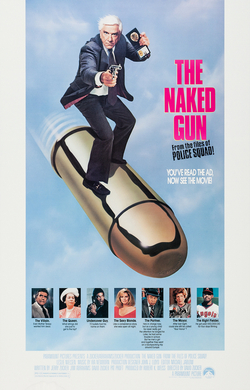
The Naked Gun: From the Files of Police Squad! follows Lieutenant Frank Drebin through a criminal investigation that collides with a royal visit. In David Zucker's 1988 comedy, Drebin's colleague Nordberg is shot while investigating heroin smuggling on a boat owned by businessman Vincent Ludwig. Drebin refuses to believe that his friend is a drug dealer and follows the connection to Ludwig. Police Squad also has to protect Queen Elizabeth II during her visit to Los Angeles. Ludwig's assistant Jane Spencer is asked to find out what Drebin knows, but she and the detective fall in love. His efforts to expose Ludwig repeatedly backfire. He destroys evidence while searching the office, then mistakes a ceremonial musket presentation for an assassination attempt and throws himself at the Queen. His conviction that something is wrong costs him his job just when the real plot is approaching.
Jane discovers that the Queen will be attacked at a baseball game and warns Drebin. He gets onto the field in disguise, first as singer Enrico Pallazzo and then as an umpire searching the players for weapons. Ludwig activates a hypnotised Reggie Jackson to carry out the killing. Drebin's attempt to stop him accidentally sends a spectator falling onto Jackson, saving the Queen. Ludwig dies while trying to escape, but his control device is stepped on and Jane is compelled to turn a gun on Drebin. His declaration of love and offer of an engagement ring break the spell. He is reinstated, and Nordberg recovers, only to suffer another accident at his friend's hands. Drebin has solved the case without acquiring much control over the havoc he causes.
Drebin had already been the centre of Police Squad!, the short-lived 1982 television series starring Leslie Nielsen. Zucker recalled that the team initially struggled to find a three-act movie story and made the series instead. Returning to the character as a feature gave the visual jokes a cinema audience's attention. The new title came from a list supplied by Paramount, with The Naked Gun appealing to Zucker because its promise was so excessive. The central performance kept the manner of a serious police drama. Zucker said Nielsen understood where the written jokes were and trusted their rhythm, without trying to add a wink or improvise a funnier delivery. The filmmakers argued over individual words and kept speeches short. Drebin could therefore sound completely authoritative while misunderstanding his surroundings. Zucker described trying to make jokes carry the plot, rather than stopping the comedy whenever information had to be delivered. His driving-school car chase is one example: a familiar pursuit becomes a lesson with the wrong passenger in charge.
The baseball game gave those ambitions a destination. Pat Proft recalled that the writers developed the ending first and worked backwards, finding enough material in the sport for an entire third act. Jim Abrahams described wanting a familiar public event, and Zucker noted that an umpire's mask offered Drebin a believable disguise. The national anthem provides another route onto the field. Proft had wanted someone to mangle the song, but Drebin's impersonation also had to move the investigation forward. Zucker said every incorrect lyric was scripted. Even the Queen's extraordinary first pitch had a physical method behind it. Chuck Fick, who played the catcher, described a ball threaded onto a thin wire and fired towards his glove, with a circular movement producing its corkscrew path. Real teams and experienced baseball players surrounded Nielsen's fake official. That recognisable sporting activity gives Drebin ordinary duties to misunderstand while he is supposed to be preventing a murder in the stands.
The romance gives Drebin a problem that cannot be solved by his police authority. Zucker described the character beginning the film unhappy after being left by his girlfriend, despite his ability to defeat a roomful of enemies. Meeting Jane allows him to gain a relationship, lose it and try to recover it. The emotional goal stays simple enough to follow amid the criminal schemes. Zucker also used the original film's pistachio stakeout to explain how quickly a visual joke should end: Drebin and Ed Hocken's mouths become pink while they talk and eat, but the colour disappears when Drebin moves into the next scene. The gag does its work and the film moves on. That freedom lets a ridiculous detail occupy a moment without demanding a lasting explanation from the story.
Co-writer Proft described writing Drebin with Humphrey Bogart in mind: a tough, solitary policeman who also needs love. The parody drew on police television and films, with Bullitt and Dirty Harry among his references. That broad approach leaves room for an investigation, a chase and a romance within the same comic character. Drebin's confidence belongs to the familiar detective figure; his failures come from what happens when he applies that confidence to people and situations he has badly misread.
Proft also described Drebin as well-intentioned and largely unaware of the chaos he creates. The character combines several familiar detectives rather than reproducing just one role. For Nielsen, the writing called for a literal, dramatic performance, whether a scene depended on dialogue or physical business. Proft valued the gradual change in his expression when a problem began to register. He said the foundation was on the page, even though rewriting could continue during filming. New ideas still had to fit the plot and characters. That discipline gives Nielsen room to play a man who believes he is restoring order while the scene around him comes apart.