
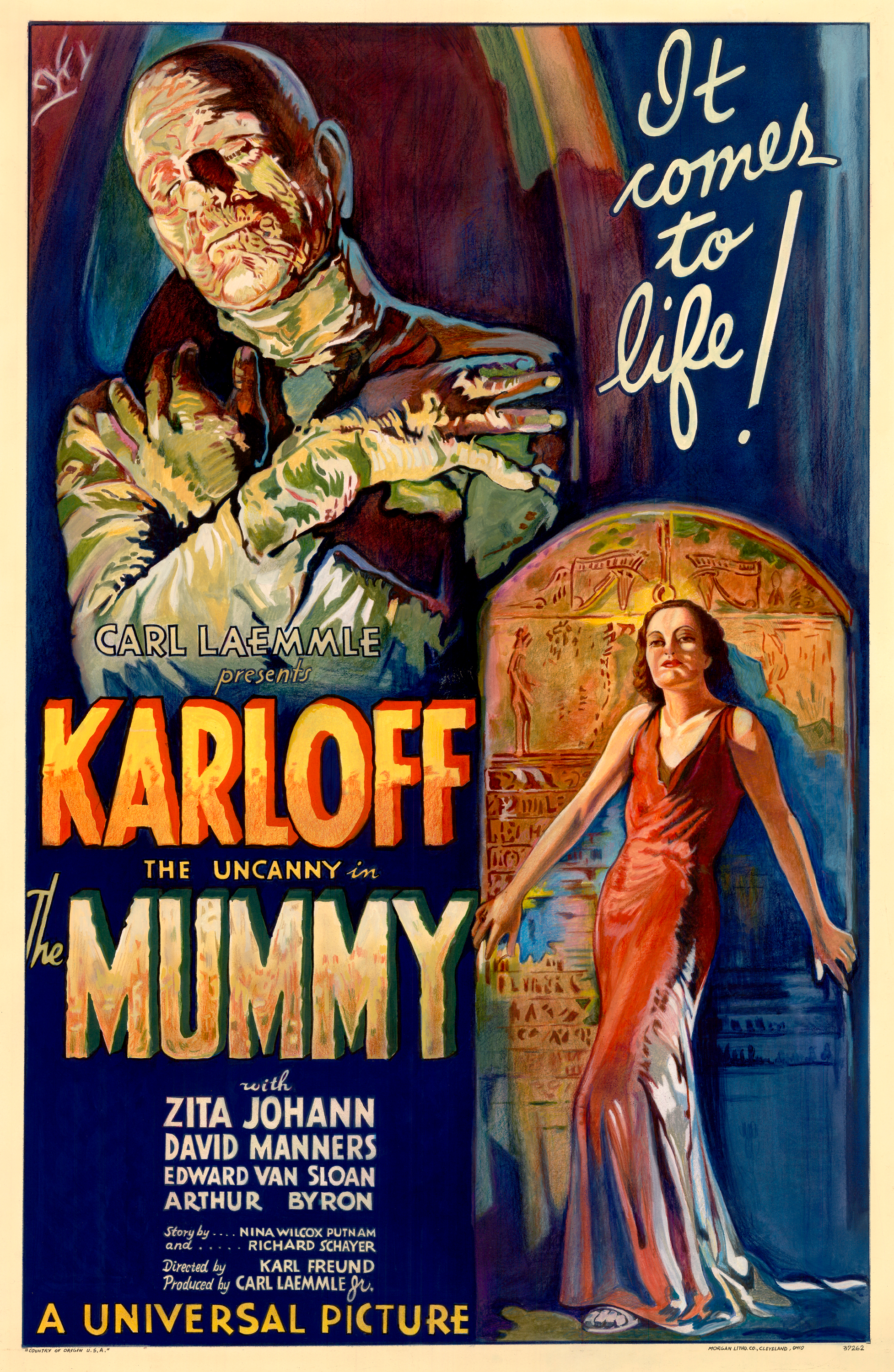
Behind the film
- Year
- 1932
- Director
- Karl Freund
- Writers
- John L. Balderston, Nina Wilcox Putnam, Richard Schayer
- Genres
- Horror, Fantasy
- Production
- Universal Pictures
- Country
- United States
- Cast
- Boris Karloff, David Manners, Edward Van Sloan, Noble Johnson, Leonard Mudie, Zita Johann, Arthur Byron, Bramwell Fletcher
About the film
Contains story spoilers.
The Mummy follows Imhotep, played by Boris Karloff, from an Egyptian tomb into modern Cairo. He had been buried alive for attempting to resurrect his dead lover. In 1921, Ralph Norton reads the Scroll of Thoth and accidentally revives him. Imhotep leaves with the scroll; Norton goes mad. Years later, using the name Ardath Bey, he directs Frank Whemple and Professor Pearson to Princess Ankh-es-en-Amon's tomb. Helen Grosvenor, played by Zita Johann, resembles the princess. Imhotep believes she is his lost lover reincarnated and intends to kill, mummify and revive her as his immortal bride. He kills Sir Joseph Whemple when the archaeologist tries to burn the scroll. At the climax, Helen appeals to Isis. The goddess's statue sets the scroll alight, ending Imhotep's immortality and reducing him to dust.
The scroll introduces its world before the expedition begins. Its opening inscription invokes Isis raising Osiris, then describes death as a passage into another life. Those words establish the promise Imhotep will try to impose on Helen. Karl Freund directed the film for Universal, with John L. Balderston writing the screenplay from a story by Nina Wilcox Putnam and Richard Schayer. Milton Carruth edited it. Universal released The Mummy in 1932. Its development began with Cagliostro, a treatment about an ancient Egyptian who survives through nitrate injections and kills people resembling a woman who betrayed him. Balderston changed that revenge story into the pursuit of a dead lover. Producer Carl Laemmle Jr. had seen an opportunity in the public fascination surrounding Tutankhamun's tomb. The film became The Mummy during production, after earlier working titles including The King of the Dead.
Karloff's transformation involved long hours before the camera could roll. Jack Pierce used Fuller's Earth, beauty clay and cotton soaked in collodion, with linen bandages covering the actor's body. The earth irritated Karloff's eyes, and removing the makeup required melting it away. Ardath Bey's human appearance still meant hours of work applying cotton strips to wrinkle his face and hands. Freund lit Karloff's eyes with spotlights while lowering the surrounding light. The stare belonged to the lighting as well as the makeup. Pierce also worked from photographs of Seti I's remains in the Cairo museum. The wrinkling process involved stretching Karloff's skin before applying cotton strips dipped in collodion. When the skin relaxed, the applied material creased.
The opening resurrection keeps much of Imhotep's movement outside the frame. Norton chants offscreen while Karloff slowly opens one eye. The camera travels down the bandaged body, and a hand reaches for the parchment beneath Norton's elbow. Norton turns and screams at something the audience cannot see. As his reaction gives way to hysterical laughter, the camera moves again. Scraps of bandage trail out of the crypt; the coffin is empty. Michael Koller's account of the scene draws attention to how little sound and visible action it needs. Norton supplies the frightened response while the mummy's departure is reduced to traces. The bandaged figure then gives way to Ardath Bey for the remainder of the film. Koller also describes Freund's preference for keeping several people within a shot and moving the camera between them, rather than continually cutting between speakers. Individual shots and close-ups become occasions for emphasis. His comparison with Dracula centres on the struggle over a woman's mind and body: both supernatural figures can hypnotise others, command followers and encounter resistance through religious images. In this reading, Imhotep's pursuit of Helen belongs to a contest over her freedom as well as an attempt to recover his past.
Imhotep's past also gives Karloff a different kind of role. The ancient flashback shows him alive and in love before punishment turns him into the figure discovered by the expedition. Robert Spadoni places this passage within the early sound horror film's continuing relationship with silent cinema. His study separates the story into three periods: ancient Egypt, the discovery in 1921 and the main action years later. The flashback lets Karloff appear briefly as a conventional romantic leading man, though the romance is already doomed. Spadoni reads a tension between that possibility and the developing expectations of the monster film. A leading man might survive and win his lover; the undead monster moves toward destruction. Karloff occupies both positions within the same character. The passage into the past makes the lover visible, while the return to the present restores the dried skin, supernatural power and fatal pursuit.
The combination of an immortal lover and an ancient body has literary parallels beyond a single adaptation. Richard Freeman's study compares the film with Arthur Conan Doyle's The Ring of Thoth, whose long-lived Egyptian Sosra still loves a woman who died centuries earlier. Freeman also discusses Lot No. 249, connecting its avenging mummy and scroll with elements found across mummy films. These comparisons concern shared story ideas; they do not establish which stories Balderston knew. Freeman finds another resemblance in Maurice Tourneur's silent film The Undying Flame, with its Egyptian reincarnation in an English woman. He explicitly leaves the extent of such films' influence on the 1932 screenplay open to speculation.