
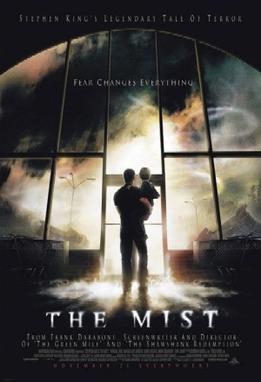
Behind the film
- Year
- 2007
- Director
- Frank Darabont
- Writers
- Stephen King, Frank Darabont
- Runtime
- 2h 6m
- Genres
- Horror, Science fiction, Monster, Drama
- Production
- Dimension Films
- Country
- United States
- Cast
- Thomas Jane, Marcia Gay Harden, Laurie Holden, Andre Braugher, Toby Jones, Alexa Davalos, Buck Taylor, Chris Owen
About the film
Contains story spoilers.
The Mist begins with a storm that damages David Drayton's home and sends him, his son Billy and neighbor Brent Norton into town for supplies. The supermarket becomes a refuge when an unnatural mist closes around it and creatures make leaving dangerous. Inside, practical disagreements turn into competing explanations of what is happening. Mrs. Carmody presents the disaster as divine judgment and insists that sacrifice is necessary. David's responsibility for Billy gives those arguments an immediate personal consequence: each decision must protect a child while taking account of threats that remain partly invisible. The people gathered among the shelves gradually divide over whether to trust one another, accept Carmody's account, or risk the world beyond the store.
Carmody's growing authority eventually finds a target in Private Jessup. Her followers blame the soldier for the catastrophe, attack him and throw him outside to the creatures. In the production oral history, actor Sam Witwer explains how the scene was changed from a spectacular effects death into a more personal killing: Jessup appeals for help at the window, leaving a handprint behind. The surviving group then escapes the supermarket, moving from a conflict they understand into a landscape they cannot measure. Laurie Holden described the central divide as one between people struggling to preserve civilization and people using religious certainty to hide from their own fear.
On the road, an immense creature makes the scale of the transformed world apparent. The journey ultimately ends with David believing there is no way to save his companions. He kills the others, including Billy, and emerges alone, expecting the mist to finish him. Instead, military vehicles arrive as the fog begins to clear. Rescue has come after the irreversible decision. Thomas Jane's recollection of the giant creature connects it directly to this conclusion: he argued for keeping the shot because it established why the travelers would believe their world had ended. The final reversal depends on that loss of perspective as much as on the appearance of help itself.
Frank Darabont chose an unusually mobile production style for the adaptation. In his Rotten Tomatoes interview he described two cameras filming throughout, with a third whenever space allowed, and operators moving so freely that actors could not anticipate where a shot would end up. He wanted a rough, immediate documentary quality. Marcia Gay Harden's account in the same interview places Mrs. Carmody's force in the director's choice of angles, faces and reaction shots as well as in the performance. She approached the character through the cruelty that fear can authorize within a crowd. The method brought the ensemble's shifting responses into the filmmaking itself, allowing a threatening social relationship to develop through looks and interruptions around a shared room.
That freedom required continuous attention from the cast. Speaking to Fangoria, Holden compared the experience to live theatre: a glance toward another performer could produce a different exchange in each take, and the actors trusted the eventual selection of moments. Andre Braugher, who played Norton, recognized similarities with his work on Homicide. A wide shot could be as unpredictable as a close-up, so preparation could not be reserved for the moment a camera isolated his face. Marks remained useful for focus, but the performers could move away from them during a struggle. Toby Jones also described the supermarket's group behavior as recognizable beyond an American setting, comparing its shifting alliances and competing voices with strangers reacting to one another on a train.
Darabont protected the ending through a financial choice as well as a storytelling one. In his CHUD interview, he recalled rejecting an offer of roughly twice the eventual budget because it required replacing the conclusion. Dimension's support meant working with less money and less time while retaining the version he wanted. He described those constraints as a practical challenge that connected the production with low-budget horror he admired. The same interview explains that the later monochrome presentation required returning to the digital intermediate and adjusting shots for exposure and contrast with color timer Keith Shaw. Producing that version was therefore a deliberate photographic process, rather than simply removing color from an existing transfer and assuming its tonal relationships would remain effective.
In a separate Classic-Horror interview, Darabont called black and white his preferred version while leaving viewers free to prefer the color release. He associated the monochrome image with late-1950s and early-1960s creature films and with the experience of watching horror on television as a child. Ray Harryhausen's work also informed the desired flavor of the monsters. Darabont defended CafeFX's contribution in the context of the resources available, identifying an effects budget of four million dollars. That explanation ties the alternative presentation to a particular lineage of genre filmmaking and to the practical conditions of this production. Both versions preserve the same confrontation between external creatures, human panic and David's desperate attempt to choose a survivable course for his son.