
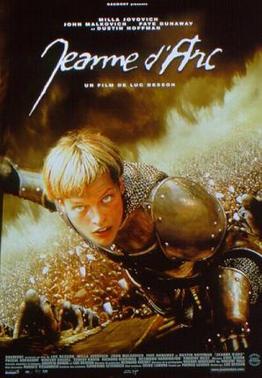
Behind the film
- Year
- 1999
- Director
- Luc Besson
- Writers
- Luc Besson, Andrew Birkin
- Runtime
- 2h 38m
- Genres
- Drama, Historical drama, Historical, War
- Production
- Gaumont, Columbia Pictures
- Country
- France
- Cast
- Milla Jovovich, John Malkovich, Faye Dunaway, Dustin Hoffman, Tchéky Karyo, Vincent Cassel, Pascal Greggory, Richard Ridings
About the film
Contains story spoilers, including the ending.
The Messenger: The Story of Joan of Arc follows a young woman whose confidence in a divine mission brings her into the struggle for the French throne. Milla Jovovich plays Joan in Luc Besson's drama, with John Malkovich as the ruler she asks to give her an army. Her claim offers hope to a court caught in political and religious conflict, but also raises the question of what she has understood about her visions. The film supplies a violent childhood experience as part of that question: Joan witnesses an attack on her village and the rape and killing of her sister. This is an incident in Besson's fictional treatment, rather than an established event in the historical Joan's life. The story connects her faith and her exposure to violence before bringing her before the king. Her conviction must persuade people who have practical reasons to want a military victory.
Joan leads the French toward Orléans, interrupting a retreat and returning to the attack after being wounded. The victories allow Charles to be crowned at Reims, but they do not secure unlimited support for her further campaigns. Her attempt against Paris fails without the reinforcements she requests, and Charles prefers diplomacy to the expense of another army. Burgundian forces capture Joan at Compiègne and sell her to the English. In Rouen, the proceedings against her turn her claim to divine guidance into a charge of heresy. Bishop Cauchon fears condemning someone who might truly have received visions, while the English want her removed. Joan signs a recantation, which should protect her from execution, but guards take her clothes and leave her men's clothing. They use her reappearance in those clothes to demand her death. She is burned in Rouen, and a closing note records her later canonisation. The film follows the change from a military leader welcomed for what she can accomplish to a prisoner whose former allies no longer protect her. Its court and prison scenes narrow the freedom she appeared to possess at the head of an army.
Joan's visions give the film a second set of encounters alongside its battles and audiences at court. She sees a robed boy and a figure resembling Christ, while Dustin Hoffman's Conscience confronts her in captivity. He asks her to reconsider the meaning she has given to events, including finding a sword in a field. The object that she treats as a sign can also have an ordinary explanation. The confrontation makes interpretation itself part of the drama: Joan has acted on certainty, and now must revisit how that certainty formed. Hoffman's character is a device through which the film stages her doubts, rather than a documented visitor to the historical prisoner. The sword episode also belongs to Besson's construction of her story. Keeping that distinction matters because the film's argument about what Joan believes depends on incidents it has chosen or invented. Its images of religious experience offer access to this particular screen character's thoughts without settling the nature of the historical Joan's faith.
Besson described Joan's motives as pure when asked whether he believed God had actually spoken to her. His answer emphasised her belief that God was speaking, leaving a distance between the character's conviction and a definitive explanation of its source. Jovovich's work also involved the physical demands of appearing in armour, which she described as weighing fifty pounds. She recalled an unexpected response from early screenings: some viewers wanted the burning removed because it spoiled the ending. That reaction concerned the film's handling of an unavoidable destination in Joan's story, rather than a different ending the filmmakers adopted. Faye Dunaway played Yolande of Aragon, Charles's mother-in-law, and explained that her apparent shaved head was created with a skull cap. Those preparations serve different parts of the world Joan enters. The armour places Jovovich in the military action, while Dunaway's altered appearance belongs to the court where Joan must negotiate for the support that puts her there.
The film gives warfare a dense physical presence through siege weapons, horses and armoured bodies. Catapults, flaming arrows and close combat keep the military campaign grounded in actions that can injure the people caught inside it. The religious passages use a different means of making Joan's experience visible, including flashes of light, altered colour, tilted angles and sudden changes of pace. Those choices distinguish a vision from the ordinary space around her, while the battle scenes bring the camera close enough for blood to hit the lens. Éric Serra's score accompanies that forceful approach to the action. Court conversations also rely heavily on close views of faces, giving the discussions between Joan and the powerful people around her a compressed screen space. The film moves between massed conflict and those isolated faces as her public role grows and then collapses. Its visual treatment keeps bodily violence alongside the beliefs through which Joan tries to understand what she has done.