
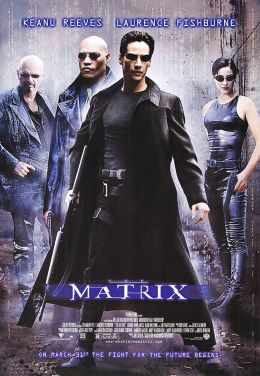
Behind the film
- Year
- 1999
- Director
- Lana Wachowski, Lilly Wachowski
- Writers
- the Wachowskis
- Runtime
- 2h 16m
- Genres
- Thriller, Dystopian, Cyberpunk, Action thriller
- Production
- Village Roadshow Pictures, Warner Bros. Entertainment, Silver Pictures
- Country
- United States, Australia
- Cast
- Laurence Fishburne, Carrie-Anne Moss, Joe Pantoliano, Hugo Weaving, Keanu Reeves
About the film
Contains story spoilers.
The Matrix begins with the feeling that an ordinary life has been arranged around someone else's rules. Thomas Anderson has an office job, a boss and a second identity online as Neo. He senses that something is wrong before he has language for what it is. The early encounters with Trinity and Morpheus turn that vague discomfort into a concrete choice. Learning the truth will also mean losing the familiar world that made daily life manageable.
The red pill does not deliver Neo into a comfortable freedom. He wakes into physical vulnerability and a devastated world. That reversal gives the premise its bite. The simulated city can be false and still offer pleasures that the truth cannot easily replace. Cypher's desire to return makes the cost explicit. His betrayal is terrible, but the temptation behind it is easy to recognise: he wants comfort without having to remember what that comfort conceals.
Morpheus and his crew travel aboard the Nebuchadnezzar, connecting to the Matrix from outside the simulation. Machines control the system, and human minds experience its constructed world as daily reality while their bodies remain captive. Agents police that world and can turn seemingly ordinary surroundings into a trap. Zion offers the prospect of a human community beyond the system, though this first film largely keeps its attention on the crew. Training programmes let Neo learn fighting techniques and test the gap between what he understands intellectually and what he can make himself believe. The mechanics give the action clear stakes: people must reach exits, companions outside the simulation must keep them connected, and injury inside it can have fatal consequences. The sharp clothes and extraordinary movement therefore rest on vulnerable bodies elsewhere. Freedom is a shared operation, dependent on people maintaining the conditions that allow another person to act. The spectacular rescues remain tied to that ordinary work of watching over someone.
Morpheus believes Neo can change their world before Neo believes he can do anything exceptional. Laurence Fishburne gives that certainty a calm authority, leaving room for Keanu Reeves to play confusion without turning Neo into a joke. Their training scenes make doubt practical. Knowing that the environment is a simulation does not immediately remove the habits of a lifetime. Neo's body keeps behaving as though the limits he learned are permanent.
The Oracle complicates the simple idea that a chosen hero only needs confirmation. Her conversation makes Neo consider what he will do for someone else, and his decision to rescue Morpheus becomes more revealing than a declaration about his destiny. Trinity also moves the story through action long before she explains her feelings. The group gives Neo reasons to take risks. His development depends on those relationships as much as on new abilities, which keeps the grand premise attached to people who can be hurt.
The Wachowskis make the artificial world attractive through sharp silhouettes, controlled movement and action that seems to exceed the camera's usual limits. The bullet-time sequences let a moment stretch while the viewpoint moves around it. A physical impossibility becomes something the audience can inspect. Martial arts choreography gives the same idea a different texture: bodies meet surfaces, recover from impacts and gradually discover room to move beyond expected limits. The spectacle communicates the premise before another explanation is needed.
The film is patient about turning uncertainty into suspense. Early scenes make a ringing telephone, a sealed room or a stranger's instruction seem suddenly urgent. Neo often has to act before he understands why, placing the audience close to his bewilderment. Once the premise becomes clear, those devices acquire rules we can follow. An exit becomes something to reach, a passer-by can become a threat, and solid ground cannot always be trusted. Later action is satisfying because we know enough to recognise the danger without losing the possibility of surprise. The design makes the philosophical question active inside an accessible chase. Asking what counts as reality matters immediately when the answer determines where someone can run, whom they can trust and whether the next decision will leave them alive. The simulated city's order and the crew's cramped life outside it also keep the choice difficult. Understanding the lie does not instantly make the truth an easier place to live.
Agent Smith brings a contrasting stiffness. His suit, measured voice and repeatable appearance make him feel like authority stripped of individual life. Hugo Weaving's flashes of disgust disturb that surface, suggesting that even the system's representative finds his assigned world intolerable. By the closing confrontation, Neo's change is visible in how he looks at the environment. The city is no longer an unquestionable reality whose blows he must merely endure. He can perceive its construction. The ending offers a beginning rather than a fully liberated humanity: one person has learned to see the rules and act against them. The force of that final promise comes from remembering how powerless he looked inside his office at the start.