
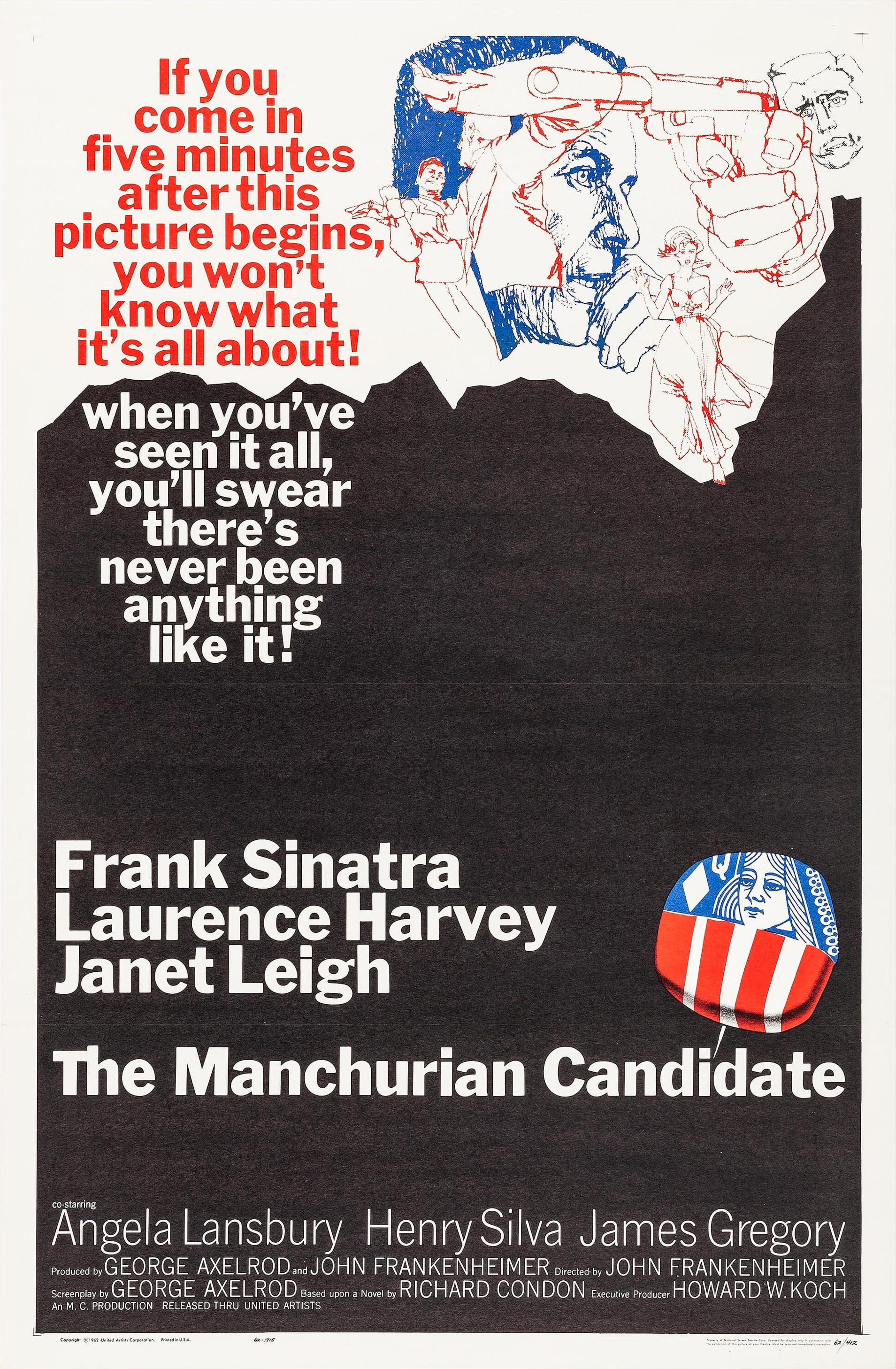
Behind the film
- Year
- 1962
- Director
- John Frankenheimer
- Writers
- George Axelrod, John Frankenheimer
- Genres
- Film noir, Political, Thriller, Drama
- Country
- United States
- Cast
- Frank Sinatra, Janet Leigh, Angela Lansbury, Laurence Harvey, James Gregory, Henry Silva, Leslie Parrish, Whit Bissell
About the film
Contains story spoilers.
Raymond Shaw returns from the Korean War with the Medal of Honor, but his heroism is an implanted memory. Major Bennett Marco's nightmares expose their platoon's captivity and Shaw's conditioning as an assassin. Shaw cannot remember his killings. His mother Eleanor exploits his public reputation to advance her husband, Senator John Iselin, and secretly directs her son. Shaw marries Jocelyn Jordan, then kills her father on Eleanor's orders and Jocelyn when she interrupts. Eleanor next orders him to kill the presidential nominee at a convention, clearing Iselin's path to power. Marco tries to break Shaw's conditioning. At the convention, Shaw instead kills Eleanor and Iselin, then dies by suicide before Marco can save him. Marco later mourns the man whose supposed military heroism concealed his captivity and whose final act stopped his family's conspiracy.
George Axelrod's screenplay grew from Richard Condon's novel and a project that studios resisted. In his Backstory interview, Axelrod recalled buying the book the day after reading a New Yorker review. Political satire made the proposed film difficult to sell; he credited Frank Sinatra with making it possible. Axelrod wrote his first draft in Bedford Village, then went to work with John Frankenheimer in late summer or early autumn 1961. He described Frankenheimer as a helpful collaborator from the beginning, while Condon did not participate in the screenplay.
Frankenheimer explained the nightmare's changing setting to Terry Gross on Fresh Air as a problem of movement and belief. Condon's book supplied the scene's basic conception. The director began with a camera circling a hotel garden-club meeting, where a woman talks about hydrangeas. By the end of the complete turn, the setting has become an amphitheatre with a Chinese psychiatrist addressing the captors. Sliding platforms moved into place as the camera turned away, while performers hurried between them. Frankenheimer wanted the transformation to happen without a cut, so the change would feel strange before editing began to fragment it. He then filmed seven or eight arrangements of the soldiers, women and delegates, allowing the sequence to move between incompatible versions of the room. Its confusion was deliberate. He felt the opening shot established the audience's belief, leaving him free to alternate the settings afterward. In the same Fresh Air programme, Angela Lansbury described Eleanor as a role with many layers and personas. She relished playing her and compared the part's dramatic scope to Lear. Her account stresses how much was available to play within the mother who also controls the political plot.
Eleanor's authority shapes the press conference's arrangement of people and screens. Rob Nixon's Turner Classic Movies account describes Lansbury in the foreground, with James Gregory's Iselin behind her carrying out her instructions. The Secretary of Defense appears on a television Eleanor watches, angrily answering accusations of communist influence in his department. The frame holds the person directing the attack, the politician voicing it and its televised target. Photography is credited to Lionel Lindon, with editing by Ferris Webster and art design by Richard Sylbert and Philip M. Jefferies.
Writing in a 1993 Sight & Sound essay, J. Hoberman connected the film's politics to television image-building and the strange alliance between an anti-communist demagogue and a communist conspiracy. In his reading, electoral power becomes a spectacle: public accusations and patriotic appearances can serve the people supposedly threatened by them. Hoberman also distinguished Condon's mildly futuristic novel from the film's period setting, with its climax at the 1956 Republican Convention. That choice puts the fictional scheme inside an already familiar political past. The release brought it into another tense moment: the film premiered in 1962 during the Cuban Missile Crisis. Hoberman's account separates its later absence from circulation from a story that grew around it. He reported that, when the film returned, its withdrawal was explained as a financial dispute between Sinatra and United Artists. That explanation differs from the mythology that Sinatra suppressed a supposedly prophetic film. Hoberman treats the release and return as parts of its history, alongside the Cold War anxieties already built into the story.
David Amram recalled having six weeks to compose the score, working at Hollywood's Montecito Hotel with an old piano and a Moviola in his room. In his interview with William Rosar and Peter Bloesch, he described deciding where music should begin, end and change, then writing for those particular stretches of film. The material had to respond to the pictures and their smaller shifts. Music he had written beforehand was discarded because it no longer fitted what he saw, despite his earlier reading of the script and discussions of it. Asked about the theme, Amram described three-part counterpoint: each line had an independent shape, while the sounds formed together remained harmonically organised. His recollection places the composition beside the moving image, with the piano and viewing machine close enough for him to revise what a passage needed as the film took shape.