
Behind the film
- Year
- 1962
- Director
- John Ford
- Writers
- Willis Goldbeck
- Genres
- Western, Flashback, Drama, Revisionist western
- Production
- Paramount Pictures
- Country
- United States
- Cast
- James Stewart, John Wayne, Vera Miles, Lee Marvin, Edmond O'Brien, Woody Strode, Andy Devine, John Carradine
About the film
Contains story spoilers, including the ending.
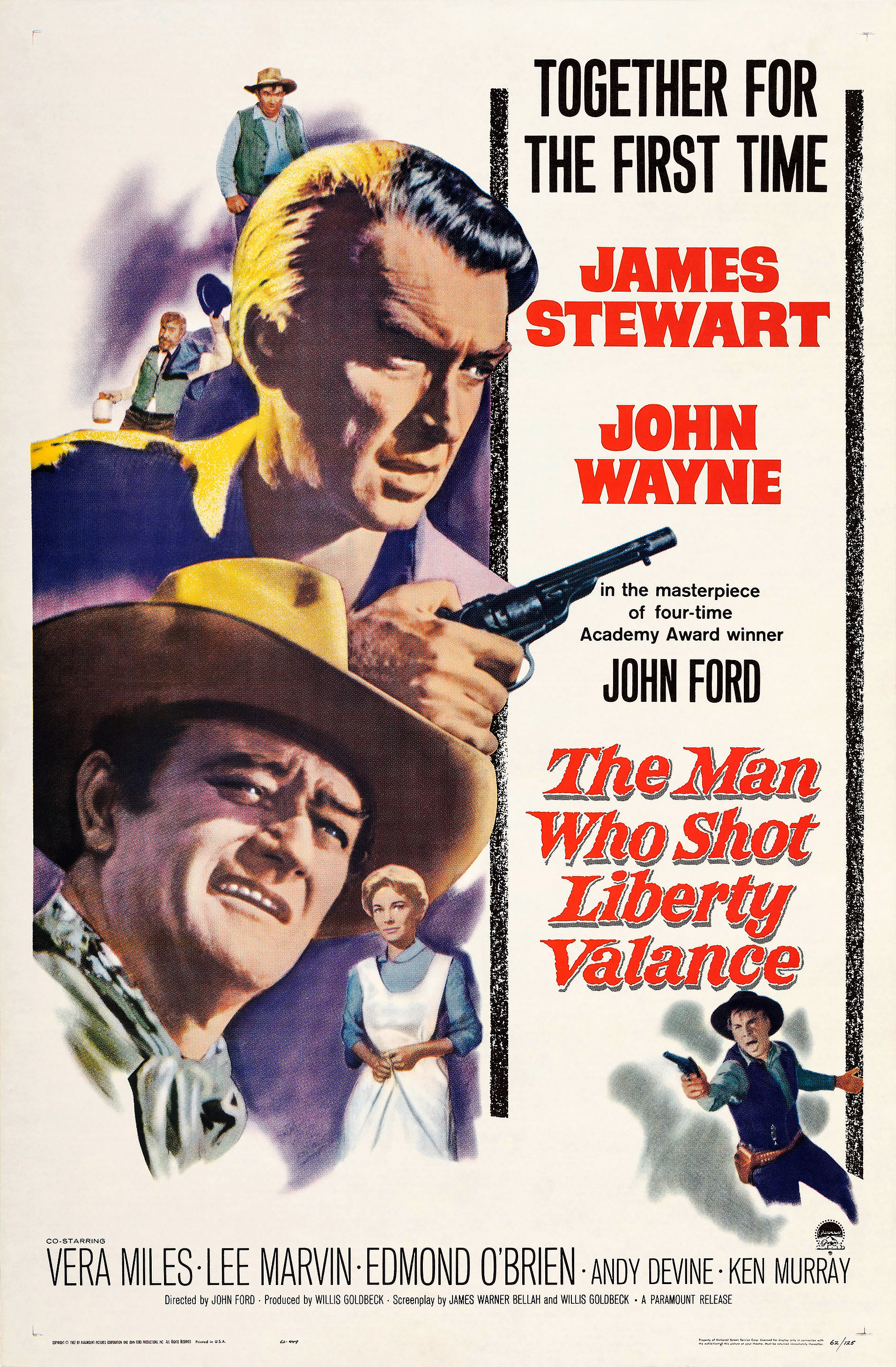
The Man Who Shot Liberty Valance starts with a funeral that seems too small for the people attending it. Senator Ranse Stoddard and his wife Hallie have returned to Shinbone to bury Tom Doniphon, and a reporter wants to know why an important politician has come for an obscure rancher. Stoddard's answer takes the film back to his arrival as a young lawyer, when Liberty Valance ruled through fear. James Stewart plays Stoddard, John Wayne plays Doniphon and Vera Miles plays Hallie. Their shared history gives the public question a private weight before the explanation is complete. John Ford adapts Dorothy M. Johnson's short story around the distance between a reputation and the events that created it. The famous man has a story to tell, but the man in the coffin can no longer speak for himself.
Stoddard initially tries to answer Valance with the law, education and political participation. Hallie helps him recover after Valance's gang beats him, and his school becomes part of the effort to change the town. Valance attacks newspaper editor Dutton Peabody, then faces Stoddard in a gunfight the lawyer has little chance of winning. Valance falls, and Stoddard receives the credit. Later, Doniphon reveals that he fired the fatal shot from the shadows at the same moment. The hidden intervention saved Stoddard while helping create the reputation that carries him into politics. It also cost Doniphon the future he imagined with Hallie. In the present, the newspaper chooses to destroy the account rather than publish the truth. A cactus rose on Doniphon's coffin and the couple's journey home keep that private loss beside the public legend. The train conductor still honours Stoddard as the man who killed Valance, repeating what the confession has just shown to be false.
Ford's choice of black-and-white photography and soundstage settings gives Shinbone a different texture from the broad colour landscapes associated with some of his earlier westerns. Stoddard brings education and a belief in law into territory where rough justice has been allowed to stand in their place. The transition is difficult: the town needs a life beyond the gun, yet the man who can protect the lawyer is skilled in precisely that older form of power. The setting concentrates attention on streets, rooms and people facing one another. Arguments about the future have to pass through the places where townspeople work, gather and hear the news. Doniphon and Stoddard share an enemy without sharing an idea of how to defeat him. Their disagreement makes the movement toward civic order costly, with somebody left outside the prosperous public story that follows.
The long recollection also gives the leading actors' age a particular place in the film. Critic Thomas Flanagan reads Liberty Valance as a film about remembered youth, observing that Ford does little to disguise Wayne and Stewart as young men during the flashback. The past is therefore carried by familiar, older faces rather than sealed off as a completely separate world. Flanagan also points to the gunfight the story appears to promise for Wayne's character but withholds. Doniphon can face Valance down, and his ability with a weapon is understood, yet the decisive shot comes out of the darkness instead of a heroic public duel. Stoddard receives the visible role while Doniphon performs the concealed action. That arrangement changes the kind of courage the town can celebrate. The deed that supports its later history is one that its legend cannot describe accurately without taking its central hero apart.
Richard Brody's reading puts writing near the centre of the conflict. Stoddard brings written law, while newspapers help determine which version of events becomes public knowledge. Brody argues that the film shows civic order resting on an act of violence outside the law it establishes. That makes the newspaper's final choice particularly sharp. Its authority to explain the past becomes a reason to keep a false account in circulation. The reporter receives a correction from the person best placed to give it, then the institution decides that the existing story should survive.
Peter Bogdanovich resisted treating the decision to preserve the legend as a simple statement of Ford's own beliefs. In an interview, he argued that Liberty Valance exposes the ways accepted history can be wrong, even as Ford remained interested in the value of heroes. That distinction leaves the ending open to an uncomfortable reading without making it indecisive about the facts. We know who fired the fatal shot, and we know who has lived with the resulting fame. What remains unsettled is how the public should live with that knowledge. The funeral gives the truth a brief hearing, but the newspaper refuses it a wider audience. Stoddard leaves with the advantages of a story he has tried to correct; Doniphon remains the largely forgotten man whose action made that story possible. The film allows both the building of a community and the loss beneath its founding tale to remain visible.