
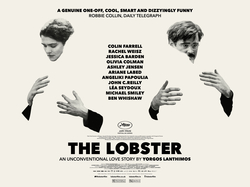
Behind the film
- Year
- 2015
- Director
- Yorgos Lanthimos
- Writers
- Yorgos Lanthimos, Efthimis Filippou
- Runtime
- 1h 58m
- Genres
- Science fiction, Romantic comedy, Dystopian, Arthouse science fiction
- Production
- Film4 Productions
- Country
- Greece, United Kingdom, France, Netherlands
- Cast
- Colin Farrell, Rachel Weisz, Ben Whishaw, Léa Seydoux, John C. Reilly, Ashley Jensen, Olivia Colman, Jessica Barden
About the film
Contains story spoilers.
David arrives at a seaside hotel after his wife leaves him for another man. His brother Bob, now a dog after failing to find a partner, comes with him. The hotel gives David forty-five days to pair off; if he cannot, staff will transform him into the animal he has chosen. He picks a lobster for its long life and because he likes the sea. Guests attend dances, watch presentations about the benefits of couples and are encouraged to match through one conspicuous trait. A lisp, a limp or recurring nosebleeds can become the basis for a courtship. The hotel’s polished grounds and courteous staff make this threat feel like an ordinary service, while a tranquilizer gun in David’s room hints at the force behind the friendly routine.
David watches John fake nosebleeds so he can pursue a woman who suffers them naturally. The match succeeds, although their relationship remains subject to the hotel’s supervision. Their domestic routine is less a private life than an examination: staff ask whether they are happy and whether the arrangement is working. David, meanwhile, courts the Heartless Woman by pretending to share her lack of feeling. When she stages a choking incident in the pool, he does nothing, and she accepts this as proof that they are alike. They move into a suite together. The act ends when she kills Bob and David openly grieves. She recognizes the deception and tries to report him, but the maid helps David drug her and flee. The hotel’s other rule is that guests hunt Loners in the surrounding woods, earning extra days for each person they capture; the escape takes David directly into the targets’ territory.
The Loners have built their own camp under a leader who bans flirting, sex and romance. They punish any breach, so David’s new relationship must stay hidden. He and the Short-Sighted Woman share a condition that first gives them an easy way to recognize each other. They invent small gestures they can use without drawing attention and, on trips to town, pretend to be a married couple. Their bond grows through time spent together and a private language rather than a public declaration. The contrast with the hotel is clear: one community demands that singles pair off, the other demands that they remain single. Both regulate intimacy, and David’s attempt to live outside either system becomes harder when the couple are discovered.
The Loner Leader finds their plan in the woman’s notebook and takes her to town under the pretext of an operation to improve her sight. Instead, she has the woman blinded. David asks about blood types, music, food and languages in the hope of finding a substitute for their shared condition. None gives them the same certainty. The leader orders David to dig his own grave, leaving him exposed to the camp’s dogs. He turns the threat around by binding her in the grave and leaving her there. David and the woman reach a city restaurant, where the old pressure to prove compatibility returns in a more intimate form. He considers blinding himself so they will match again, takes a steak knife to the restroom, and prepares to use it. The film remains with the woman waiting at the table; the choice itself stays unseen.
Lanthimos described the hotel as a prison with a pleasant surface, where attractive grounds conceal uniforms, routines and inflexible rules. The city was chosen to look contemporary without belonging obviously to one country. These decisions place the extraordinary system close to recognisable everyday life. David’s route carries the viewer from city to hotel to forest and finally back into the city; escaping one institution never guarantees freedom from its assumptions. The woods introduce a darker, more romantic part of the story, as Lanthimos explained, but they also give David another authority to evade. A secluded landscape can impose rules as harsh as those enforced inside a comfortable building.
The director left room for actors to follow their instincts and worked largely with natural light. His use of music deliberately complicates the action: dramatic passages may accompany an awkward or funny moment instead of simply reinforcing its apparent emotion. The contrast creates an unsettled tone around people who discuss mutilation and animal transformation with everyday seriousness. What begins as an administrative demand to find a match eventually becomes a private question about the injury David might inflict on himself.
Producer Lee Magiday’s account of making the film adds another reason the voices sound unlike those of a single community. Lanthimos wanted Farrell and Weisz early, and the ensemble drew performers from several countries without requiring a unified national identity. Money and scheduling limited advance rehearsals, while co-writer Efthimis Filippou remained on set for much of the shoot, discussing the sound and construction of the dialogue with Lanthimos. County Kerry supplied the physical production over thirty-five days. The wider European co-production divided editing, sound, picture work and effects among different countries, with the producers seeking a budget that protected the director’s creative control. The world’s oddness was developed through language, performance and ordinary locations rather than explained through an elaborate history of how its laws began.