
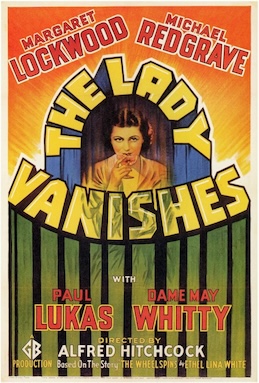
Behind the film
- Year
- 1938
- Director
- Alfred Hitchcock
- Writers
- Sidney Gilliat, Frank Launder, Ethel Lina White
- Runtime
- 1h 36m
- Genres
- Thriller, Comedy thriller, Crime, Detective
- Production
- Gainsborough Pictures, Gaumont-British Picture Corporation
- Country
- United Kingdom
- Cast
- Margaret Lockwood, Michael Redgrave, Paul Lukas, May Whitty, Cecil Parker, Linden Travers, Naunton Wayne, Basil Radford
About the film
Contains story spoilers.
An avalanche strands travellers at an Alpine inn in the fictional country of Bandrika. Among them are Iris Henderson, a wealthy Englishwoman returning home to marry, and Gilbert Redman, a musicologist whose noisy folk-dance practice keeps her awake in the room below. Iris also notices Miss Froy, an elderly English governess listening to a street musician. The musician is strangled outside the inn, though the passengers are soon absorbed in their own delays. The next morning, as the railway line reopens, a planter falls from above and strikes Iris. Dizzy and suffering from a headache, she boards the train with the others, unaware that the attack was meant for Miss Froy.
Iris and Miss Froy share a compartment, then tea in the dining car. The train is loud enough to drown their conversation, so Miss Froy writes her name on the steamed window and explains that it rhymes with “joy.” Iris later falls asleep. When she wakes, the older woman has vanished, and the other passengers deny that she was ever there. Dr Hartz, a brain surgeon travelling with a heavily bandaged patient, tells Iris that her head injury could have produced a hallucination. The denial forces the central question into the open: has Iris mistaken a stranger for a friend, or are the passengers cooperating in a disappearance?
Gilbert initially enters Iris’s story as a reluctant ally. The two had quarrelled at the inn over his late-night dancing, but he believes that her distress deserves investigation. They search the moving train and question the people who shared Iris’s carriage. Most have reasons to avoid attention: cricket enthusiasts Caldicott and Charters want to get to a match; the adulterous Todhunters fear a scandal; and others prefer Hartz’s explanation to the trouble of challenging it. Iris and Gilbert find traces that support her memory, including Miss Froy’s writing on the window and a tea packet caught against the glass. Her broken spectacles provide another clue. Each discovery is small enough to be dismissed, but together they turn a personal recollection into evidence.
The train’s first stop brings a new deception. A bandaged patient is loaded aboard under Hartz’s care, accompanied by a nun. Later, a woman appears in Miss Froy’s clothes, and the passengers claim she is the companion Iris remembers. The disguise seems to make Iris’s account less reliable, especially after the blow to her head. Gilbert keeps searching, while Iris notices that the supposed nun wears high heels and does not behave like a religious attendant. Their investigation points to an organised effort to remove Miss Froy without stopping the train. The people around them do not form a single, unified conspiracy; some hide what they know for private reasons, while Hartz directs the larger plan.
Hartz eventually admits that he is part of the operation. He drugs Iris and Gilbert, expecting them to become unconscious before they can interfere. The nurse, however, is British and has not given them the drug, so the pair only pretend to be incapacitated. They locate the bandaged patient and uncover Miss Froy, then replace her with the unwilling woman who had been dressed in her clothes. The trick allows Hartz to leave the train believing his patient has been recovered. When he realises the switch, he orders the train onto a branch line, where armed soldiers board and the passengers are trapped between the gang and the border.
During the gunfight, Miss Froy reveals why Hartz wants her silenced: she is a British agent carrying a coded message in the form of a folk tune. She gives the melody to Iris and Gilbert, then escapes into a nearby forest. On the train, the passengers' earlier determination to avoid involvement collapses. Todhunter tries to surrender and is shot dead, while Gilbert and Caldicott take control of the locomotive. The false nun helps them escape by switching the tracks and is wounded, but they pull her aboard. Miss Froy's whereabouts remain uncertain as the train carries the others away.
In London, Iris leaves her fiancé at the station and goes with Gilbert to the Foreign Office. They have carried Miss Froy’s message across the border, yet Gilbert admits he has forgotten the tune. In the final scene, they hear it from the next room and discover Miss Froy at a piano, alive and safe. Hitchcock described the film as a “very light” story and said it drew on a legend about a woman whose disappearance was concealed during a Paris illness scare. That lightness is built into the contrast between danger and comic inconvenience: the same train carries espionage, flirtation, class prejudice and cricket anxiety. Its compartments keep the ensemble close enough for every denial to matter, while the tune converts an ordinary piece of music into the instrument that resolves the mystery. The melody also changes function as the story moves: first it is an atmospheric fragment outside the inn, then a clue shared between strangers, and finally proof that the rescue succeeded. That return gives the closing joke about Gilbert’s memory a practical consequence, while Iris’s decision to leave her fiancé makes the mystery part of her own change.