
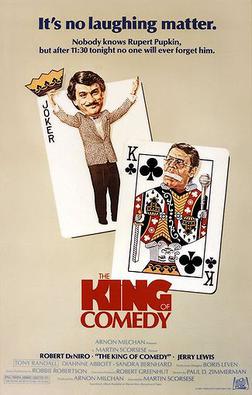
Behind the film
- Year
- 1982
- Director
- Martin Scorsese
- Writers
- Paul D. Zimmerman
- Runtime
- 1h 49m
- Genres
- Drama, Comedy, Crime, Crime drama
- Production
- 20th Century Studios, Regency Enterprises
- Country
- United States
- Cast
- Robert De Niro, Jerry Lewis, Sandra Bernhard, Diahnne Abbott, Shelley Hack, Martin Scorsese, Tony Randall, Don Letts
About the film
Contains story spoilers.
Rupert Pupkin is an office messenger who treats fame as a room he has nearly been invited into. After comedian and talk-show host Jerry Langford is mobbed outside his studio, Rupert helps him into a limousine, climbs in after him and asks for a chance to perform. Jerry offers a polite instruction to contact his office, meant to end the encounter. Rupert takes it as a promise. At home, in a bedroom fitted with life-size cutouts of Jerry and Liza Minnelli, he rehearses a fantasy dinner in which the two men are already friends. The gap between those scenes sets the film’s rhythm: Rupert speaks as though success is settled, while everyone around him is trying to get him to leave.
Rupert’s day job takes him around New York delivering packages, but the route becomes an excuse to telephone Jerry repeatedly and turn up at the show’s offices. Jerry’s assistant Cathy Long asks him to submit a tape, then returns it with advice to develop the act in clubs. Rupert hears the instruction but treats it as a formality blocking an appointment he believes he has earned. In between these visits he calls on Rita, a bartender he once knew, and boasts about his autograph collection. He gives her his own autograph and announces that he is already the King of Comedy. Rita does not share the joke.
Masha, another fan who has been trying to reach Jerry, becomes Rupert’s accomplice. He first met her outside the limousine, where she was removed after attacking the host with her attention; later she pays him to deliver a letter and demands to know what passed between them. He brings Rita to Jerry’s country house, expecting the host to welcome them for the weekend. Jerry returns to find strangers in his home and orders them out. Rita is embarrassed by the intrusion; Rupert turns on her for spoiling the scene he had pictured. The visit makes plain that his fantasy has consequences for another person, but it does not change his plan to force a way onto the show.
The kidnapping is organised around the television performance Rupert believes he deserves. He and Masha seize Jerry with a toy gun that looks real, then make him call the show’s producer and read requests from cue cards. At first the producer assumes the call is another fan’s prank; Jerry has to answer coded questions to establish that he is genuinely being held. The network decides to tape Rupert’s ten minutes and later weighs whether to broadcast them. Masha interprets being alone with her idol as a romantic opening, preparing a candlelit dinner and propositioning him while he is tied to a chair. Rupert, meanwhile, treats each delay as a production problem on the way to his debut.
At the studio, Rupert tells Cathy that he is the kidnapper, then refuses to answer the FBI agents until he has performed. The show is taped with guest host Tony Randall, and the staff introduce Rupert as “the newest King of Comedy.” His routine turns his own neglectful, alcoholic parents into material, and the studio recording adds a laugh track. During the broadcast, he admits he kidnapped Jerry to get the spot, then says it is better to be king for one night than a nobody for life. He leaves Rita and the bar patrons money before the agents take him away. Jerry escapes after persuading Masha to remove the tape binding him, and his ordeal does not depend on Rupert’s later explanation of it.
Scorsese's restrained framing matches Rupert's rigid self-image. He said the characters were like rocks and a medium shot could hold their conversations; the still camera leaves room for gestures and makes bodies' positions in each room carry the scene. The production spent two weeks on Jerry's country-house visit, a sequence Scorsese recalled as painful because Rupert barges into a private space. In Masha's later candlelit approach, Bernhard drew on her stand-up performance; Lewis repeatedly laughed, disrupting the threat until the pair found the scene's rhythm. The blocking and performance keep Rupert's celebrity fantasy pressed against other people's unwanted presence. Scorsese filmed a monologue for Jerry, then cut it: if viewers disliked the jokes, they might stop believing Rupert’s devotion. He also pared back connective shots, preferring to let the characters hold the frame rather than repeatedly explain how they entered each space.
Screenwriter Paul Zimmermann traced the idea to a magazine account of a viewer who kept a diary grading Johnny Carson’s nightly broadcasts. He began thinking about autograph hunters and assassins as people who stalked the famous with different instruments. After working on competing versions with Miloš Forman, he sent his preferred screenplay to Scorsese. De Niro responded to it, and the eventual collaboration drew on Zimmermann’s script and a novelized version. That origin gives the film’s attention to fandom a concrete starting point: someone who watches another person nightly may begin to feel entitled to judge and control that person’s life.
After Rupert’s arrest, the film shifts into a montage of news coverage, magazine covers and his release from prison. It presents a best-selling memoir, offers for further work and a new television appearance, then ends with Rupert in the studio lights, waiting to speak. The montage’s sudden success feels like another of his daydreams, and the closing shot offers no firm marker to settle the question. That uncertainty is part of the ending’s sting: the same media that gave him a few televised minutes could turn his crime into a career, while Rupert’s own mind has been rehearsing exactly such an outcome throughout.