
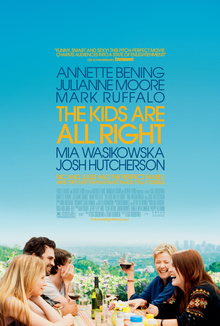
Behind the film
- Year
- 2010
- Director
- Lisa Cholodenko
- Writers
- Lisa Cholodenko, Stuart Blumberg
- Runtime
- 1h 46m
- Genres
- Comedy drama, Comedy, Lgbtq-related, Drama
- Country
- United States, France
- Cast
- Annette Bening, Julianne Moore, Mark Ruffalo, Mia Wasikowska, Josh Hutcherson, Yaya DaCosta, Zosia Mamet, Stuart Blumberg
About the film
Contains story spoilers, including the ending.
The Kids Are All Right begins in a household approaching a familiar change: a daughter is about to leave for college. Eighteen-year-old Joni and fifteen-year-old Laser have grown up with two mothers, Nic and Jules, who conceived them using the same anonymous donor. Once Joni can request his identity, the children contact Paul, a restaurateur whose relaxed manner attracts their interest. The introduction quickly extends beyond the children. Paul shares a meal with the family and develops a connection with Jules, while Nic becomes wary of his place in their lives. Annette Bening plays the doctor Nic, Julianne Moore plays Jules, Mark Ruffalo plays Paul, Mia Wasikowska plays Joni and Josh Hutcherson plays Laser. Lisa Cholodenko directs the 2010 film. The new relationship arrives inside a marriage whose frustrations existed before Paul appeared. Jules wants attention and appreciation; Nic has become used to controlling the household. The children’s curiosity gives those tensions a new focus.
Paul hires Jules to work on his garden, and their working relationship becomes an affair. Jules feels that he values abilities Nic overlooks, while Nic increasingly resents his influence over the children. At a dinner in Paul's home, Nic finds evidence of the affair. Jules tells her that she does not love Paul, and refuses his suggestion that she leave Nic and bring the children to live with him. Paul later comes to the family house and finds himself rejected. Jules asks her family for forgiveness before Joni's departure for college. The next day they make the journey together, and the goodbye brings Nic and Jules into a tentative moment of affection. Laser also makes clear that he wants his mothers to remain together. The family returns to its own relationships after Paul's intrusion, with the marriage hurt but still present. The departure they had been preparing for happens amid the work of repairing another kind of separation.
Cholodenko and co-writer Stuart Blumberg took years to decide how to organise the competing viewpoints. She recalled asking whether the film belonged to the children or whether Paul was taking up too much space. Eventually they settled on the integrity of the family as the centre, with the mothers' relationship holding it together. That decision required each person to have weaknesses as well as vulnerabilities, so no character became only an obstacle for someone else. The garden also grew from personal experience. Cholodenko and her partner had bought a house and undertaken landscaping work; that helped suggest Jules's occupation and the indoor-outdoor Southern California setting. At one stage, casting availability prompted a version set around New York and New Jersey, with Paul connected to a restaurant and organic garden in Brooklyn. Returning the story to California restored the surroundings in which it had first developed. The finished garden brings Jules and Paul into sustained contact through work, giving their attraction a practical reason to keep them together.
Moore described the film as a portrait of a middle-aged marriage, asking what happens to a couple after twenty years when the children are nearly ready to leave. Cholodenko acknowledged its political dimension but said she wanted to avoid a sanctimonious approach. Showing two mothers doing familiar family work was part of that intention. The performances also depended on the particular pairing of Moore and Bening. Moore had supported the project for years and encouraged Bening's casting, while Cholodenko wanted the brusque humour and protective energy Bening could bring to Nic. These comments locate the drama in specific adults, with their own habits and frustrations. They are the filmmakers' aims for this family, rather than a claim that one household can represent every marriage or every experience of gay parenthood.
In a personal essay, Cholodenko connected the screenplay with her own relationship and the process of choosing a sperm donor. She and Blumberg had a substantial draft by late 2005, with Moore attached, but her pregnancy delayed production. Becoming a mother then gave her further details to bring into the script. The family in the film remained fictional, while its development ran alongside changes in her own home. The delay meant that a story first imagined before parenthood could be revisited after she had begun living through it.
Blumberg brought another connection to the subject: he had been a sperm donor in college and wondered whether he had children. Both writers described their partnership as a full collaboration, rather than dividing the characters by gender. Securing money took years despite Moore's early involvement. Cholodenko recalled eventually working with a budget of three and a half million dollars and a twenty-three-day shoot, a much smaller production than they had once expected. A planned rafting sequence was removed, but they kept the rights to Joni Mitchell's Blue for the dinner scene in which Nic sings. Cholodenko also answered criticism of Jules's affair with a man, saying she did not consider exploring it irresponsible. The choices around money, music and character kept the production focused on the marriage at its centre, even when that marriage made some viewers uncomfortable.