
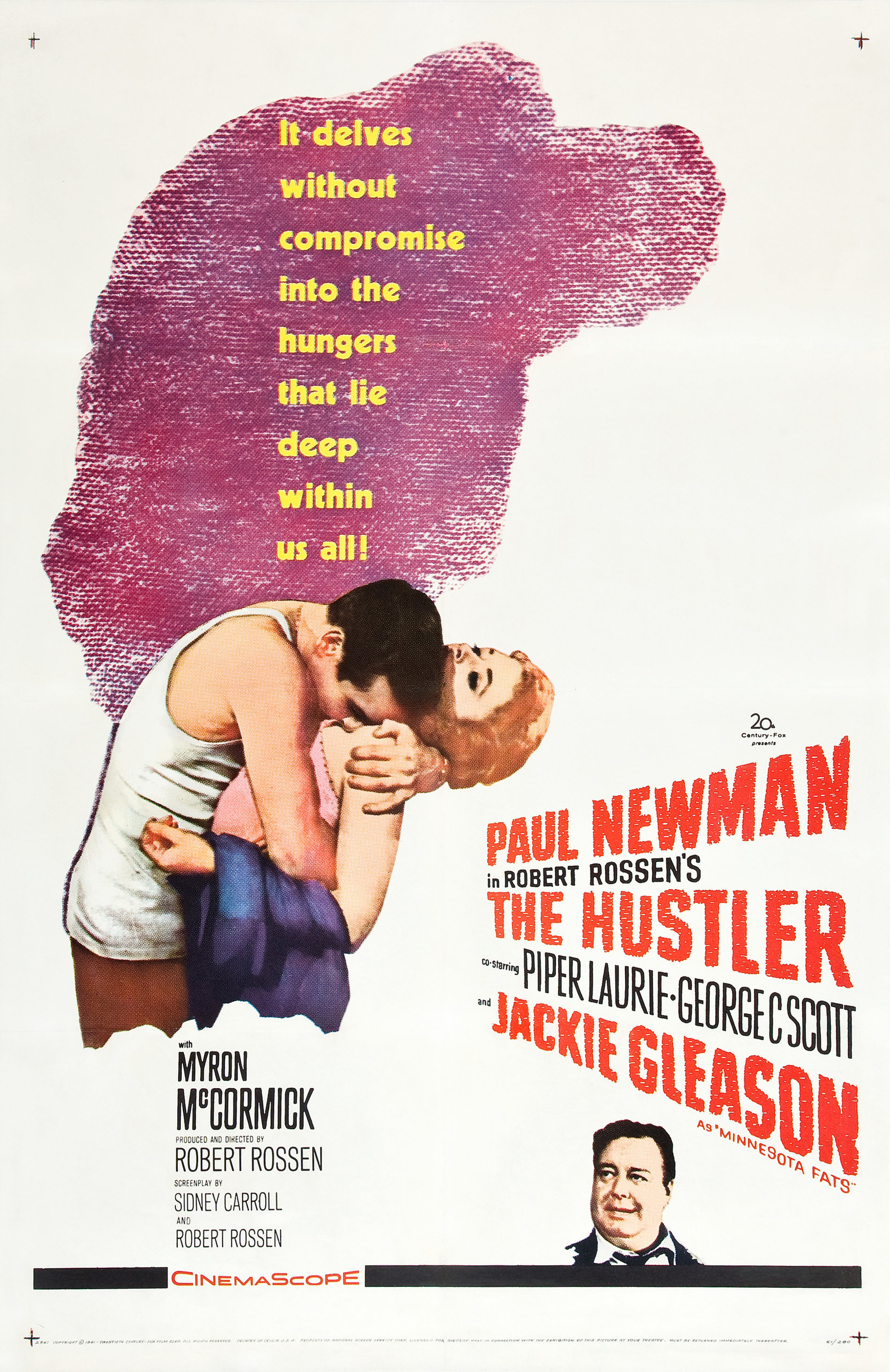
Behind the film
- Year
- 1961
- Director
- Robert Rossen
- Writers
- Walter Tevis, Robert Rossen, Sidney Carroll
- Runtime
- 2h 14m
- Genres
- Drama, Sport
- Production
- 20th Century Studios
- Country
- United States
- Cast
- Paul Newman, Jackie Gleason, Piper Laurie, George C. Scott, Vincent Gardenia, Jake LaMotta, Murray Hamilton, Michael Constantine
About the film
Contains story spoilers, including the ending.
The Hustler follows Paul Newman's Eddie Felson into a contest he believes will establish him as a great pool player. Robert Rossen directed the 1961 drama and adapted Walter Tevis's novel with Sidney Carroll. Eddie and his manager Charlie make a living by misleading other players about Eddie's skill before raising the stakes. Challenging Minnesota Fats offers a different kind of recognition. At the Ames pool hall, Eddie can win games without understanding how to sustain the contest. Fats keeps his discipline while Eddie drinks, presses his advantage too far and eventually loses. Away from the table, Eddie begins living with Sarah Packard, but his ambition keeps drawing him back toward Fats. Bert Gordon offers backing that could finance another attempt, bringing a person who treats Eddie's talent as a means of control into his life.
Eddie's skill cannot protect him from the people he hustles. After one game, a group of men breaks both his thumbs, temporarily taking away the ability on which his livelihood depends. Once he has recovered, he accepts Bert's backing and travels with him and Sarah to Louisville to play the wealthy Findlay. Eddie wins, but the journey leaves Sarah exposed to Bert's cruelty and his determination to dominate the player he finances. Sarah dies by suicide. Eddie returns to New York and challenges Fats again, now carrying the consequences of the trip into the room where he originally wanted only to prove himself. This time he defeats Fats, then refuses Bert a share of the winnings. The two victories require different decisions. Playing well can settle his standing at the table, but walking away from Bert means rejecting the arrangement that was supposed to help him get there.
Rossen described the story as Eddie's effort to fulfil himself as a human being. That aim gives Sarah a place beyond comforting a disappointed player. The film expanded her importance from Tevis's novel, including a picnic scene in which Eddie describes the feeling of playing pool at his best. Sarah responds to a form of confidence that she can recognise and believe in. The outdoor setting also gives the relationship room apart from the enclosed pool halls and shabby interiors. Inside those halls, the actors needed to make the sport credible. Newman learned enough to perform most of his shots, with technical adviser Willie Mosconi handling selected close-ups. Jackie Gleason performed Fats's shots himself. Their physical work allows the difference between the two men to appear in how they approach the table, alongside the dialogue about who deserves to be called the better player.
Editor Dede Allen recalled the pool sequences being among the first material filmed. She worked on the long opening match while the crew was shooting at Ames. The sequence needed to sustain the contest's duration while varying its pace, and Allen combined montage passages with material that played without that compression. She described making rough black-and-white montages, shortening and reshaping them until they fitted the larger game. The movement between shots, the table and the watching players gives the match a rhythm beyond the simple count of balls pocketed. Allen remembered Rossen resisting unnecessary refinement when a scene already worked. Their approach could let a passage run long if its dramatic movement held, while condensing other stretches. Eddie's exhaustion therefore develops within a match that has time to become a test of endurance, with the surrounding reactions helping establish how his apparent command begins to slip.
Allen also described extensive rearrangement during the edit, treating each move as a change to the story's relationships. A strong Newman scene had to be removed because it repeated something another scene already communicated. Bringing the two passages closer together made that duplication clear. Allen valued Rossen's grounding in writing because it gave those changes a purpose: the order could alter how a character was understood, how emotion developed and what the audience needed explained. She recalled assembling masters with a few close-ups when the studio pressured the production for an early cut. That temporary assembly helped secure space to continue the work. Her account places the finished drama beyond the isolated strength of any one performance. A favourite moment could disappear if the surrounding scenes already gave it a job that had been done, leaving the relationship between passages to carry the story forward.
The final confrontation gives Eddie recognition from Fats at the same time that it costs him access to the world he wanted to conquer. Bert demands his money and threatens violence, but Eddie stands against him and speaks of having traded Sarah for a pool game. His anger acknowledges his own part in the loss rather than assigning the entire cost to an unlucky result. Bert eventually tells his men to back away and orders Eddie to stay out of major pool halls. Before Eddie leaves, he and Fats exchange respect for each other's play. The champion's acknowledgement arrives after Eddie has found a reason to refuse the terms attached to winning. Sarah cannot be recovered by beating Fats, and the ending gives no easy way to turn the money or the victory into a replacement for her.