
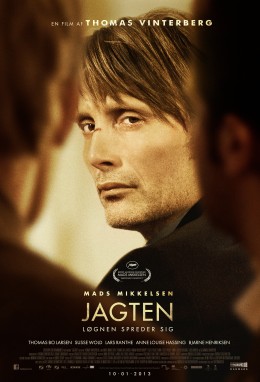
Behind the film
- Year
- 2012
- Director
- Thomas Vinterberg
- Writers
- Thomas Vinterberg, Tobias Lindholm
- Runtime
- 1h 51m
- Genres
- Drama
- Production
- Zentropa, Nordisk Film
- Country
- Denmark, Sweden
- Cast
- Mads Mikkelsen, Thomas Bo Larsen, Alexandra Rapaport, Susse Wold, Lars Ranthe, Anne Louise Hassing, Bjarne Henriksen, Lasse Fogelstrøm
About the film
Contains story spoilers.
Lucas is a divorced teacher who has lost his school job and now works at a nursery in a close-knit Danish town. He is trying to rebuild his relationship with his teenage son, Marcus, who lives with his mother, and begins dating Nadja, a colleague. His friend Theo is also a parent at the nursery, and Lucas is a familiar, trusted presence to Theo’s daughter Klara. When she wanders away from home after her parents argue, Lucas comforts her and lets her walk his dog, Fanny. The story first establishes the ordinary trust between these people before showing how abruptly it can collapse.
Klara develops a crush on Lucas, gives him a small handmade heart and kisses him. He gently tells her that the gift and kiss are not appropriate between them. Hurt by the rejection, she tells a nursery employee a confused story about Lucas. She has also seen a sexual image on an older child’s iPad, and the film shows how that fragment mixes with her feelings. Grethe, the head of the nursery, takes the child’s vague remarks as evidence and invites an acquaintance to question her. His leading questions make the allegation sound more definite. Klara is not a mastermind: she is a child drawn into a process the adults believe they are managing.
The school informs parents and the authorities, but Lucas is left uncertain about what he has supposedly done. When Klara later contradicts her account, the adults treat that change as a sign of fear rather than a reason to reconsider. Rumours grow beyond her first statement, and Lucas loses his job, his friendship with Theo and his place in the town’s everyday routines. He also ends his new relationship with Nadja because he thinks she doubts him. There is no single person directing the response. Each adult acts as if caution requires believing the worst, and their separate decisions combine into a conviction the town no longer sees a need to test.
Marcus runs away from his mother to live with Lucas, but the grocery store refuses to serve either of them. When police arrest Lucas, Marcus tries to confront Klara about what she said and is attacked by adults. Bruun, Lucas’s friend and Marcus’s godfather, takes him in. He tells Marcus that the case may be dismissed because several children’s accounts mention a basement that Lucas does not have. It is a tangible flaw in the accusation, yet it cannot undo what the town has already decided. The case later collapses and Lucas is released, but the people around him do not immediately return his job, friendship or trust.
Hostility follows Lucas home. Someone kills Fanny and throws a stone through his window, so he sends Marcus back to his mother for safety. On Christmas Eve, supermarket workers assault Lucas and throw him out. He comes back, headbutts the butcher who has been provoking him and carefully pays for his groceries. The action is shocking, but the payment is an ordinary habit that continues after the violence. At the church service, Lucas confronts Theo and demands that his oldest friend look him in the eyes. Theo had once said he could always tell when Lucas was lying; now Lucas wants him to decide whether he sees a liar.
Later that night, Theo asks Klara what happened. She admits that Lucas did nothing bad to her, and Theo brings food to Lucas’s home. Their friendship starts to reopen, but the confession does not reverse what the town did or restore Lucas’s former life. By the following autumn, neighbours greet him again and he and Nadja have reconciled. At a gathering at Bruun’s house, Marcus receives his first rifle. Lucas carries Klara over the cracks in a tiled path, returning to the small kindness that preceded the accusation. The film lets these gestures suggest repair while leaving the community’s return to normal feeling incomplete.
During the men’s hunt, Lucas walks alone when a bullet passes close and strikes a tree. He turns and sees a figure in the distance aim at him again before disappearing. The shooter is not identified, and the film does not explain whether the shot came from someone in the town. The threat is enough to unsettle the apparent reconciliation: the neighbours can resume greetings and rituals while one of them may still want Lucas dead. Thomas Vinterberg said he wanted the characters brought back together, but he did not fully believe in that ending; words cannot be taken back, and the final shot keeps that doubt alive.
Vinterberg and co-writer Tobias Lindholm keep the camera close to Lucas as the familiar town turns against him. The film is mostly without music after its opening, with handheld camerawork and natural light keeping the action close to ordinary life. The everyday surfaces make the sudden violence feel as if it could happen in the same streets where neighbours shop and share meals. The story also borrows from horror and revenge thrillers, with dry humour interrupting moments that might otherwise become solemn. Vinterberg said he allowed improvisation when actors could contribute useful ideas; Mads Mikkelsen kept asking questions about scenes and proposing lines. The result follows Lucas through the emotional pressure of the accusation rather than turning his case into a courtroom puzzle.