
Behind the film
- Year
- 2013
- Director
- Paul Feig
- Writers
- Katie Dippold
- Genres
- Action, Comedy, Buddy cop, Lgbtq-related
- Production
- 20th Century Studios, Chernin Entertainment, RatPac-Dune Entertainment
- Country
- United States
- Cast
- Sandra Bullock, Melissa McCarthy, Michael Rapaport, Demián Bichir, Tony Hale, Thomas F. Wilson, Kaitlin Olson, Marlon Wayans
About the film
Contains story spoilers.
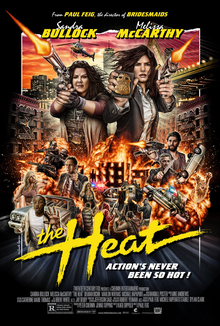
The Heat pairs Sandra Bullock's Sarah Ashburn, an arrogant FBI investigator, with Melissa McCarthy's Shannon Mullins, a Boston detective who relies on instinct and is short-tempered. Paul Feig directs Katie Dippold's 2013 comedy, in which the hunt for a drug lord forces two loners into a partnership. Dippold found the friction between these women in a friendship of her own. She told Interview that a comedian friend had surprised her by speaking bluntly where a new acquaintance might usually offer polite reassurance. That friend could agree with an uncomfortable feeling or tell Dippold she was behaving badly. Mullins's persistent jabs at Ashburn grew partly from that experience of getting to know someone without the usual careful small talk. Dippold wrote the screenplay on nights and weekends, without a commission. Fear that another version of the idea might appear before she finished pushed her to work faster. Selling it did not end her involvement: she said she handled the rewrites and spent three months in Boston, attending the shoot each day. Feig welcomed a continuing supply of alternative jokes. Dippold would watch a scene from her chair and hand him a written suggestion when something occurred to her.
Feig's account of joining the film describes a much shorter interval between reading and shooting than that long writing process might suggest. Speaking to The Credits, he recalled receiving Dippold's script while developing other projects and immediately wanting to make it. Bullock was already interested, and reading Mullins made him think of McCarthy. Her availability imposed a sharp deadline: she had six weeks in which to shoot before returning to her television series. Production began eight weeks after Feig first read the screenplay. McCarthy finished another film, flew in that night and started work the following day. Once her television commitments resumed, she returned on weekends for more filming. Those weekend visits matter to the timetable: the six-week window was her initial availability, rather than a description of the entire production. Feig welcomed the speed, saying that a strong script and contributions from good collaborators helped make the compressed process possible.
The action-comedy form was there before the cast began adding jokes. Dippold told HeyUGuys that she had grown up enjoying Running Scared, Lethal Weapon and 48 Hrs., and wanted women to have that kind of street-level case to solve. She distinguished this from Feds, a film she also liked, whose women were still at the training academy. Her first draft took place in New York, a city she knew. Moving the story to Boston required a substantial rewrite, and she felt that the new setting suited Mullins. The family scenes gained another connection to the city through performers from Boston, whose familiarity with its speech helped a writer who had not grown up there. On set, the screenplay remained a starting point: Feig would get the scripted material before allowing the actors to try alternatives. Dippold singled out the leads' competition over getting through a doorway as something they created themselves. Even a small entrance could become another contest between two people unwilling to give way.
Feig wanted the friendship to remain the main personal story. In his interview with William Bibbiani, he explained that Ashburn's flirtation with Levy was always secondary; it offered Mullins a chance to push her colleague towards a life outside work. Mullins's clothes developed through McCarthy's ideas about female rappers of the 1980s, combined with a reference photograph of Patti Smith's wild hair. Costume designer Catherine Marie Thomas proposed the vest McCarthy liked. Feig watched wardrobe photographs for changes in her posture and playfulness as she found the character. The drunken dance took a less prescribed route. It was absent from the script, and the performers agreed to do it without choreography. Bullock supplied the idea of reviving a dance from high school and teaching it to Mullins. Feig wanted an imperfect drunken lesson. He also described Ashburn's disastrous fictional tracheotomy attempt as a turning point in her failing confidence, rather than expertise. Written screening responses objected to the gag, while recordings captured laughter. He kept the moment as an example of her insistence on knowing what to do finally going too far.
Ashburn's promotion prospects send her to Boston. She and Mullins bug a nightclub manager's phone while DEA investigators Craig and Adam pursue the same drug lord, Larkin. Surveillance implicates Jason, Mullins's brother, whom she previously arrested. His information leads them to a paint factory and Larkin's lieutenant Julian. Over drinks, Ashburn reveals her childhood in foster care; next morning, her car explodes after she has given it away. Julian escapes, threatening Mullins's family. Jason's shipment tip proves false, and Larkin shoots him for informing. The partners quarrel, reconcile and enter a warehouse, where Julian captures them and wounds Ashburn. Craig and Adam arrive, but hearing Jason survived makes Adam shoot Craig and reveal himself as Larkin. He orders Julian to kill the women and heads for Jason's hospital. They overcome Julian and follow. Larkin disarms Mullins at Jason's bedside, but Ashburn shoots him. She asks to remain in Boston. Jason recovers, and the family cheers at Mullins's commendation. Mullins leaves Ashburn a yearbook message offering her a sister, making their new connection explicit after the case is over.