
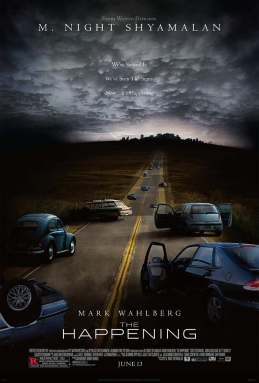
Behind the film
- Year
- 2008
- Director
- M. Night Shyamalan
- Writers
- M. Night Shyamalan
- Genres
- Thriller, Science fiction, Drama, Comedy horror
- Production
- Spyglass Media Group, Blinding Edge Pictures, UTV Motion Pictures
- Country
- United States
- Cast
- Mark Wahlberg, Zooey Deschanel, John Leguizamo, Betty Buckley, Spencer Breslin, Alan Ruck, Ashlyn Sanchez, Cyrille Thouvenin
About the film
Contains story spoilers, including the ending.
The Happening begins with a disaster that turns people against their own survival instinct. An invisible toxin enters the air, and ordinary public spaces become places of sudden death. M. Night Shyamalan places a family on the road through this environmental crisis, making escape the immediate task before anyone can establish a reliable explanation. Mark Wahlberg plays the man trying to get his family out of danger. The threat reaches into Philadelphia, and leaving the city appears to offer a chance of safety. Yet the danger belongs to the environment itself, so travelling away from one affected place cannot promise a secure destination. The film’s horror comes from that basic uncertainty: the people running for their lives must keep breathing the same air that may be killing everyone around them.
Elliot Moore is a Philadelphia science teacher travelling with his wife Alma, his colleague Julian and Julian’s daughter Jess. Their train stops after losing contact with the outside world. Julian goes to look for his wife and leaves Jess with the Moores, turning their escape into the care of a child whose father will not return. A nursery owner suggests that plants are releasing a defensive toxin. Elliot begins dividing the survivors into smaller groups after a larger gathering is affected. His scientific reasoning becomes a series of urgent decisions made without the time or equipment for a proper investigation.
The apparent safety of isolation also fails. At the secluded home of Mrs. Jones, Elliot, Alma and Jess encounter someone deeply suspicious of strangers. Jones is affected while alone, undermining Elliot’s belief that only groups are vulnerable. The three survivors finally step outside together and find that the outbreak has stopped. Three months later, they have formed a household with Jess, and Alma discovers that she is pregnant. Their domestic future opens again, but the film closes with another outbreak in Paris. Survival has given this family another chance while leaving the larger danger unresolved.
Elliot’s profession matters because the crisis challenges the habit of assuming that an explanation will arrive in time to help. In a conversation with Scientific American, Shyamalan linked the film to the limits of the categories people use to understand nature. Elliot can observe patterns and change his behaviour, but he cannot turn those observations into mastery of the event. Julian’s last mathematics lesson gives that problem a quieter counterpart. Facing death, he returns to teaching the story of rice grains doubling across a chessboard. Knowledge remains something he wants to share even when it cannot save him. Shyamalan also described the return to normal life after the disaster as a willingness to accept a comfortable explanation and move on. That intention leaves the ending uneasy: the immediate emergency can pass without humanity changing the relationship with nature that the film asks it to reconsider.
Shyamalan developed the premise through an interest in science that went back to growing up in a family connected with medicine. He told ABC News that he first imagined the story, then asked a research assistant to investigate whether the environment could possess the kind of defensive capacity he had invented. The assistant returned with research papers, and James Lovelock’s ideas became an influence. That route into the material helps explain why the central character is a biology teacher rather than a soldier or an investigator hunting a criminal. Elliot responds to a biological threat by thinking about how living systems might react to pressure. The film takes those interests into speculative horror. Its lethal airborne plant defence belongs to the fiction, where scientific curiosity supplies a way to frame the nightmare and a desperate means of navigating it.
The countryside’s ordinary appearance required carefully built effects. Production notes describe Steve Cremin’s crew using large mobile fans, some over twenty feet across and driven by race-car engines, to give the wind different strengths. Ed Hirsh added digital enhancements, while sound mixer Tod Maitland recorded wind moving through trees, grass and windows. Those details let a familiar breeze become a warning without giving the threat a visible body. Jeannine Oppewall’s design for Mrs. Jones’s home worked in the opposite direction, removing signs of modern life from an old farmhouse. Power lines were buried, porches built and shutters aged; a garden and animals made its isolation practical. The refuge therefore looks capable of existing apart from the world that is collapsing. Wind and sound can still reach it. Shyamalan’s wish for a clean, naturalistic thriller keeps that tension tied to recognisable places rather than a landscape already announcing itself as monstrous. James Newton Howard approached the score through ideas discussed with Shyamalan before the finished film existed. Their conversations included a steadily rising musical pressure and unsettling percussion, with a cello theme for humanity’s struggle. The cello carries the human struggle while natural sounds bring the danger close.