
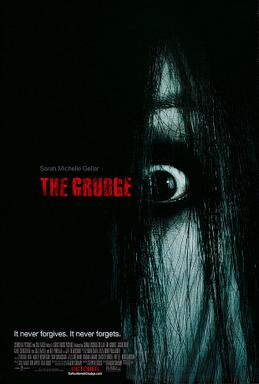
Behind the film
- Year
- 2004
- Director
- Takashi Shimizu
- Writers
- Stephen Susco, Takashi Shimizu
- Genres
- Horror, Monster, Action, Ghost
- Production
- Ghost House Pictures, Columbia Pictures
- Country
- United States, Japan
- Cast
- Sarah Michelle Gellar, Clea DuVall, KaDee Strickland, Grace Zabriskie, William Mapother, Jason Behr, Bill Pullman, Ted Raimi
About the film
Contains story spoilers.
The Saeki family's deaths leave their Tokyo house haunted. Kayako's husband Takeo kills her and their son Toshio after discovering her fixation on Peter Kirk; Kayako's ghost then kills Takeo. Peter finds the aftermath and later dies. The Williams family moves in, and the curse claims Matt and Jennifer while pursuing Matt's sister Susan beyond the house. Replacing missing care worker Yoko, Karen finds Toshio and witnesses Kayako killing Emma Williams. Karen investigates with Detective Nakagawa, whose attempt to burn the house fails. Returning to rescue Doug, Karen sees Kayako descend the stairs and kill him. She starts a fire and survives, but learns that the house remains standing. Beside Doug's body, she discovers that Kayako still haunts her. These events unfold out of chronological order.
Screenwriter Stephen Susco recalled beginning development in early 2002 with Roy Lee and Shintaro Shimosawa. The project was initially independent, and Susco intended to direct it himself. Joining Sam Raimi and Senator did not immediately change that arrangement. By the third quarter of 2003, the script was complete and money had been raised to shoot, so the producers approached studios about distribution. Columbia's relationship with Raimi helped bring it into the project, which moved towards a studio production. Susco's original directing intention belongs to that development history; Takashi Shimizu directed the finished film. Shimizu described working with an American screenwriter as a way to refresh the story while keeping its basic premise. He welcomed unfamiliar horror ideas reaching American audiences, but warned that repeatedly remaking successful films could eventually exhaust those ideas too.
The screenplay developed through translation in both directions. Susco told the Horror Writers Association that every outline and script went into Japanese for Shimizu and producer Taka Ichise, whose notes came back in English. Meetings in person helped speed up the exchange. The adaptation drew together elements from Shimizu's earlier films and new material, with many unused ideas removed across successive drafts. The intended rating also changed. Susco said the production first aimed for an R, before Columbia and Sony's distribution involvement brought a preference for PG-13 and its larger potential audience. Earning that rating required cuts. His account ties those concessions to the distributor's marketing investment, rather than suggesting the film had always been conceived within the same rating limits.
Sarah Michelle Gellar described Karen as a combination of several characters from the original film, including a nurse. She understood the production as a Japanese film made in English, with the Japanese location and crew essential to its identity. The house itself was built from start to finish on a soundstage. Gellar recalled a complete two-floor set with working rooms, rather than a real house borrowed for filming. Her experience of finding her way around Japan also helped her understand Karen's uncertainty. She distinguished her own enjoyment of the trip from the character's greater distress. Communication with Shimizu required attention beyond ordinary conversation: without a shared language, she found their exchanges unusually concentrated and came to recognise his intuitive understanding of her.
Shimizu's ghost rules came from combining stories he had read as a child, rather than following one fixed legend. In Todd Gilchrist's interview, he described selecting elements that sounded or looked right to create his own ghost world. The familiar ghost noise was his own voice. Performance timing mattered just as much to him. Some actors thought he held a moment too long, but he asked them to trust the mood he wanted to sustain. Returning performers faced changes too: the security guard actor and KaDee Strickland each had to learn some of the other's language for their scene. The locations differed from those in the original. Shimizu also said the DVD would keep the same ending, while expressing his wish to restore material removed for PG-13. That was his stated plan for a later version, separate from the released story's continuing curse.
The shower scare began with a specific vulnerability. Shimizu told Staci Layne Wilson that people are more easily frightened when they cannot defend themselves, which suggested the extra hand appearing while someone washes their hair. He linked that idea to his longstanding interest in discovering what would frighten people or make them laugh. His explanation of the wider ghost cycle was equally direct: victims become ghosts and repeat the process. Working with American actors added a scheduling constraint. Shimizu said their daily working-hour limits differed from his experience in Japan, making timing the actors' and crew's work difficult. That practical adjustment accompanied the effort to keep the pauses and scares he wanted.
Raimi described his producing responsibility as protecting Shimizu's vision. He rejected the suggestion that he was acting as a mentor. The success of Spider-Man had given him and Robert Tapert the means to establish Ghost House and a stronger relationship with Columbia, which he believed helped him defend the director's choices. He compared this with producing John Woo's first American film, when he felt less able to offer that protection. Raimi also saw renewed influence from filmmakers overseas in American horror. What interested him in Shimizu was a personal, creeping fear: the director's own sense of a nightmare, communicated through the film.