
Behind the film
- Year
- 1985
- Director
- Richard Donner
- Writers
- Chris Columbus, Steven Spielberg
- Genres
- Adventure, Comedy, Children's, Treasure hunt
- Production
- Amblin Entertainment
- Country
- United States
- Cast
- Sean Astin, Josh Brolin, Jeff Cohen, Corey Feldman, Kerri Green, Martha Plimpton, Ke Huy Quan, Anne Ramsey
About the film
Contains story spoilers.
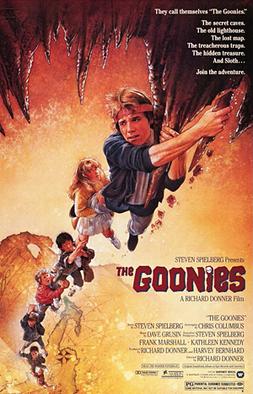
Mikey Walsh and his friends are spending what may be their last weekend together in the Goondocks, an Astoria neighborhood threatened by the expansion of a country club. An old map and a doubloon in the Walsh attic suggest that the legendary pirate One-Eyed Willy left a fortune nearby. Mikey sees the hunt as a chance to prevent the families from losing their homes. He, Mouth, Data and Chunk get past Mikey's protective older brother Brand and follow the clues to a derelict coastal restaurant. Brand catches up with them, accompanied by Andy and Stef, but the building is occupied by the Fratellis, a family of criminals. A passage in the basement sends most of the children underground. Chunk, separated from the others, tries to get help and instead falls into the Fratellis' hands. After interrogation, he is left with Sloth, the brother whom the family keeps confined. The two become allies while the criminals follow the treasure hunters into the tunnels.
The underground journey gives the children a succession of problems that require more than simply following the map. They find the remains of an earlier explorer, Chester Copperpot, and move through traps that have protected Willy's hiding place. An encounter at a wishing well offers a possible return to the surface, but the group continues. Andy has to interpret a musical clue at an organ whose wrong notes threaten the floor beneath them. Beyond the tunnels they finally reach the Inferno, Willy's ship, and discover the riches they have been seeking. The Fratellis catch them and confiscate their haul, then force them toward the plank. Chunk and Sloth arrive in time to intervene. The escape becomes a scramble as traps and dynamite bring down the cavern, with Sloth lifting a boulder from the route out. On the beach, the children are reunited with their parents and the criminals are arrested. Rosalita discovers jewels still hidden in Mikey's marble bag, giving his father the means to reject the foreclosure papers. The freed Inferno sails out to sea.
The adventure's geography combines recognizable Oregon streets and coastline with a much larger world built in California. Donner chose Astoria after travelling up the West Coast, and the production made the Uppertown neighborhood the children's home ground. The Walsh house on 38th Street, the old Clatsop County Jail, the Flavel House Museum and the Lower Columbia Bowl all contributed locations. Work began in October 1984, with the company occupying an entire local motel for a month. Cannon Beach supplied the next stage of the journey: a replica restaurant was built at Ecola State Park, and Haystack Rock appears among the coastal settings. After the Oregon filming ended in November, production moved to the Burbank soundstage containing the pirate ship. The beach reunion was filmed at Bodega Bay. That succession of places takes the children from a lived-in town to open coastal landmarks, then to the constructed cavern and finally back outside. The ship and its hiding place could therefore be designed around the adventure's requirements while the opening established an identifiable home worth saving.
Building the Inferno at full size did not remove the need for visual effects. ILM's crew recalls that the practical ship and water-filled cavern occupied Stage 16 at Burbank, reducing the amount of work required from the miniature ship already under construction. Michael McAlister was asked to help light the enormous set and approached it by scaling up the principles he used for miniatures. Matte artists Frank Ordaz and Caroleen Green extended the ship's masts and sails beyond the stage's physical limits. The extensions were static paintings, so the brevity of those shots helped sustain the illusion of light, moving sails. A quieter effect occurs when Mikey aligns the doubloon with the coastal landmarks. The apparently straightforward view combines blue-screen elements, background photography and painted scenery; its change of focus was especially difficult with optical compositing. The organ chamber also joins practical action to an invented depth below the children, using five paintings and a large miniature containing rocks, water and fog. These methods serve quite different moments: the scale of a discovery, the reading of a clue and the immediate danger beneath the group's feet.
Dave Grusin's score supplies another way of connecting the adventure's changing spaces and moods. A detailed Film Score Monthly study identifies separate musical ideas for the children, Data, Willy and the treasure, alongside the opening Fratelli chase. The Goonies' reflective melody gives the group a more wistful sound than the chase's comic bustle. Data's recurring figure accompanies his mechanical ingenuity, while Willy's descending idea returns through the map and cave sequences, keeping the absent pirate present in the music. The treasure melody first appears at the wishing well and receives a fuller brass statement near the end. The score also makes room for film references: Sloth's rescue draws on Max Steiner's music for The Adventures of Don Juan, and his Superman shirt is accompanied by John Williams' Superman theme. The study traces the change to a swashbuckling sound when the Fratellis interrupt the treasure gathering and the return of warmer music when Chunk invites Sloth home. Rather than treating every passage as the same kind of chase, the music distinguishes pursuit, invention, attraction, discovery and reunion. Its recurring ideas carry those distinctions across the film's traps and reversals.