
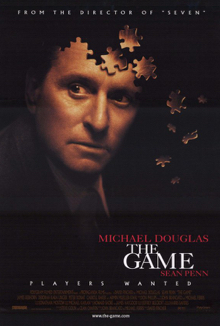
Behind the film
- Year
- 1997
- Director
- David Fincher
- Writers
- John Brancato, Michael Ferris
- Genres
- Neo-noir, Film noir, Mystery, Drama
- Production
- Universal Pictures, Propaganda Films, PolyGram Filmed Entertainment
- Country
- United States
- Cast
- Michael Douglas, Sean Penn, Deborah Kara Unger, James Rebhorn, Armin Mueller-Stahl, Carroll Baker, Michael Massee, Tommy Flanagan
About the film
Contains story spoilers, including the ending.
The Game gives Michael Douglas’s Nicholas Van Orton a birthday present that attacks the security of his ordinary life. Nicholas is a wealthy San Francisco investment banker, divorced, reaching the age at which his father died by suicide. His brother Conrad, played by Sean Penn, offers him entry into Consumer Recreation Services. The company promises an experience tailored to its participant, supplying whatever his life is missing. James Rebhorn plays Jim Feingold, the representative who introduces Nicholas to that proposition. David Fincher’s 1997 thriller then follows the banker as the service moves beyond an appointment and begins interfering with his world. Apparently playful incidents become threats to his money, reputation and physical safety. Conrad’s invitation has put Nicholas in contact with an organisation whose limits he cannot establish. His usual resources become less useful as he starts to suspect that the entertainment conceals an operation directed against him.
Nicholas undergoes examinations at the company, then receives the irritating news that his application has been rejected. Nevertheless, a wooden clown appears in his driveway and a television newsreader begins addressing him personally. A waitress named Christine enters the succession of encounters, helping a sick man before she and Nicholas find themselves pursued through the city. Conrad also returns in a panic, accusing the company of attacking him. The incidents become physically dangerous when a taxi carries Nicholas into San Francisco Bay. Later, Christine tells him that the examinations have allowed the company to reach his bank accounts. Reassurance from his lawyer does little good: she has drugged him, and he wakes in a Mexican cemetery. Returning home requires selling his watch, and San Francisco offers further evidence of apparent ruin. He retrieves a hidden gun and recognises Feingold in a television advertisement. Realising that the employee is an actor gives him someone to confront, but it does not yet reveal how much else has been performed.
The confrontation eventually drives Nicholas and Christine onto a roof. She tells him the danger has been staged and that his family and friends are waiting to celebrate, but he no longer believes an assurance from her. When the door opens, he fires at Conrad, who is carrying champagne. Believing he has killed his brother, Nicholas jumps from the building, repeating the action that has haunted his memory of his father. He crashes through the glass below and lands on an enormous air cushion. Conrad is alive, and the gathered guests reveal the birthday celebration underneath the elaborate ordeal. The people who had populated Nicholas’s nightmare are present as participants in the performance. Afterward, he follows Christine outside and discovers that her real name is Claire. She is leaving for another assignment, and their conversation ends with an invitation to coffee at the airport. The final exchange lets Nicholas approach someone without the authority his position usually supplies, after a game designed to strip that authority away.
Fincher described the film as a drama of inner conflict in an interview conducted in Tokyo around its release. The events unfold outside Nicholas, but their force depends on what they uncover within him. His difficulty in distinguishing a game from reality also asks the audience to reconsider the rules by which it interprets a film. Fincher wanted the story to work visually while withholding facts that a more explanatory version of the screenplay had supplied. He brought Andrew Kevin Walker into the revisions partly to remove explanatory dialogue and change the tone. The earlier conception of Nicholas was too comfortable and pleasure-loving to make his eventual desperation convincing to the director. Tightening the character’s emotional life gave the outward conspiracy something to work against. This explains the importance of a central figure who begins with money and influence but little ease with other people. Each apparent disclosure arrives through circumstances he has to interpret, with no dependable account of the organisation’s purpose available to settle what he is seeing.
Harris Savides photographed the film, and the locations and sets give Nicholas’s loss of control a concrete setting. Much of the shoot took place in San Francisco and Mexicali, with additional stage work in Los Angeles. The brothers’ lunch was filmed at the City Club in San Francisco. To accommodate Fincher’s preferred wide lens while keeping them close together, the filmmakers replaced the normal table with a smaller one. The company’s offices were constructed inside an actual city office space, with soft overhead light giving them a modern appearance against the traditional luxury of Nicholas’s home. That home becomes a different environment when ultraviolet paint covers its rooms with graffiti, illuminated by specialised fixtures. Even the cameras were blacked out to reduce their reflections in glass and other surfaces. These practical choices help the film move between recognisable wealth and an environment that seems to have been taken over by someone else. The rooms remain familiar to Nicholas while their appearance and uses cease to belong to him.