
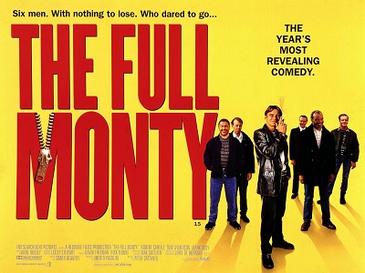
Behind the film
- Year
- 1997
- Director
- Peter Cattaneo
- Writers
- Simon Beaufoy
- Runtime
- 1h 30m
- Genres
- Comedy drama, Comedy, Lgbtq-related
- Production
- Film4 Productions, Searchlight Pictures, Redwave Films
- Country
- United Kingdom, United States
- Cast
- Robert Carlyle, Mark Addy, Tom Wilkinson, William Snape, Steve Huison, Paul Barber, Hugo Speer, Bruce Jones
About the film
Contains story spoilers.
The Full Monty is set in Sheffield after the steel industry has shed much of its workforce. The mill that once gave men like Gaz and Dave a steady identity is now a place to sneak into for scrap. Gaz is divorced, short of money and worried that his former wife will seek sole custody of their son Nathan. Dave is his close friend, but he has withdrawn from his wife Jean and from himself, carrying shame about his body and the fact that he no longer has work. Their problems are specific to their town and circumstances, yet the film keeps its focus on how job loss enters friendships, marriages and the way a person sees himself.
Gaz spots a queue of women waiting to see a Chippendales show and realizes that a local act might earn money quickly. He decides the group should go further by stripping completely, calling the idea the full monty. The plan begins as a hustle to cover overdue child support and improve his chances of seeing Nathan. It is also a way to turn a humiliating situation into something he can choose and control. Gaz’s confidence can look like bravado, but the film shows how much depends on the show working: he has little money, little time and no guarantee that the people he recruits will be willing to perform.
The first men to join bring their own troubles. Lomper, who guards the mill, is at a desperate point when Gaz and Dave encounter him. Gerald, their former foreman, has been unemployed for months but hides the fact from his wife Linda. He has the polish and dance lessons that could help the others, though his authority over his old workers has lost its foundation. Horse is older and has a bad hip, but he can dance. Guy cannot dance at all; the others accept him for a different reason. The group is assembled from people who might never have chosen one another, and rehearsals give them a reason to keep showing up.
The dancing makes the film’s humour physical and communal. Men who feel awkward in their own bodies practice moves in ordinary places, including the dole queue, where a rhythm catches them before they can think too hard about it. Their act asks them to put their bodies on display for money, so the joke also touches the fear behind it. Dave has trouble accepting that he can be wanted when he feels out of shape and unsuccessful. His insecurity strains his marriage, and Jean’s attempts to reach him are as important to his recovery as the friends’ rehearsals.
Gaz’s relationship with Nathan gives the scheme its clearest personal stake. He wants to be a father who can provide, but he cannot pay the support he owes and cannot promise that the show will solve anything. Nathan quietly lends him the deposit needed to book the venue, showing that the boy has more faith in Gaz than Gaz can comfortably ask for. The arrangement complicates the usual parent-child roles: Nathan is still young, yet he is helping to keep his father’s plan alive. When Gaz later gets arrested after an ill-advised rehearsal, the legal consequences threaten the access to his son that motivated him in the first place.
Gerald’s debts catch up with him when bailiffs arrive to seize his belongings. Linda throws him out, and he takes refuge with Gaz. Lomper and Guy form a relationship; Dave takes a security job and initially leaves the group. These shifts keep the troupe from becoming a simple band of comic underdogs. Each man has to decide whether he can accept help, admit fear or risk being seen. Dave’s return comes after Jean encourages him to stop treating his body as proof that he has failed. The group’s solidarity grows through small acts of trust and the shared embarrassment of rehearsal.
The final performance gathers the film’s strands into one public test. The show sells out after the men’s earlier misadventures attract attention, but the audience is not exactly what they expected, and Gaz hesitates at the last moment. Nathan urges him on. Dave also arrives, having found a measure of confidence, and the men step onto the stage together. Their act succeeds because they commit to it, not because the film suddenly makes unemployment disappear. Gaz gets a chance to reconnect with Nathan and stand beside his friends; the larger economic conditions around them remain. The final strip is both a spectacle and a decision to reclaim some control over how others see them.
Sheffield is present in the film through the gap between the men’s former work and what they can find now. The closed mill is not only a setting for comic rehearsals; it is the landmark of a community whose old routine has broken apart. The men have skills and histories, but those do not automatically turn into the wages or respect they need. The stripping act is deliberately precarious and a little ridiculous, which keeps the story grounded in the question of how they might make a living this week. It lets them invent a new kind of teamwork without pretending the lost jobs will return.