
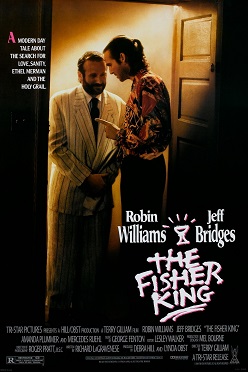
Behind the film
- Year
- 1991
- Director
- Terry Gilliam
- Writers
- Richard LaGravenese
- Genres
- Fantasy, Comedy, Drama
- Production
- Columbia Pictures
- Country
- United States
- Cast
- Robin Williams, Jeff Bridges, Mercedes Ruehl, Amanda Plummer, Michael Jeter, Tom Waits, Christian Clemenson, Dan Futterman
About the film
Contains story spoilers.
Terry Gilliam’s The Fisher King follows Jack Lucas, a disgraced New York radio presenter, and Parry, the homeless man who rescues him. Jeff Bridges plays Jack, while Robin Williams plays Parry, a former professor who has retreated into a world of castles, knights and a quest for the Holy Grail. Parry believes the cup is hidden in a Manhattan mansion. Jack’s girlfriend Anne, played by Mercedes Ruehl, runs the video store where he works after his fall. Jack’s reckless broadcast prompts a listener, Edwin, to commit a restaurant massacre. Parry’s wife is among the victims. Jack learns that Parry is Henry Sagan, traumatised by witnessing her murder. Three years after the massacre, two young men attack Jack after mistaking him for a homeless person, nearly setting him on fire before Parry intervenes. Henry had become catatonic after the killing, then emerged with a new identity.
Jack tries to help Parry approach Lydia, played by Amanda Plummer, hoping that arranging a romance will relieve his own guilt. After dinner with Jack and Anne, Parry walks Lydia home and declares his love. She responds, but the encounter revives his trauma and visions of the Red Knight. The attackers who previously assaulted Jack beat and stab Parry, leaving him catatonic. Jack abandons Anne and plans a career comeback, then changes course and returns to his friend. He enters the architect’s mansion and takes the trophy Parry believes is the Grail. Finding its owner unconscious after a suicide attempt, Jack triggers the alarm to summon help. He brings the cup to Parry, who wakes and says he is ready to miss his wife. Lydia embraces him, and Jack reconciles with Anne. The final scene finds Jack and Parry lying naked in Central Park beneath clouds and fireworks.
Screenwriter Richard LaGravenese began with the idea of a narcissistic man who would eventually perform a selfless act. Several drafts used the same two central characters in different stories before Robert A. Johnson’s book He, which relates the Fisher King myth to male psychology, helped him find Jack’s path. Making Jack a radio presenter gave the story its shape. LaGravenese described Gilliam’s arrival as a chance to restore the stranger material removed during earlier development. He also recalled working through the fireside account of the Fisher King in rehearsal: Gilliam wanted Parry to tell a story, rather than deliver an explanation of the title. That was a writing decision still being worked on during production. LaGravenese said the collaboration also taught him to judge individual scenes as parts of longer sequences, cutting material that disrupted the surrounding tone.
LaGravenese later explained that he had wanted to write about narcissism and sacrifice in response to the cynicism he associated with the 1980s. Jack was initially a cab driver, then an heir to a fortune. Listening to Howard Stern suggested the radio profession that finally connected the character to the story. A draft in which Jack had to find Lydia a husband to receive his inheritance gave way to his guilty attempt to bring her and Parry together. LaGravenese also connected the film’s changing roles to the Grail legend: by the end, Jack becomes the Fool and Parry the wounded King. He described Parry’s quest and love for Lydia as the purposes that kept the character grounded. Williams, he said, respected the screenplay and departed from it only occasionally. Jeff Bridges provided the steadiness that held the central relationship together.
Production designer Mel Bourne helped turn the Armory at Madison Avenue and 94th Street into Parry’s imagined castle, adding stained glass, gargoyles and an entrance built in California. The Grand Central waltz was filmed over two nights, with work ending as the first commuter train arrived. Speaking to Iain Banks in 1991, Gilliam said the dance had not been in LaGravenese’s screenplay. He claimed it as his own addition and described it as an exercise in controlling his filmmaking. He also said returning to New York had made the city feel alive to him again. His aim was to turn it into a fairy tale.
Gilliam later recalled receiving The Fisher King alongside a script for The Addams Family. He was not drawn to the latter, but said he accepted The Fisher King within its first few pages. Taking on a screenplay he had not helped originate meant breaking rules he had set for himself after earlier productions. Casting mattered to that decision. On a flight to meet the studio, he watched The Fabulous Baker Boys and became convinced that Jack should be played by Jeff Bridges. In his conversation with Banks, Gilliam explained that LaGravenese’s script had made him laugh at a time when he felt exhausted by filmmaking. He wanted to discover whether he could direct without the elaborate machinery of his earlier projects, concentrating instead on characters he understood.