
Behind the film
- Year
- 2020
- Director
- Florian Zeller
- Writers
- Christopher Hampton, Florian Zeller
- Runtime
- 1h 37m
- Genres
- Drama, Psychological
- Country
- United Kingdom, France
- Cast
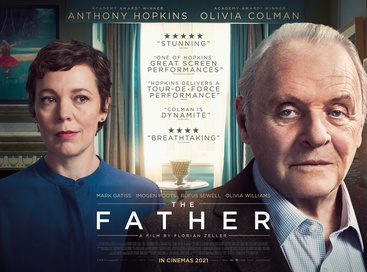
- Anthony Hopkins, Olivia Colman, Mark Gatiss, Imogen Poots, Rufus Sewell, Olivia Williams
About the film
Contains story spoilers.
Anthony lives alone in a London flat and resists the help his daughter Anne tries to arrange. He is sharp and proud, but small disruptions keep taking hold: his watch goes missing, he accuses a carer of stealing it, and he cannot remember where he has put things. Anne says she is moving to Paris with a man she has met, which Anthony dismisses as implausible. She has already watched him turn away several carers and knows she cannot keep visiting every day. Their arguments start from different accounts of the same life: Anthony believes the flat is his and Anne must explain why she is there, while Anne is trying to make a workable care plan before she leaves.
The film stays close to Anthony as the people around him shift. A man named Paul appears in the flat and says he is Anne’s husband and that Anthony is living in their home. Anne returns, but the woman in front of Anthony is not the daughter he remembers. A carer named Laura visits for an interview; Anthony tells her he was a professional dancer and insists he needs no assistance. Her face recalls Lucy, the younger daughter he has not seen for a long time. The changes in actors are not presented as ordinary flashbacks. They make the audience do what Anthony is doing: trying to decide whether this person belongs to the life he thinks he knows.
Anne’s plan to move makes the question of care impossible to postpone. She warns that if Anthony keeps refusing help, she may have to consider a nursing home. He hears this as disloyalty, while she is balancing his safety against a life she cannot keep suspending. Paul grows frustrated by the repeated disruptions to their home, including a cancelled holiday and the strain of responding to Anthony’s accusations. In another version of the confrontation, Paul slaps him. The film offers no outside view to confirm whether this is a new event, an altered memory or a fear taking shape. Each change makes Anthony’s uncertainty practical: he cannot tell what happened, while the people around him must still decide what to do next.
The missing watch gives Anthony a concrete reason to accuse visitors of lying. He treats his own disorientation as evidence that somebody has taken it, even as the rooms stop matching his memory. The flat seems to be his, then Anne’s; furniture and familiar objects move, and the hallway feels different. A doctor’s visit does not settle the questions for him. Lucy’s absence also becomes harder to place: Anthony remembers being proud of her as an artist, but the circumstances of her death surface only as a fragment he cannot explain. The film does not supply a stable chronology that corrects his account, so viewers have to hold the family’s version of events beside what Anthony can recognize.
At one point Anthony walks out of the flat and finds himself in a hospital corridor. The memory of Lucy in a hospital bed, injured and covered in blood, does not become a complete account of what happened. He wakes in a different bedroom, in a care home. A nurse introduces herself as Catherine, played by Olivia Williams, who earlier appeared as an alternate Anne.. Catherine tells him Anne lives in Paris and visits on some weekends. Bill, another worker, resembles one of the men Anthony thought was Anne’s husband. The roles begin to connect with pieces of his present life, but Anthony cannot hold that explanation in place for long.
In the final scene, Anthony asks Catherine who he is and breaks down, saying he wants his mother and that he is losing his leaves, branches, wind and rain. The proud man from the opening has become frightened by the loss of his own bearings. Catherine comforts him and suggests they go to the park. The film then cuts to trees outside rather than explaining what will happen next or assigning a neat timeline to the scenes we have seen. Anne’s move and occasional visits form part of the care-home present, but the ending does not turn her decision into a verdict on her love for her father. It leaves the audience with Anthony’s immediate need for comfort.
Florian Zeller adapted his play with Christopher Hampton and designed the film around a flat that subtly changes as Anthony’s sense of time and place slips. Production designer Peter Francis described a set with a long hallway and doors leading into a shared living room; pictures, lamps and furniture could shift while the basic geography stayed recognizable. The palette changes too: Anthony’s flat uses ochre, Anne’s space dusty blue, and the care home colder blue. Zeller said he wanted the film to feel like losing one’s bearings, with space carrying memory as much as dialogue does. Those choices make ordinary moments—looking for a watch, opening a door, or meeting a carer—part of the mystery. The room offers familiar landmarks, but each return changes their meaning.