
Behind the film
- Year
- 1997
- Director
- Lee Tamahori
- Writers
- David Mamet
- Genres
- Adventure, Action, Drama, Survival
- Country
- United States
- Cast
- Anthony Hopkins, Alec Baldwin, Harold Perrineau, Elle Macpherson, L. Q. Jones, Bart the Bear, Kathleen Wilhoite, Gordon Tootoosis
About the film
Contains story spoilers, including the ending.
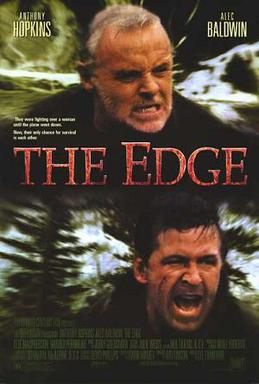
The Edge places a wealthy husband and a possible rival in country where neither money nor social confidence can offer protection. Anthony Hopkins plays Charles Morse, a bookish billionaire married to model Mickey, played by Elle Macpherson. Alec Baldwin is photographer Bob Green, whose interest in Mickey troubles Charles before the journey goes wrong. Lee Tamahori directs the 1997 film from David Mamet's screenplay. The initial trip belongs to the organised world of a fashion shoot, with Charles accompanying his wife to Alaska. Bob's search for an outdoorsman to photograph takes the men farther into the wilderness. A plane crash leaves them struggling to return, and a bear becomes a threat after killing fellow survivor Stephen, played by Harold Perrineau. The setup makes cooperation a necessity between men who already have reasons to distrust each other. Their disagreement now has consequences that cannot be settled within the comforts of the lodge.
Charles's habit of reading supplies practical knowledge once the ordinary arrangements of the trip disappear. The information that made him seem withdrawn in company becomes a means of finding food, making tools and considering a way out. His knowledge also gives Bob something to resent: Charles's wealth no longer matters, but his ability to think through a problem still places him in authority. Before the crash, their conversation had already raised the question of whether anyone could befriend a rich man without wanting something from him. Charles answers Bob's teasing with the suggestion that Bob may be planning to kill him. The accident makes that uncertainty harder to resolve. Bob is a companion Charles needs, but also someone whose intentions he cannot confidently judge. Their survival struggle repeatedly interrupts the rivalry. A man-eating bear demands attention more urgently than an ambiguous remark, and Charles's ingenuity has to become action. He begins the film surrounded by the rewards of success, yet it is his response to physical danger that lets him discover what he can actually do without the arrangements that usually support his life.
The bear kills Stephen after he wounds his leg, leaving Charles and Bob to face it together. They eventually stop trying to evade the animal and fight it with spears. Charles kills it, and their shared meal briefly allows them to celebrate as companions. Finding a cabin then restores the human threat. A receipt confirms Charles's suspicion about Mickey and Bob, and Bob admits his plan to murder him. He takes a rifle and forces Charles outside, but falls into a pit trap before he can shoot. Charles pulls him out and treats his injuries rather than leaving him there. They travel downriver in a canoe, with Bob acknowledging his betrayal and saying Mickey did not know about the murder plan. Rescue finally comes, but Bob dies from his wounds. Back at the lodge, Charles hands Mickey the watch she gave Bob, silently revealing what he knows. To reporters asking about the dead men, he credits them with saving his life. His final account leaves the betrayal private while acknowledging that survival had depended on people who could also hurt him.
Working with Bart the Bear required a different kind of cooperation behind the camera. Hopkins recalled rules against smoking, carrying food or looking the animal in the eye. His account presents Bart as a performer responding to marks and rewards, while Tamahori stressed the strength that remained dangerous even in a gentle, trained animal. The crew built a soft rubber track for chase scenes because Bart was unused to running over rough stones, although that did not immediately solve the difficulty. Tamahori also described keeping an action the bear supplied naturally: slapping at the tree on which Hopkins's character hangs above a ravine. Most of the bear material used Bart, with a small amount of artificial work for safety. Hopkins had a separate physical difficulty, entering production with a ruptured neck disc that affected his right arm and sleep. He said surgery in Calgary relieved the pain after filming had begun. The harsh location work and the animal scenes therefore involved practical limits quite apart from the characters' fictional danger. What appears as an uncontrolled encounter on screen required handlers, physical preparation and decisions about which actions could be filmed safely.
Producer Art Linson's account of developing the project describes Mamet pitching a bookish rich man, his model wife and a photographer who might kill him. Their crash and encounter with a bear supplied the adventure around the betrayal. In Linson's recollection, a studio executive interrupted to question whether audiences would root for someone wealthy. Mamet maintained that they could. The concern goes to the choice of Charles as the survivor at the centre of the film: his privilege is already part of the conflict before his knowledge becomes useful. The screenplay was originally titled Bookworm during its development.