
Behind the film
- Year
- 1991
- Director
- Krzysztof Kieślowski
- Writers
- Krzysztof Kieślowski, Krzysztof Piesiewicz
- Runtime
- 1h 38m
- Genres
- Fantasy, Art, Drama
- Production
- Canal+, Norsk Film, Zespól Filmowy "X"
- Country
- France, Poland, Norway
- Cast
- Irène Jacob, Aleksander Bardini, Claude Duneton, Guillaume de Tonquédec, Philippe Volter, Sandrine Dumas, Jerzy Gudejko, Kalina Jędrusik
About the film
Contains story spoilers.
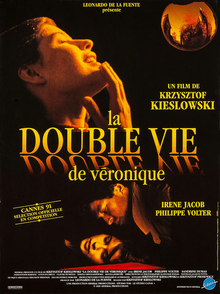
Weronika sees her identical French double in Kraków, then dies while singing a solo. In France, Véronique feels unexplained grief and gives up singing. Their shared music is credited to Van den Budenmayer, a fictitious composer created by Zbigniew Preisner and Kieślowski; Preisner wrote the score. Anonymous packages and a tape lead Véronique to puppeteer Alexandre in Paris. He admits testing whether she would follow his clues. She leaves, but they reconcile and become lovers. Her photograph from Poland reveals Weronika looking towards her on the tourist bus, making her weep. Alexandre makes duplicate puppets and writes about connected women. In the original ending, Véronique touches a tree at her father's gate as he senses her presence inside. The American version continues with him emerging and the pair embracing, seen through a window. Criterion identifies four added shots in the U.S. ending, made by Kieślowski at Harvey Weinstein's urging.
Irène Jacob recalled spending an entire afternoon auditioning, with much of the crew present as Kieślowski worked through the scenes with each candidate. After choosing her, he arranged for her to live with a Polish family for ten days. She could learn Weronika's Polish dialogue while getting used to daily life there. Jacob's account also shows how a small change during filming could alter a scene. Weronika was originally meant to frown when she saw her French double. On set, Kieślowski asked Jacob to try a cautious smile instead. For Jacob, this made Weronika open herself to the mystery rather than resist it. Although the script specified details closely, she remembered room for experiment and suggestions from the people making the film.
In another interview, Jacob described the performance as an attempt to make intuition and private sensations visible. Geoffrey Macnab's account places her casting after Andie MacDowell had agreed to play the two women but left following a contractual mix-up. Jacob remembered Kieślowski giving her improvisations at their first meeting and studying tiny movements, including swallowing, humming and licking her lips. One exercise asked her to pretend that a book about cigars had been written by someone she loved. He also asked her to consider solitude and how she behaved alone, attending to the smallest outward signs of an inner life. Jacob said that these concrete tasks mattered because he would not discuss metaphysics, chance and doubles with her. In her recollection, the poetic possibilities of the story required everyday particulars, such as rain or a patch of light.
Jacob's recollection of rehearsals describes actors discussing movement and feeling with Kieślowski before shooting, sometimes the previous evening or that morning. He wanted a scene to begin with tension rather than routine greetings. Limited film stock meant few takes; he counted the celluloid used at the end of the day. Filming from different angles gave him choices, and Jacob remembered him knowing which part of a take he needed. For the two characters, she proposed gestures drawn from her own habits, such as cooling her cheek against a glass or window when flustered. She described an approach centred on physical behaviour rather than abstract thought. Asked about Véronique's motivation at the original ending, Jacob understood her as trying to connect. That is the actress's interpretation of the final gesture.
Cinematographer Sławomir Idziak described the train scene's glass sphere and reflected landscape as a simple way of suggesting a fairy tale and something unreal. The interview also raises fragmented or duplicated identity as a possible reading of the reflections. His explanation ties that particular optical effect to the film's uncertainty without supplying a literal mechanism for the connection between its two women. Kieślowski told Tony Rayns that financing had not dictated the two-country story. He could imagine the women in Kraków and Gdańsk, although he acknowledged that the finished production reflected its financing. The subject was personally close to him.
Jonathan Romney's account describes a world repeatedly seen through glass and coloured filters. As a child, Weronika sees earth and sky upside down; later, a transparent ball in her hand inverts the landscape, while the train window bends the view outside. Romney notes the yellow-green filtering used by Kieślowski and Idziak and reports the director's explanation that it contrasted with the grey locations of Kraków and Clermont-Ferrand. He also describes the film's construction through editing. Kieślowski and editor Jacques Witta prepared around twenty rough cuts, according to the director's estimate, varying how clearly the narrative could be followed. One gave more space to Véronique's involvement in a friend's divorce hearing; another removed that subplot altogether. These were alternative edits of the film, with different amounts of information about her life, rather than additional events that all belong to the released story. Romney reports that Kieślowski even considered a different version for every cinema. Jacob likewise recalled that the screenplay had seemed clear when she read it, before Kieślowski removed explanation during editing.