
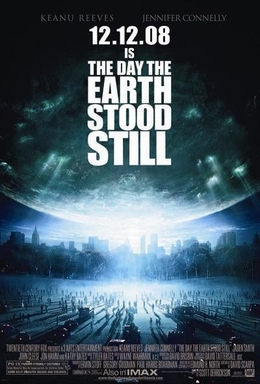
Behind the film
- Year
- 2008
- Director
- Scott Derrickson
- Writers
- David Scarpa, Edmund H. North
- Runtime
- 1h 43m
- Genres
- Science fiction, Disaster, Action
- Production
- 20th Century Studios
- Country
- United States, Canada
- Cast
- Keanu Reeves, Jennifer Connelly, Jaden Smith, Kathy Bates, Jon Hamm, John Cleese, Kyle Chandler, Robert Knepper
About the film
Contains story spoilers.
A prologue set in 1928 shows a mountaineer finding a glowing sphere in the Karakoram. He wakes with a scar on his hand, while the sphere has vanished. Decades later, an object races toward Earth and threatens to destroy all life. The U.S. government assembles scientists, including astrobiologist Helen Benson, to study it. The object slows and lands in Central Park as a vast sphere. A human-shaped visitor approaches Helen, but a soldier fires in the confusion. A gigantic robot emerges in defense. The wounded visitor orders it to stand down, and scientists take him to a laboratory, where they remove the bullet and watch his body transform into the adult Klaatu, played by Keanu Reeves.
Klaatu asks to address the United Nations, but Secretary of Defense Regina Jackson rejects the request and arranges an interrogation. Helen is tasked with studying him. Although asked to drug him, she injects a placebo, giving him time to escape the secure facility. He reconnects with Helen and Jacob, her stepson, and tells them his mission is to save Earth from humanity. Other spheres begin appearing around the planet. Klaatu explains that they carry samples of animal life to preserve it for a possible return after human civilization is gone. He also meets Mr. Wu, another alien who has lived on Earth for years. Wu agrees that people are destructive and reluctant to change, but says he has grown to love them and wants to remain. Klaatu has not yet reached that conclusion; he sees the survival of the biosphere and the survival of humans as opposing outcomes.
Helen takes Klaatu to Professor Barnhardt, hoping the scientist can persuade him that people can change. Barnhardt describes how Klaatu’s own civilization faced extinction and evolved through cooperation. He argues that humanity may also change when forced to confront the edge of survival. While they speak, Jacob calls the authorities, believing his dead Army father would have turned Klaatu in. The call draws the military to the house, and Klaatu escapes with Jacob. At the same time, soldiers examining Gort attempt to understand the machine and trigger its transformation into a swarm of self-replicating nanobots. The small metallic creatures consume manufactured objects and spread beyond the facility. The threat is no longer a warning about what could happen: the process of removing humans and infrastructure from the planet has begun.
The military captures Helen while Klaatu and Jacob escape on foot. Traveling together changes Klaatu’s view of Jacob, who has been angry and difficult since his father’s death. Jacob leads him to his father’s grave and asks him to bring the dead man back. Klaatu says he cannot. Jacob breaks down, and Helen finds him there; despite the boy’s rejection of her, she comforts him and tells him she sees his father in him. This reunion is one of the human actions Klaatu has watched unfold. The Secretary sends Helen to persuade him to stop the destruction, but her effort matters because Klaatu has seen her care for Jacob without any promise of reward. The reunion convinces Klaatu that humanity can still change, and he agrees to try to stop the swarm.
Helen, Jacob and Klaatu travel with Michael Granier toward the Central Park sphere as the swarm grows. During this final effort to reach the sphere, Jacob becomes infected by the nanobots. Klaatu draws them out of the boy, protecting his life while the larger attack continues. The film’s conflict rests on whether that judgment can still change. Barnhardt has offered an argument about transformation at the brink, Mr. Wu has described a long attachment to people despite their destructive habits, and Helen and Jacob have shown Klaatu a bond that persists after loss and betrayal. None of these encounters erase what humans have done. They give Klaatu evidence beyond the military’s violence and Jacob’s call for help, and he decides the species deserves another chance. He walks into the swarm toward the sphere, knowing it will consume his human body before he can reach it.
Klaatu touches the sphere as the nanobots overtake him, and the machine shuts down the swarm. His body is lost in the process, but the sphere releases an energy pulse that disables electronic and mechanical systems around the world before departing. The planet is spared from the immediate destruction, though the blackout leaves people facing the consequences of a world without its usual technology. The ending ties the title’s stillness to a global interruption rather than a peaceful conference: human activity stops, and the survivors must decide what to do with the chance they have been given. Klaatu’s change of mind does not come from a general declaration that people are good. It follows from particular actions by Helen, Jacob and Wu, and the cost of his decision is the human form he used to move among them.