
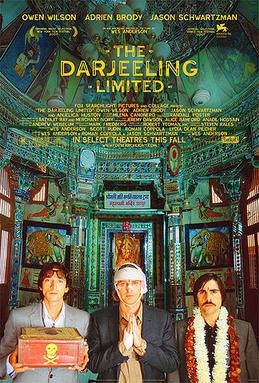
Behind the film
- Year
- 2007
- Director
- Wes Anderson
- Writers
- Wes Anderson, Roman Coppola, Jason Schwartzman
- Runtime
- 1h 31m
- Genres
- Drama, Comedy
- Production
- Searchlight Pictures
- Country
- United States
- Cast
- Owen Wilson, Adrien Brody, Anjelica Huston, Jason Schwartzman, Natalie Portman, Waris Ahluwalia, Irrfan Khan, Barbet Schroeder
About the film
Contains story spoilers.
Francis takes his brothers' passports and imposes an itinerary, hiding his plan to visit their mother, Patricia, now a nun. His controlling behaviour provokes a fight, and the brothers are thrown off the train. They try to rescue three boys from a river; Peter cannot save one, who dies. At the village funeral, they remember their own father's funeral and their failed attempt to collect his car. At the airport they abandon their flight and head to Patricia's convent. Francis admits his motorcycle crash was intentional. After confronting their mother about leaving them, the family reconnects in silence. By morning Patricia has gone again. The brothers leave, discarding their father's luggage to catch the Bengal Lancer. Francis offers back the passports, but Peter and Jack ask him to keep them.
Jason Schwartzman described writing with Wes Anderson and Roman Coppola as a regular, demanding commitment. When they were apart, they held four-hour conference calls each day. Together, they could spend thirteen hours asking questions, exchanging stories and writing scenes. Schwartzman recalled approaching the characters as people whose actions had already happened, then trying to understand their reasons. On the writers' trip through India, he acted Jack's part when they tried out scenes, although he distinguished that exercise from actually becoming the character. Their journey also turned into a location scout. Carrying scripts in their backpacks, they would stop at a temple, work through a scene and consider where cameras and lights might go. A place encountered while travelling could become a place used in the film.
Anderson told Terry Gross that films by Satyajit Ray had inspired his wish to make a movie in India. The production rented a standard train from the government, then turned it into an imaginary railway assembled from his experiences of trains around the world. Production designer Mark Friedberg gave that invention a more specific mixture of references. Indian trains met the Orient Express, contemporary European transit and New York's 20th Century Limited. Rajasthan patterns and Indian Railways colours were combined with modern Art Deco shapes. Art director Adam Stockhausen and graphic artist Mark Pollard helped develop the fabrics, prints and textures. Local painters covered the exterior with hundreds of hand-drawn elephants, working in shifts through the day and night to finish it before filming.
Inside, the train had to accommodate a camera as well as passengers. Cinematographer Robert Yeoman could neither place equipment on the roof nor extend it far from the sides, where trees and telephone poles passed close by. Lights were built into the ceilings, and precut gels fitted the windows to retain detail outside. Sliding walls opened the brothers' sleeper compartment to camera positions. A ceiling track allowed movement along the corridor without a dolly. Yeoman said Anderson generally insisted on filming aboard a moving train, including at night, because he felt its energy could not be simulated; exceptions were rare.
Living arrangements kept Owen Wilson, Adrien Brody and Schwartzman close together away from the carriages too. At the New York Film Festival press conference, Schwartzman described sharing a large house and developing a sense of family. He connected the brothers' roughness with his own experience of siblings who could fight fiercely despite their capacity for affection. Brody recalled competitive badminton games; Schwartzman denied feeling any rivalry, prompting Brody to point out that Schwartzman was the better player. For Amara Karan, making her first film, the moving train and desert surroundings were daunting. Brody said working on an authentic location helped actors connect with their material.
Jack's past has a separate filmed chapter in Hotel Chevalier. Anderson explained that the short began independently, then became linked to the feature while he was writing it. He compared the relationship to a short story and a novel that refer to one another. Schwartzman found it useful to have performed an earlier experience in Jack's life, rather than only imagining it before playing him on the train. Small connections carry that experience forward: the perfume slipped into his luggage in the short becomes the bottle he later smashes, and Jack's reading of a story ending recalls the short's final exchange. During the film's 2007 release, Anderson told Rotten Tomatoes that the short had been added to American prints after initially being offered online.
Another departure from the ordinary carriage is the montage Anderson described as following a train of thought. He acknowledged its connection to the cross-sectioned boat in The Life Aquatic and his hesitation about repeating a visual device. The shot required a specially built set and the return of performers whose work had finished, including Bill Murray and Natalie Portman. Once everyone was back, the production took the train into the desert for an afternoon to film it. Music from Ray and Merchant Ivory films also accompanied the work before it became the soundtrack. Anderson recalled playing a collection of those cues while travelling together, scouting locations and going to the set, so the music was already familiar during filming.