
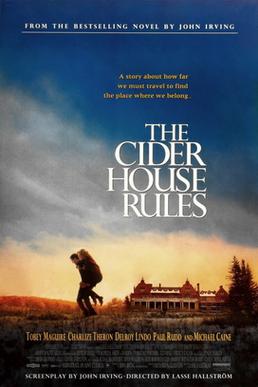
Behind the film
- Year
- 1999
- Director
- Lasse Hallström
- Writers
- John Irving
- Runtime
- 2h 6m
- Genres
- Romance, Drama
- Production
- Miramax, Walt Disney Studios Motion Pictures
- Country
- United States
- Cast
- Tobey Maguire, Michael Caine, Charlize Theron, Paul Rudd, Delroy Lindo, Erykah Badu, Kieran Culkin, Jane Alexander
About the film
Contains story spoilers.
In rural Maine during the Second World War, St. Cloud’s is both a home for children without families and a small medical practice. Dr. Wilbur Larch delivers babies for women who cannot raise them, then offers the newborns a place in the orphanage; he also performs abortions in secret, because the procedure is illegal. Homer Wells has spent nearly all his life there. Two attempts to place him with foster families have ended with him returned, and the institution’s nurses and older boys have become the people he knows as family. Larch, a fatherly presence with an ether habit he hides from the children, teaches Homer practical medicine. Homer becomes capable in childbirth, but will not perform abortions. He believes a child who might otherwise never have been born deserves the chance he received. Larch’s answer is rooted in the women he treats: a dangerous procedure done by an untrained person can kill them. Their disagreement is intimate and practical, not a debate kept at a distance from the patients.
Larch hopes Homer will eventually take charge of St. Cloud’s, but Homer has no formal medical qualification and wants to find out what life beyond its walls feels like. His chance arrives when Candy Kendall and her boyfriend, Wally Worthington, come to the orphanage seeking Larch’s help. They are young, and the visit gives Homer a glimpse of a couple making plans in the ordinary outside world. He decides to leave with them and work at the Worthington family’s apple orchard. The move trades familiar rooms and a carefully managed routine for an unfamiliar landscape: the coast, lobster fishing, a drive-in cinema and seasonal labour among people he has never met. For Homer, these first experiences are not a holiday from his old life; they are a test of whether he can be useful without simply inheriting Larch’s role.
The orchard’s cider house is the bunkhouse for Arthur Rose’s Black migrant apple-picking crew. A list of rules hangs on the wall, though the workers cannot read it and had no say in writing it. Homer reads the notices aloud. Rose’s response gives the title its concrete meaning: rules made by absent owners can miss the conditions of the people expected to obey them. The crew’s work and lodging bring Homer into a community organized around the harvest, while the Worthingtons own the land and set its terms. When Wally returns to military service, Homer and Candy are left together. Her loneliness and his inexperience draw them into a relationship while Wally is overseas. The film lets that choice carry its discomfort: Homer knows he is living inside someone else’s absence, and Candy has not stopped caring about Wally.
Larch remains at St. Cloud’s, managing the orphanage and the pressure to find a successor. He has already concealed the death of Fuzzy Stone, a sick child, by telling the other boys that Fuzzy has been adopted. That lie protects them from grief while repeating the institution’s familiar story that a child’s departure means a new home. At the orchard, the next harvest brings a different secret into view. Homer learns that Rose’s daughter, Rose, is pregnant by her father. Homer’s earlier refusal to perform abortions meets a person facing a danger he cannot answer with a rule. He agrees to help her. In doing so, he does not resolve the moral conflict that shaped his training; he acts in the immediate situation before him, drawing on the medical skill Larch gave him and the principle of care that underlay Larch’s own work.
Rose tries to leave after the abortion. When Arthur comes to say goodbye, she stabs him and runs. Arthur asks Homer and another worker to tell the police that he died by suicide, and the men are left to deal with the request as well as what they know about the family. The film does not make the orchard a simple refuge: its rules, loyalties and dependence on seasonal labour have left people with few safe choices. Wally eventually returns from Burma with a severe war injury that has left him paraplegic. Candy chooses to care for him, ending her relationship with Homer. Around the same time, Homer learns that Larch has died after accidentally taking too much ether. The two losses make the decision he had postponed feel different. The orchard gave him a life and relationships outside St. Cloud’s, but it cannot take the place of the home where his skills and presence are needed.
Homer goes back to the orphanage, where the children and staff welcome him. He then discovers how far Larch went to secure that return: the doctor had falsified Homer’s medical record to keep him out of wartime service and invented college credentials to satisfy the board. Larch had also used reverse psychology, telling trustees Homer was too religious to perform abortions so they would appoint him. Homer’s succession is therefore neither the straightforward fulfilment of a plan nor a clean break from his mentor. He returns with experience of a world that challenged his beliefs, and with a clearer understanding of the women who came to St. Cloud’s and the children still growing up there. At bedtime he speaks Larch’s familiar blessing to the boys. The final exchange passes the orphanage’s care from one man to another while leaving Homer to decide how he will practise what he has learned.