
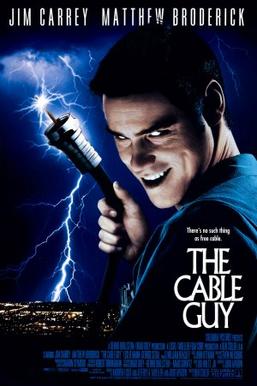
Behind the film
- Year
- 1996
- Director
- Ben Stiller
- Writers
- Judd Apatow, Ben Stiller
- Runtime
- 1h 36m
- Genres
- Comedy, Mystery, Comedy thriller
- Production
- Brillstein Entertainment Partners
- Country
- United States
- Cast
- Jim Carrey, Matthew Broderick, Leslie Mann, Jack Black, George Segal, Diane Baker, Ben Stiller, Eric Roberts
About the film
Contains story spoilers.
Steven Kovacs moves into a new apartment after his girlfriend Robin turns down his marriage proposal. The move is meant to give them space, and Steven expects the usual practical business of settling in: furniture, a working television and cable service. His friend Rick suggests offering the installer extra money for movie channels. The technician who arrives calls himself Chip Douglas, and he supplies the channels as a favor, but he also treats the exchange as the start of a much closer relationship. Chip soon turns up socially, and Steven, lonely after the breakup and reluctant to make a scene, goes along with it.
Chip’s idea of friendship is shaped by television, which he says filled the gap left by an absent father and an inattentive mother. He takes Steven to a huge satellite dish that he regards as the source of the programs they watch, and talks excitedly about a future when television, telephones and computers will join together. The visit gives the film a physical image for Chip’s outlook: he sees connection as something that arrives through a system, and treats access to that system as a route into other people’s lives. Steven does not share the same intensity. He accepts some of Chip’s attention because it seems eccentric rather than threatening, and because he hopes to repair things with Robin. Chip also offers Steven an expensive home-theater system, which Steven refuses; the rejection shows that the gifts are not welcome simply because they are generous. The satellite visit and the equipment both make Chip's professional access feel like a shortcut into a friendship Steven has not agreed to.
Their outings expose the gap between those expectations. Chip inserts himself into Steven’s pickup basketball game, where his aggressive version of the rules turns a casual match into a confrontation. At Medieval Times, the staged medieval spectacle becomes a real fight between the two men, complete with the restaurant’s weapons and theatrical setting. Back at Steven’s apartment, Chip arranges a karaoke party and sings Jefferson Airplane’s “Somebody to Love” with show-stopping commitment. The scenes move between comic performance and physical danger, while Steven remains too passive to set a clear boundary. Chip can read popular entertainment as a script for how to behave, but he does not recognise when his companion wants the scene to end. The film keeps cutting to a television trial involving former child star Sam Sweet, played by Stiller, accused of killing his twin brother. That broadcast gives Chip and Steven another shared screen-world to joke about, while its courtroom spectacle runs alongside their increasingly messy real-life conflict.
The party also reveals how far Chip has already crossed that boundary. He has arranged for a woman to sleep with Steven, who discovers she is a prostitute hired by his new friend. Steven throws Chip out. Chip responds by attacking Ray, the man Robin has been dating, and then upgrades her cable service as a supposed gift from Steven. Robin and Steven begin seeing each other again, but the reunion is built on Chip’s interference rather than a change in their relationship. When Steven learns what happened, he tries to end the friendship politely. Chip hears the rejection as betrayal and announces that he can be Steven’s best friend or his worst enemy.
Chip’s retaliation turns the increasingly intimate friendship into a campaign against Steven’s independence. He arranges for Steven to be arrested over a stolen item, then attends a family gathering where he steers the conversation into a sexually explicit version of Password. Steven’s parents and Robin see an eccentric guest at their family gathering, not the calculating threat he believes Chip to be. Meanwhile, Chip arranges for a recording of Steven insulting his boss to circulate through the company’s computer system, costing him his job. Rick looks into Chip’s story and discovers that his name is an alias; he had been fired by the cable company, and his identities come from television shows. Steven tries to explain what Chip has done, but his own impulsive behavior and Chip’s carefully performed friendliness make the people around him reluctant to believe the accusation.
The conflict converges at the satellite dish after Chip tells Steven he is going to Robin’s apartment. Steven finds her gone and traces her to the dish, where Chip has taken her hostage. Steven frees Robin as police close in, but Chip climbs higher on the structure. He speaks about having to “kill the babysitter,” blaming television for raising him, and throws himself into the dish, cutting the cable signal across the city. Chip survives and apologizes to Steven while paramedics carry him away. Steven and Robin are left together, while the final exchange with a paramedic suggests Chip is already seeking another friend. Ben Stiller’s film uses familiar television and movie forms as part of the action: Chip borrows them to perform intimacy and menace, and the story’s violent showdown makes those borrowed roles collide with the ordinary people around him.