
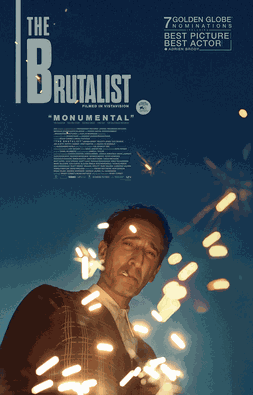
Behind the film
- Year
- 2024
- Director
- Brady Corbet
- Writers
- Mona Fastvold, Brady Corbet
- Runtime
- 3h 35m
- Genres
- Drama, Historical
- Production
- Brookstreet Pictures
- Country
- United States, United Kingdom
- Cast
- Adrien Brody, Felicity Jones, Guy Pearce, Joe Alwyn, Raffey Cassidy, Ariane Labed, Stacy Martin, Emma Laird
About the film
Contains story spoilers.
Hungarian architect László Tóth arrives in America after surviving the Holocaust, emerging from the crowded darkness of a ship to an upside-down view of the Statue of Liberty. His cousin Attila offers work and shelter at his Philadelphia furniture business. Attila has adopted the surname Miller and adjusted his life to American expectations; László brings a different training and a past he cannot put aside. He learns that his wife Erzsébet and niece Zsófia survived the war, but neither can join him yet. The shop provides a temporary foothold rather than a return to the profession and family he has lost.
Harry Lee Van Buren commissions the cousins to renovate his father Harrison’s library as a surprise. László transforms the room with movable shelving, light and spare furniture, but Harrison returns to find work being done without his consent and reacts furiously. The job goes unpaid, and László eventually loses his place with Attila as well. He meets Gordon, another struggling worker, and lives in charitable accommodation. Harrison later discovers the architect’s reputation and the library’s success in the architectural press. He pays what is owed and offers something much larger: a community institute dedicated to his late mother, containing a library, auditorium, gymnasium and chapel.
The institute gives László a chance to build on his own terms, although its money comes from a man who can withdraw it. He fights consultants over costs and the proportions of the design while Harrison’s lawyer helps bring Erzsébet and Zsófia to America. Erzsébet uses a wheelchair because of osteoporosis, and Zsófia has stopped speaking. Their reunion cannot undo years of separation or make the Van Burens’ hospitality comfortable. Harry treats the family with contempt, and László’s dependence on Harrison extends into his home. When a train carrying materials derails, Harrison suspends the project, leaving the architect’s labour and ambitions stranded.
Years later, László and Erzsébet are working in New York, while Zsófia prepares to move to Jerusalem with her husband and their expected child. Harrison revives the institute, drawing László back into the commission. A trip to Carrara to choose marble ends in Harrison sexually assaulting him. The patron’s power is no longer confined to payments or instructions about the building. Back in America, László gives Erzsébet heroin to relieve her pain and nearly kills her. During her recovery she proposes that they leave for Jerusalem. She then confronts Harrison in front of his family, accusing him of rape; Harry forces her out, and Harrison subsequently disappears.
The final movement jumps to the 1980 Venice Architecture Biennale. László, elderly and using a wheelchair, attends a retrospective, while Erzsébet has died. Zsófia explains the relationship between the institute, eventually completed in 1973, and the camps where the couple were imprisoned. Its dimensions reproduce confinement but change the experience of it, allowing light and height where their prison spaces denied both. The revelation gives the building a history Harrison could never fully possess. It also leaves a difficult distance between the finished work and the damaged lives behind it: the public monument survives, while the people who paid for it in other ways cannot be restored.
The film’s changing spaces make the struggle concrete. A furniture-shop storeroom, temporary housing and the Van Buren estate offer very different kinds of shelter, each dependent on somebody else’s permission. László can argue over a ceiling or a material more directly than he can secure his own place in America. Cinematographer Lol Crawley describes moving between formal compositions and a more physically involved camera. The opening travels up through the ship with László, turning arrival into an awkward ascent rather than a polished view of a landmark. Close, moving images keep the architect’s bodily experience present alongside the much larger scale of his commission.
Crawley and Brady Corbet initially considered VistaVision for the marble quarries and other expansive locations, then used it for much of the film, including interiors and close-ups. The format carries 35mm film horizontally through the camera, producing a larger negative than conventional vertical 35mm photography. Its association with the 1950s also suited the period they were depicting. Crawley deliberately resisted an excessively pristine image, using textured film stocks and push-processing, including for some daylight scenes. The resulting grain matters alongside the resolution: stone, clothing and faces belong to an imperfect, inhabited past. Smaller cameras served other purposes, including handheld scenes, while a modified camera created streaking light for particular intimate and nightclub passages.
Erzsébet’s accusation required a different kind of coordination. The confrontation plays through a long take whose apparent movement changes as the gathering collapses into disorder. In Kodak’s account, Crawley explains that Steadicam operator Attila Pfeffer remained on the rig throughout, but altered his handling to suggest a shift toward handheld movement before returning to a floating quality. That distinction matters: the effect comes from the operator’s performance rather than a literal exchange of cameras. Blocking and concealed lighting allowed the scene to unfold around him. Corbet’s preference for limited coverage put the burden on the movement within the take, letting a controlled social occasion break apart without rebuilding each confrontation from separate reaction shots.