
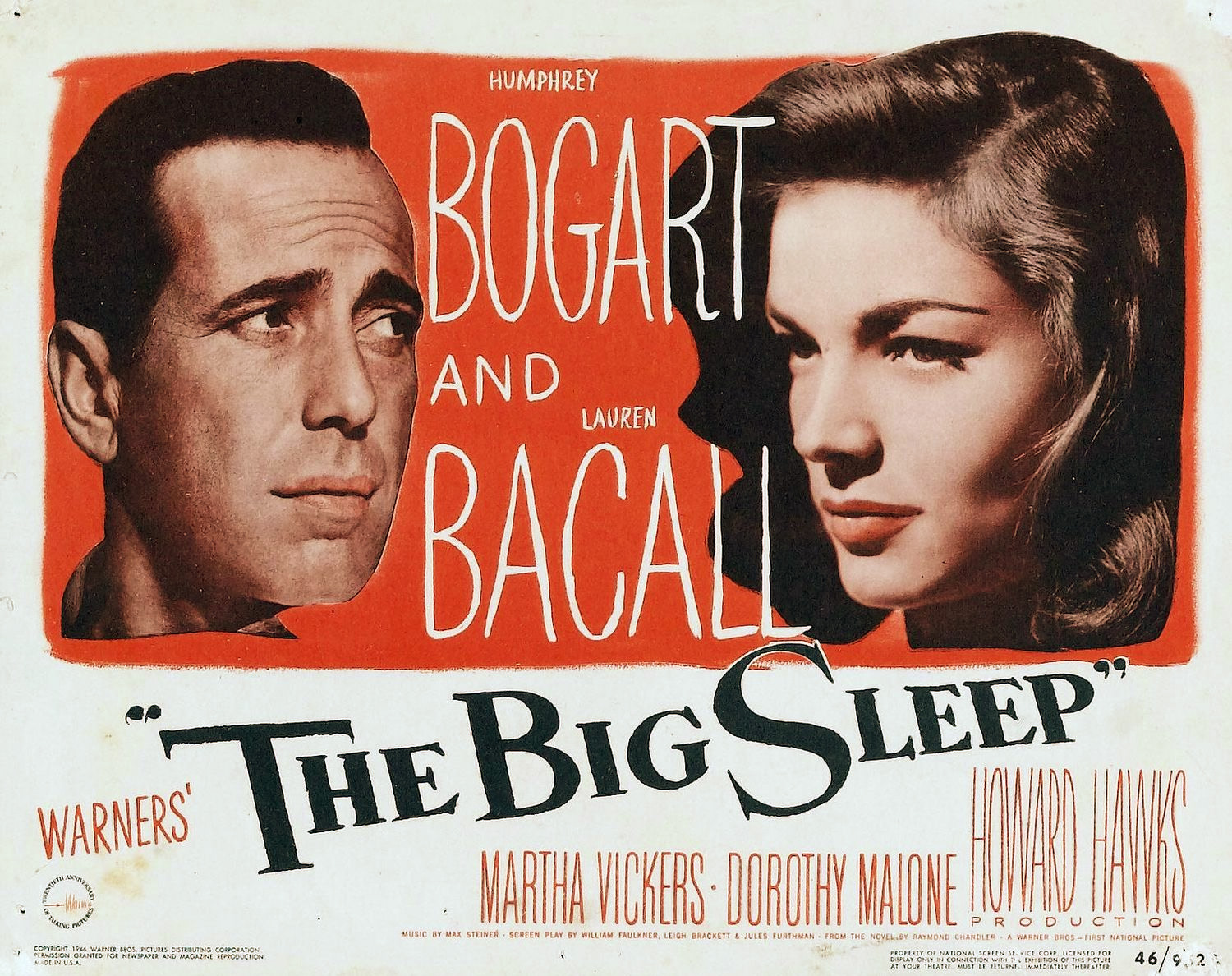
Behind the film
- Year
- 1946
- Director
- Howard Hawks
- Writers
- William Faulkner, Leigh Brackett, Jules Furthman, Raymond Chandler
- Runtime
- 1h 54m
- Genres
- Crime, Film noir, Drama
- Production
- Warner Bros. Entertainment
- Country
- United States
- Cast
- Humphrey Bogart, Lauren Bacall, Dorothy Malone, Martha Vickers, Regis Toomey, Bob Steele, Elisha Cook Jr., Charles Waldron
About the film
Contains story spoilers.
Philip Marlowe arrives at the mansion of General Sternwood, a wealthy, dying invalid whose two daughters have left him with problems he cannot manage. The younger, Carmen, is impulsive and flirtatious; the older, Vivian Rutledge, is guarded and recently divorced. Sternwood says a rare-book dealer named Arthur Geiger is demanding money over Carmen's gambling debts. He also mentions an earlier blackmail attempt by Joe Brody, which his former employee Sean Regan handled before disappearing. Marlowe agrees to investigate Geiger, though Vivian assumes the real assignment concerns Regan. The family's two troubles are entangled from the beginning: Carmen's behavior is exposing the household to blackmail, while Regan's absence has become a subject Vivian wants kept out of the open. Marlowe's manner is direct, but the people around him answer selectively. His job is not simply to identify a criminal; it is to work out which secret each person is protecting and how much danger the Sternwoods have brought into their own home.
Marlowe visits Geiger's shop and suspects the rare-book business is a front. He watches Geiger leave, follows him home, then hears a scream and gunshots from inside. He finds Geiger dead and Carmen drugged, with a hidden camera missing its film and a ledger naming the blackmail victims. Marlowe takes Carmen home and returns to find the body removed. Soon chauffeur Owen Taylor is found dead in a Sternwood car dredged from the ocean. Vivian tells Marlowe that a blackmailer has demanded five thousand dollars for a compromising photograph of Carmen taken at Geiger's house. She says she may obtain the money from Eddie Mars, a gambler whose wife Mona supposedly ran away with Regan. Marlowe traces Geiger's books to Brody's apartment and learns Mars owns the house where the killing happened. The clues multiply faster than they settle: the camera, the negative, Taylor's death, and the missing Regan may each connect to another person in the family's orbit.
At Brody's apartment Marlowe finds Vivian and Geiger's clerk Agnes hiding inside; Carmen arrives too, intending to shoot Brody. Marlowe disarms her, and Brody admits to the blackmail while denying he killed Geiger. He gives up the photographic negative, and Marlowe suspects Taylor killed Geiger because he loved Carmen. Brody is about to explain what Geiger knew about the Sternwoods when someone knocks and shoots him. Marlowe catches the killer, Geiger's assistant Carol Lundgren, who thought Brody had murdered Geiger. With the first set of deaths apparently explained, Vivian tries to dismiss Marlowe. He refuses because Regan is still missing and Mars remains at the centre of the story. When Vivian wins money at Mars's club and later suffers what appears to be a staged robbery, Marlowe reads the incident as another attempt to manipulate him. She then claims Regan has been found in Mexico, but he does not believe her.
Marlowe follows a lead from Agnes to Mona Mars, who is living at a hideout. Mars's men capture him there; Vivian is also inside. With her help, Marlowe shoots the hired killer Canino and escapes. The discovery makes Vivian's position harder to read: she has been withholding information, yet she is also exposed to the danger surrounding Mars. Marlowe decides to force the gambler into the open by luring him to Geiger's house. There he accuses Mars of using the claim that Carmen killed Regan to blackmail Vivian. Mars describes Carmen killing Regan while in a drugged haze, but Marlowe doubts the explanation. Mars's own men mistake the situation and kill their employer. Marlowe tells the police that Mars murdered Regan, then privately makes Vivian promise to send Carmen away so she cannot harm anyone else. The explanation he gives the police protects the Sternwood household from the accusation he has just used against Mars. Marlowe has not restored the household to innocence; he has arranged an outcome that may prevent another killing.
Adapting Raymond Chandler’s novel, William Faulkner and Leigh Brackett divided the chapters between them and worked on alternate sections. Hawks continued revising during filming, trying to remove scenes and keep the story moving. The film's shape owes much to its two rounds of production. The first version was completed in 1945, but preview viewers wanted more scenes with Bogart and Bacall. Warner cut about twenty minutes, including a scene meant to explain Owen Taylor's death, and replaced them with new footage, adding time for the leads' screen chemistry. The 1946 version thus makes the case less tidy while giving Vivian and Marlowe more room to spar. Hawks lets each meeting crackle with energy, replacing some police business with flirtatious exchanges. You can see the emphasis in their encounters: at the bookstore, a request for a rare title turns into a teasing exchange, while a later bar scene lets Vivian and Marlowe size each other up through horse-racing innuendo. They are not clues, but they reset the pace after a trail of bodies and make attraction part of Marlowe's work. The production changes give the detective and Vivian more room to spar, helping their relationship carry viewers through the mystery's missing links.