
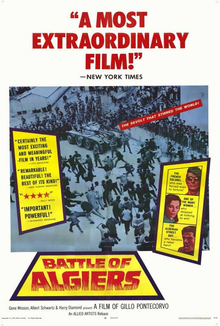
Behind the film
- Year
- 1966
- Director
- Gillo Pontecorvo
- Writers
- Gillo Pontecorvo, Saadi Yacef, Franco Solinas
- Runtime
- 1h 57m
- Genres
- Drama, War, Historical
- Country
- Italy, Algeria
- Cast
- Jean Martin, Saadi Yacef, Brahim Hadjadj, Larbi Zekkal, Fusia El Kader, Mohamed Ben Kassen
About the film
Contains story spoilers.
The film opens in 1957 with French paratroopers surrounding Ali La Pointe and three companions—Hassiba, Little Omar and Mahmoud—behind a tiled wall in the Casbah. An Algerian prisoner, broken under interrogation, has led the army to their hiding place. After Mathieu tells Ali that the FLN organization is finished, the story returns to 1954 and follows the campaign that brought the city to this standoff. The frame makes the end of the urban network visible from the start, while the flashback traces how an insurgent movement grows out of daily life in a tightly watched neighborhood. That first conversation sets a limit on the victory to come: the army can find the room, but the city’s political future remains unresolved.
Ali begins as a poor street gambler and petty criminal, not as a trained soldier. Arrested and sent to prison, he witnesses an Algerian man go to the guillotine shouting for independence. The experience shifts his sense of what French authority means. Five months later he is back in the Casbah; the FLN tests him by giving him an unloaded pistol and sending him to shoot a policeman. When the gun fails, a woman takes him to commander El-Hadi Jafar, who explains that the organization must know whether Ali can be trusted. Ali joins a movement that needs people who can keep its secrets as much as people willing to fight.
The FLN first consolidates its presence inside the Casbah. It suppresses gambling, prostitution and other activity it regards as disorder, and it punishes residents it suspects of informing for the French. Its leaders want to make the district a secure base and build a parallel authority that people use in daily life. That order is also coercive: the film shows the movement enforcing rules through threats and summary violence. Children carry messages through alleys and adults move between homes, workshops and checkpoints. Control of the neighborhood is not an abstract prize; it determines who can move, organize, hide and claim to speak for its residents. A wedding conducted by the movement also shows how its authority reaches beyond armed cells and into community life, while leaving the French administration outside the ceremony.
After FLN gunmen kill French police, the French presence around the Casbah tightens. A French police chief and settler accomplices answer with a bomb that destroys Casbah homes and kills civilians. An angry crowd gathers and wants immediate revenge, but Jafar tells them the FLN will answer rather than let the mob expose itself to police fire. The sequence leads into the women’s bombing mission: Djamila, Zohra and Hassiba change their hair and clothes, pass through checkpoints as Europeans, and leave bombs in cafés, bars and an airport lounge in the European quarter. The film watches their preparation and the civilians at the targets, then lets the explosions interrupt those ordinary afternoons.
Mathieu and his paratroopers arrive in 1957, after the urban bombings have escalated. He treats the FLN as a network to map: interrogate people, find connections, then capture the leaders. The general strike comes as a political demonstration of how many Algerians support independence, and Ali argues against it while Ben M’Hidi defends the need to continue the revolution. The army uses the strike to identify and round up residents, then forces shops open and interrogates prisoners with torture. Mathieu’s charts and briefings make the campaign look methodical, but its knowledge is extracted from people who are being brutalized. The film keeps the official operation and its human cost in the same frame. His system depends on turning ordinary residents into links on a chart, which is why the strike exposes so many people who had not been fighters.
French forces dismantle the Casbah network through arrests and killings. Ben M’Hidi is captured and later reported dead by suicide; Jafar eventually surrenders after Mathieu threatens to destroy the house sheltering him and Fathia. Ali remains the last senior FLN leader in the city. The film returns to the opening hideout as the soldiers prepare explosives at the tiled wall. Mathieu offers terms, including leniency for the boy, but Ali refuses to leave or negotiate. The people nearby watch from rooftops while the army detonates the charge, killing the four people inside: Ali, Hassiba, Little Omar and Mahmoud. The French have won the immediate battle for the Casbah, but not the political struggle.
The closing movement jumps to demonstrations in 1960, when Algerians again fill the streets with flags and chants. In one night sequence, residents answer the fighting with a chorus from their homes. Pontecorvo and cinematographer Marcello Gatti keep the camera among crowds, using grainy black-and-white images, handheld movement and mostly nonprofessional Algerian performers. Morricone’s spare percussion and the sounds of engines, gunfire, ululation and chanting distinguish competing forms of force. The voiceover then moves two years ahead to independence in 1962, while the image keeps the movement’s many faces in view.