
Behind the film
- Year
- 1995
- Director
- Scott Kalvert
- Writers
- Bryan Goluboff
- Runtime
- 1h 30m
- Genres
- Teen, Coming-of-age, Drama, Crime
- Production
- New Line Cinema
- Country
- United States
- Cast
- Leonardo DiCaprio, Lorraine Bracco, Mark Wahlberg, Bruno Kirby, James Madio, Ernie Hudson, Juliette Lewis, Michael Imperioli
About the film
Contains story spoilers.
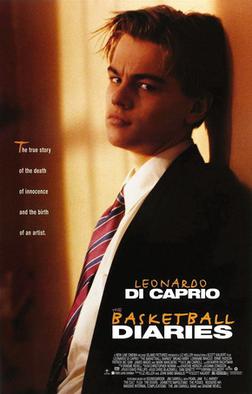
Scott Kalvert's The Basketball Diaries is a 1995 drama adapted by Bryan Goluboff from Jim Carroll's autobiographical book. Leonardo DiCaprio plays Jim, with Lorraine Bracco as his mother, Mark Wahlberg as Mickey, James Madio as Pedro and Ernie Hudson as Reggie. The production brings together David Phillips's cinematography, Dana Congdon's editing, Christopher Nowak's production design and Graeme Revell's music. Its central character is both an athlete and a writer, allowing the story to follow the loss of a place on the court alongside the continuing existence of a private written voice.
Jim begins within a recognisable network of school, friends and home. Basketball makes him admired at his Catholic high school, while his mother expects that he can build on his ability. Away from that organised setting, he joins friends in petty theft and drug experimentation. The movement toward heroin changes the scale of his behaviour: missed school and stolen money damage relationships that had previously supported him. His mother's apartment becomes a place of arguments rather than security. What starts as activity alongside his school life gradually takes over it, leaving him less able to use either athletic talent or family affection as protection.
The film connects this decline to the death of Bobby, Jim's friend who has leukaemia. Hospital visits give Jim contact with an approaching loss he cannot reverse, and Bobby's funeral is followed by a return to the basketball court. A break comes when Jim, Mickey and Pedro take pills before a game, expecting stimulation and receiving the opposite effect. Neutron refuses them. Their disastrous performance makes drug use visible inside the institution that had rewarded Jim's skill. The friends' choices separate them: Neutron remains at school while Jim and Mickey leave, narrowing their world to the opportunity to obtain drugs.
Kalvert reshapes the diary material into a concentrated account of addiction. The book's numerous neighbourhood adventures, school incidents and sexual experiences become secondary to the protagonist's deterioration. Some events reported by Carroll as things that happened to other people are reassigned to Jim, making him a participant in actions the original narrator observed or heard about. Mickey is a composite character whose aggression drives several confrontations. These alterations matter when the film is approached as an adaptation: its connected dramatic events do not reproduce the diary's arrangement or preserve every distinction between eyewitness experience and reported incident. Goluboff described the screenplay as an extreme adaptation, consolidating the material around Jim rather than reproducing the book's episodic form.
The conflict with Jim's mother reaches its most enclosed form at her locked door. He wants access and help; she hears his pleas while refusing to let him back inside. His appeal moves from begging toward anger, and the scene keeps their distress on opposite sides of the same barrier. The apartment is home to him, but entering it would also renew the pattern she has tried to interrupt. Bracco's role gives the downward spiral a family consequence beyond the harm to Jim's body or future. Affection continues to exist when accommodation has become impossible.
Reggie provides a different intervention after finding Jim unconscious in the snow. He takes him to his apartment and helps him through withdrawal, but the episode does not produce lasting change: Jim steals money and returns to drugs. Meanwhile, the group's criminal activity develops consequences of its own. Pedro is caught after a break-in, and Mickey's confrontation with a dealer ends in a death and his arrest. Help, companionship and escape routes each become unstable. Jim can receive care without immediately accepting the life it would make possible, while the friends who once shared his adventures become unavailable or dangerous.
Carroll was involved with the film as more than its source author. He approved of Goluboff's treatment and found that DiCaprio's gestures recalled his own younger self. He also distinguished the Jim in his writing from a simple first-person record, describing that figure as a character in a story. For Carroll, there were many ways to adapt the material, and the film's linked scenes differed from the book's more fragmented structure. Kalvert incorporated two poems Carroll had written at the time. Their inclusion extends the writer's presence beyond incidents from the journals and makes language part of the screen adaptation itself. The literary material supplies another register beside physical action: Jim's experience can be shaped into words, not only displayed through the escalation of theft, conflict and dependence.
Jim eventually serves six months at Rikers Island before his release. The final movement gives Jim a recovery-oriented conclusion. It compresses a difficult change into a much cleaner dramatic endpoint than the earlier cycle of withdrawal and relapse suggests. After release, Pedro offers him heroin, which he refuses, before reciting his writing to an audience. The setting leaves room for uncertainty about whether this is performance or testimony. What is clear is the changed relation between Jim and the offer in front of him. The closing refusal belongs to the film's constructed arc; it should not be mistaken for a complete account of Carroll's subsequent life.