
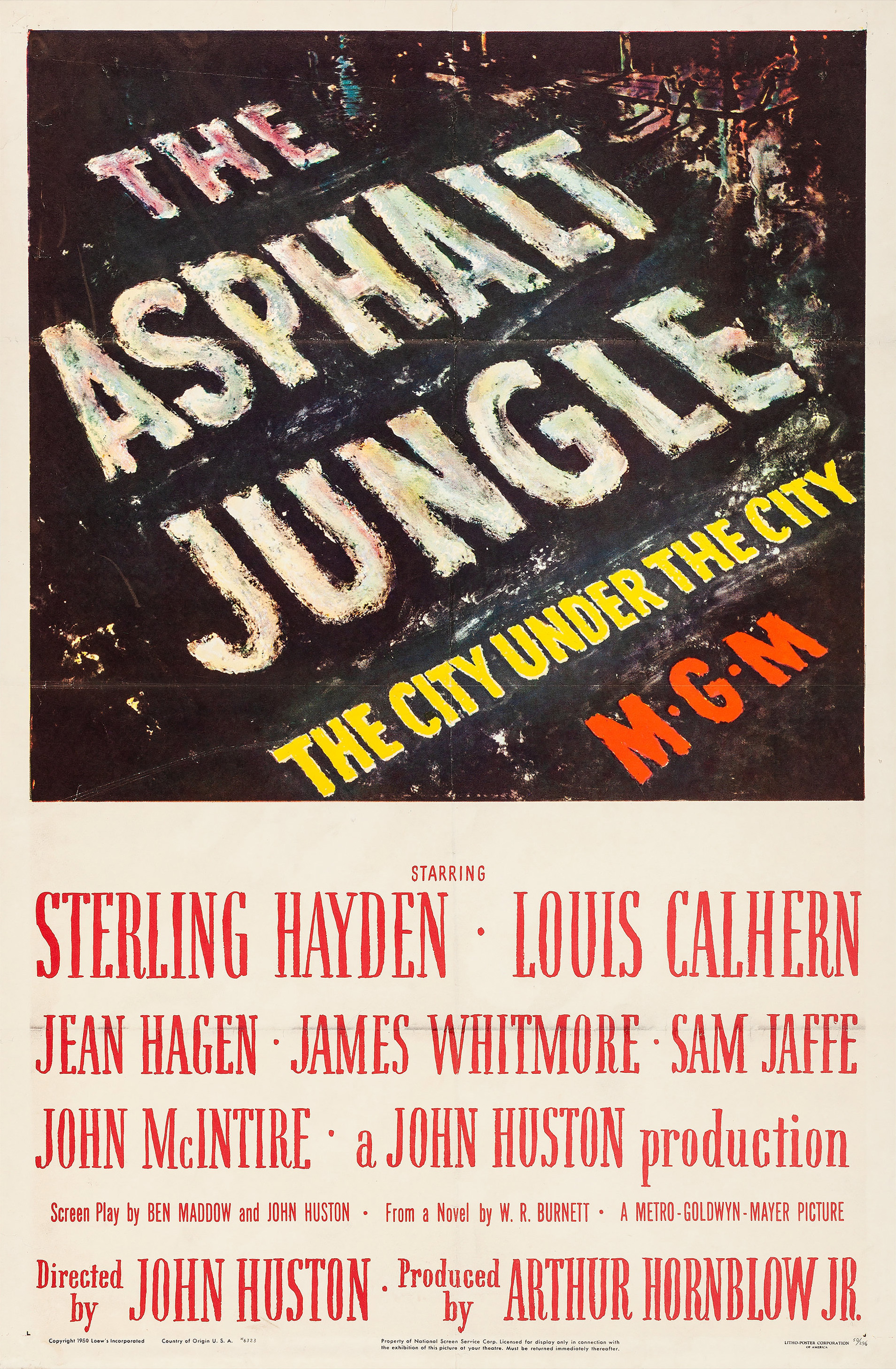
Behind the film
- Year
- 1950
- Director
- John Huston
- Writers
- Ben Maddow, John Huston
- Runtime
- 1h 52m
- Genres
- Heist, Film noir, Drama
- Production
- Metro-Goldwyn-Mayer
- Country
- United States
- Cast
- Sterling Hayden, Louis Calhern, Jean Hagen, James Whitmore, Sam Jaffe, John McIntire, Marc Lawrence, Marilyn Monroe
About the film
Contains story spoilers.
The film begins before dawn in a Midwestern city where patrol cars and police radios turn the empty streets into part of the crime story. Dix Handley, a small-time robber and horse gambler, slips into the diner run by Gus Minissi, who hides Dix’s gun when police arrive. At the same time, the recently released Doc Riedenschneider comes to bookie Cobby with a plan for a large jewelry-store robbery. Doc needs money, a safecracker, a driver and a gunman. Cobby can arrange the financing, while Dix’s reputation makes him an attractive hire. That gathering sets up a crew whose members know their jobs, but whose private needs will pull the plan apart.
Doc persuades lawyer Alonzo Emmerich to put up the money and handle the stolen jewels after the robbery. Emmerich’s respectable position hides his financial trouble: he has spent heavily on Angela Phinlay, whom he presents as his niece, and his wife May is confined to bed and starved for his company. He confides his own plan to private detective Bob Brannom: take the jewels from the robbers and flee. The rest of Doc’s crew has more ordinary pressures. Louis Ciavelli is a skilled safecracker with a wife and infant son; Gus is a diner owner who agrees to drive because Louis trusts him; Dix joins for his share of the money. Doll Conovan, a waitress who cares for Dix, stays with him and listens as he describes the Kentucky farm his family lost. He dreams of buying it back, but gambling has already taken most of his money.
Doc’s plan works through precise timing and separate skills. The crew studies the jewelry store’s routines, routes through its basement and alarms, then assigns each person a narrow job. Louis enters through a manhole and tunnel, gets into the store, and works on the safe while Doc and Dix follow. The robbery is nearly complete when the blast sets off alarms across the district. Police cars converge, and the crew has to finish under pressure. A night watchman happens by; Dix strikes him, but the watchman’s gun fires and wounds Louis. Louis insists on going home rather than to a hospital, and Gus takes him there. The plan has succeeded in getting the jewels out, yet the accidental shot changes the group’s position at once: Louis cannot travel with them, and Gus must decide whether to protect his friend or himself as police attention increases.
Doc and Dix bring the jewels to Emmerich, who says he cannot pay immediately and asks them to leave the loot with him. Brannom pulls a gun, confirming the double-cross. Dix shoots the detective, but Brannom also wounds him. Dix then threatens Emmerich, while Doc stops him from turning the room into another killing. The jewels are difficult to sell, so Doc proposes that Emmerich return them through the store’s insurance company for a fraction of their value. At home, Louis dies from his wound while Maria watches. Emmerich dumps Brannom’s body in the river, but a piece of his stationery links him to the murder. He tries to use Angela as an alibi. Doc and Dix hide near the river, where Doc can imagine a comfortable retirement in Mexico, while Dix keeps thinking about Kentucky.
The police investigation closes in through several imperfect routes. A taxi driver remembers taking Doc to Cobby’s, and Hardy presses the evidence against Emmerich. Ditrich remains corrupt, but the pressure on Cobby becomes too much; he gives the police information about the scheme. When Hardy confronts Emmerich, Angela is asked to repeat the alibi. She admits it was false, apologises to Emmerich, and still asks whether their trip is happening. He tells her she will have plenty of trips, then sits down to write to May. Unable to finish the note, he shoots himself. Doc and Dix are still fugitives, but Doc’s habit of stopping to watch a young woman dance gives the police time to catch him. Gus is arrested, and Louis’s family prepares for his funeral.
Dix and Doll drive toward the Kentucky farm, but the city’s consequences follow them. Wounded and growing weaker, Dix reaches the pasture he has talked about throughout the film. He gets out among the horses and dies there, with Doll close by. The ending brings his childhood memory into the present without making the farm a safe refuge: he has returned to the landscape he wanted, but only after the robbery has cost him his friends and his life. John Huston’s staging keeps the story grounded in practical spaces, from Gus’s diner and the jewelry store’s service passages to Emmerich’s polished rooms and the open field. The setting shifts from the city’s crowded routes to the pasture’s wide view, but Dix arrives too late to begin again. The crew’s carefully planned theft is the plot’s central event; its aftermath follows the people who thought money could carry them somewhere else.