
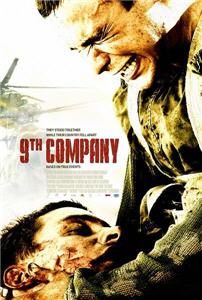
Behind the film
- Year
- 2005
- Director
- Fyodor Bondarchuk
- Writers
- Yuriy Korotkov, İskändär Ğälief
- Genres
- Drama, Action, War, Historical
- Production
- Slovo, Art Pictures Studio, STS
- Country
- Russia, Ukraine, Finland
- Cast
- Artur Smolyaninov, Aleksey Chadov, Ivan Kokorin, Konstantin Kryukov, Fyodor Bondarchuk, Mikhail Yefremov, Andrey Krasko, Aleksei Serebryakov
About the film
Contains story spoilers, including the ending.
The 9th Company follows Soviet conscripts from their farewells at home through training in Uzbekistan and deployment to Afghanistan. At the Fergana Valley camp, drill instructor Dygalo subjects them to harsh discipline. He is an Afghanistan veteran whose own experience has left him traumatised. The recruits overcome differences and form friendships under his command, but he cannot follow them to the front: his request to return is refused. At Bagram, Lyutyi receives a lucky medallion from a soldier going home. The man says it has protected him through several tours, then boards a transport aircraft that is shot down as it leaves. The gift cannot protect its giver, and Lyutyi carries it into a war where survival is already proving unpredictable. The friends are divided between companies before some reunite on Hill 3234. They have been ordered to protect passing convoys. An ambush, deaths among their comrades and retaliation against an Afghan village precede the final assault on the hill. Helicopter gunships finally break the attack, but Lyutyi is the only soldier left alive when an arriving colonel explains the withdrawal. Lyutyi eventually tears the lucky medallion from his neck, facing the loss it was supposed to prevent.
The film gives those friendships backgrounds beyond their uniforms. Vorobey hopes to teach, Gioconda wants to paint, and Stas has grown up without a father. Lyutyi's combative temperament belongs beside their different ambitions rather than erasing them. Training turns these young men into a group who depend on each other, before deployment exposes that dependence to repeated loss. In Yuliya Liderman's account of the film, the ordinary soldier's willingness to give his life sits against the command's responsibility for a war whose purpose has become impossible to justify. That tension comes to a head when the company is almost annihilated. Lyutyi survives to discover that the withdrawal has begun and the men were left defending their position through an oversight. Their commitment to one another has continued after the wider military decision has changed. The survival of one man gives the dead a witness, but gives him knowledge they never had: the hill they kept defending no longer served the purpose they believed it did. His return therefore carries both loyalty to his friends and the consequences of their abandonment. Liderman notes slow motion when the trainees rejoice at escaping punishment and when they seize a hill during a drill.
Fyodor Bondarchuk directed the 2005 drama from a screenplay by Yuriy Korotkov. Artur Smolyaninov plays Lyutyi, with Alexey Chadov as Vorobey and Konstantine Krukov as Gioconda. Bondarchuk appears as Khokhol. The studio's synopsis describes the company ordered to seize and hold ground at all costs while allowing a convoy through. Its members wait for reinforcements as their position is overwhelmed, leaving their leader as the sole survivor. The ending belongs to the drama's account of a unit whose commanders have forgotten it. The battle had thirty-nine Soviet defenders; six were killed and twelve injured, rather than a company reduced to one survivor. That difference changes the scale of the loss the film asks Lyutyi to carry. His friends' disappearance becomes the measure of what the men have given to the war, while his discovery that it is ending leaves their obedience unrewarded.
The project had changed direction before filming began. A 2004 report in KinoMechanic/New Films described an idea first conceived as a remake of Sergei Bondarchuk's Fate of a Man. Work between his son and Korotkov instead produced an original screenplay, separate from the Mikhail Sholokhov story behind the older film. The report followed the new production as shooting began in late May and the crew moved from Moscow to Crimea in June. It named Chadov and Smolyaninov among a cast that also included newcomers, with the director taking a small role himself. Bondarchuk said the screenplay drew on accounts from people who had served in the company. That statement describes his approach to gathering material; it does not make the film's final casualty count a historical record. He also discussed the expense of the technical and staging resources needed for this kind of film. The report caught the work in progress, when the release was still being planned for spring 2005. The 2004 soundtrack proposal included an original Alexander F. Sklyar composition, late-eighties songs such as Mirage's, classical music and folk music in modern arrangements. These were production plans, rather than a list of the finished film's musical cues.
Bondarchuk called his father his teacher and dedicated the film to him. The younger director had served in the army from 1985 to 1987. Years later, preparing Stalingrad, he sent The 9th Company to composer Angelo Badalamenti to explain the scale of war film he wanted to make. His earlier drama had become a reference for a new collaboration about another conflict.